
COVID-19患者血流感染的临床特征:一项回顾性队列研究。
Clinical profile of bloodstream infections in COVID-19 patients: a retrospective cohort study.
作者信息
Palanisamy Naveenraj, Vihari Nakka, Meena Durga Shankar, Kumar Deepak, Midha Naresh, Tak Vibhor, Sharma Ankur, Bohra Gopal Krishana, Kothari Nikhil, Dutt Naveen, Bhatia Pradeep Kumar, Garg Mahendra Kumar, Misra Sanjeev
机构信息
Department of Medicine, All India Institute of Medical Sciences, Jodhpur, Rajasthan, 342005, India.
Department of Microbiology, All India Institute of Medical Sciences, Jodhpur, 342005, India.
出版信息
BMC Infect Dis. 2021 Sep 8;21(1):933. doi: 10.1186/s12879-021-06647-x.
BACKGROUND
Bloodstream infections (BSIs) are an emerging cause of significant morbidity and mortality in severe Coronavirus disease 2019 (COVID-19). We aimed to assess the prevalence, clinical profile and outcome of BSIs in critically ill COVID-19 patients.
METHODS
This was a single-centre retrospective study conducted at a tertiary care hospital in Western India. All patients (age > 18 years) with reverse-transcription polymerase chain reaction (RT-PCR) confirmed COVID-19 admitted in the intensive care unit (ICU) were included. Hospital electronic records were searched for demographic data, time of bloodstream infection since admission, clinical profile, antimicrobial resistance pattern and clinical outcome of all patients who developed BSIs.
RESULTS
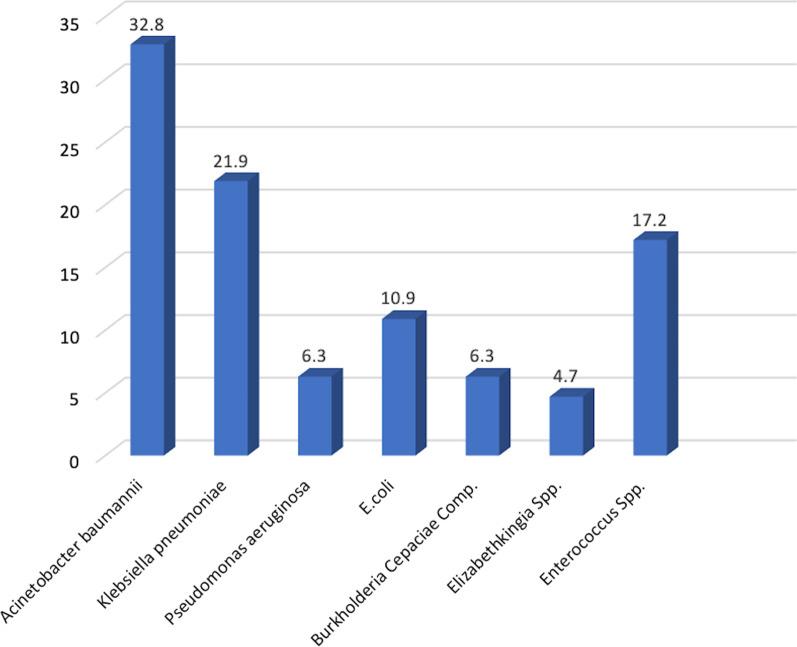
Out of 750 patients admitted in COVID ICU, 8.5% developed secondary BSIs. All severe COVID-19 patients who developed BSIs succumbed to illness. A significant proportion of BSIs were Gram-negative pathogens (53/64, 82.8%). Acinetobacter baumannii was the commonest isolate, followed by Klebsiella pneumoniae (32.8% and 21.9%, respectively). Multidrug-resistance organisms (MDRO) were found in 57.8% of the cases. The majority of MDRO belonged to K. pneumoniae and Enterococcus groups. The proportion of Gram-negative bacteria resistant to carbapenems was 47.2% (25/53). On multivariate analysis, raised total leukocyte counts, mechanical ventilation and presence of comorbidities were significantly associated with the incidence of BSIs.
CONCLUSION
We found a significant prevalence of Acinetobacter baumannii in COVID-19 associated BSIs. The presence of comorbidities raised leukocyte counts and mechanical ventilation should alarm clinicians for possible BSIs. The timely initiation of empirical antibiotics and rapid de-escalation is vital to improve the outcome. At the same time, strict compliance of infection control practices should be accomplished to reduce the occurrence of MDRO.
背景
血流感染(BSIs)是2019年严重冠状病毒病(COVID-19)导致显著发病和死亡的一个新出现的原因。我们旨在评估危重症COVID-19患者中血流感染的患病率、临床特征及转归。
方法
这是一项在印度西部一家三级医疗中心进行的单中心回顾性研究。纳入所有在重症监护病房(ICU)住院且经逆转录聚合酶链反应(RT-PCR)确诊为COVID-19的患者(年龄>18岁)。检索医院电子记录以获取所有发生血流感染患者的人口统计学数据、入院后血流感染时间、临床特征、抗菌药物耐药模式及临床转归。
结果
在750例入住COVID ICU的患者中,8.5%发生了继发性血流感染。所有发生血流感染的重症COVID-19患者均因病死亡。相当一部分血流感染的病原体为革兰阴性菌(53/64,82.8%)。鲍曼不动杆菌是最常见的分离株,其次是肺炎克雷伯菌(分别为32.8%和21.9%)。57.8%的病例中发现了多重耐药菌(MDRO)。大多数MDRO属于肺炎克雷伯菌和肠球菌属。对碳青霉烯类耐药的革兰阴性菌比例为47.2%(25/53)。多因素分析显示,白细胞总数升高、机械通气及合并症与血流感染的发生率显著相关。
结论
我们发现COVID-19相关血流感染中鲍曼不动杆菌的患病率较高。合并症的存在、白细胞计数升高及机械通气应提醒临床医生警惕可能发生的血流感染。及时开始经验性抗生素治疗并迅速降阶梯对于改善转归至关重要。同时,应严格遵守感染控制措施以减少MDRO的发生。
 Zotero 插件