
并发物质使用障碍和注意力缺陷/多动障碍的青少年的治疗:一项系统综述。
Treatment of Adolescents with Concurrent Substance Use Disorder and Attention-Deficit/Hyperactivity Disorder: A Systematic Review.
作者信息
Özgen Heval, Spijkerman Renske, Noack Moritz, Holtmann Martin, Schellekens Arnt, Dalsgaard Søren, van den Brink Wim, Hendriks Vincent
机构信息
Parnassia Addiction Research Centre (PARC), Parnassia Psychiatric Institute, 2512 HN The Hague, The Netherlands.
Leiden University Medical Center, 2333 ZA Leiden, The Netherlands.
出版信息
J Clin Med. 2021 Aug 30;10(17):3908. doi: 10.3390/jcm10173908.
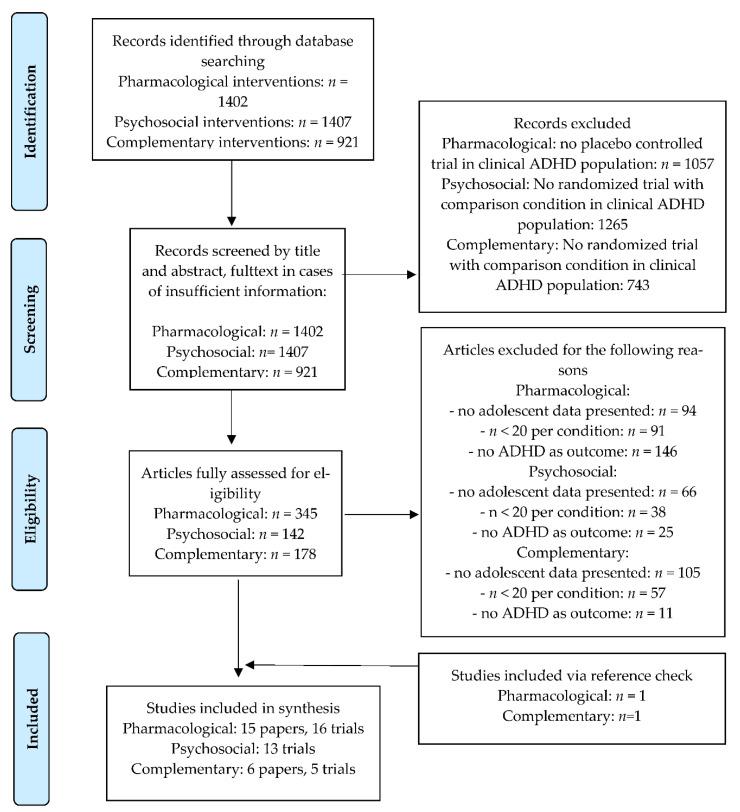
Childhood attention-deficit/hyperactivity disorder (ADHD) is a risk factor for the development of substance abuse and substance use disorders (SUD) in adolescence and (early) adulthood. ADHD and SUD also frequently co-occur in treatment-seeking adolescents, which complicates diagnosis and treatment, and is associated with poor treatment outcomes. In this study, we provide a systematic review of controlled studies on the effectiveness of pharmacological, psychosocial, and complementary treatments of ADHD in adolescents with and without comorbid SUD. In addition, we review the longitudinal association between pharmacotherapy for childhood ADHD and the development of SUD in adolescence and early adulthood. We conducted a systematic review of the research literature published since 2000 using Medline, PsycINFO, and the Cochrane Database of Systematic Reviews databases to select randomized clinical trials, observational studies, and meta-analyses. The quality of the evidence from each study was rated using the SIGN grading system. Based on the limited evidence available, strong clinical recommendations are not justified, but provisionally, we conclude that stimulant treatment in children with ADHD may prevent the development of SUD in adolescence or young adulthood, that high-dose stimulant treatment could be an effective treatment for adolescents with ADHD and SUD comorbidity, that cognitive behavior therapy might have a small beneficial effect in these patients, and that alternative treatments are probably not effective. More studies are needed to draw definitive conclusions that will allow for strong clinical recommendations.
儿童注意力缺陷多动障碍(ADHD)是青少年期和(早期)成年期物质滥用及物质使用障碍(SUD)发生发展的一个风险因素。ADHD和SUD在寻求治疗的青少年中也经常同时出现,这使诊断和治疗变得复杂,并与不良治疗结果相关。在本研究中,我们对有关药物治疗、心理社会治疗以及补充治疗对合并或未合并SUD的青少年ADHD有效性的对照研究进行了系统综述。此外,我们还综述了儿童期ADHD药物治疗与青少年期和成年早期SUD发生发展之间的纵向关联。我们使用Medline、PsycINFO以及Cochrane系统评价数据库对2000年以来发表的研究文献进行了系统综述,以选择随机临床试验、观察性研究和荟萃分析。每项研究的证据质量均使用SIGN分级系统进行评定。基于现有有限的证据,做出强有力的临床推荐并不合理,但我们初步得出结论:ADHD儿童的兴奋剂治疗可能预防青少年期或青年期SUD的发生发展;高剂量兴奋剂治疗可能是ADHD与SUD共病青少年的有效治疗方法;认知行为疗法可能对这些患者有微小的有益作用;替代治疗可能无效。需要更多研究得出确定性结论,以便做出强有力的临床推荐。
 Zotero 插件