
衰老特征的演变
The Evolution of the Hallmarks of Aging.
作者信息
Lemoine Maël
机构信息
CNRS, ImmunoConcEpT, UMR 5164, Univ. Bordeaux, Bordeaux, France.
出版信息
Front Genet. 2021 Aug 26;12:693071. doi: 10.3389/fgene.2021.693071. eCollection 2021.
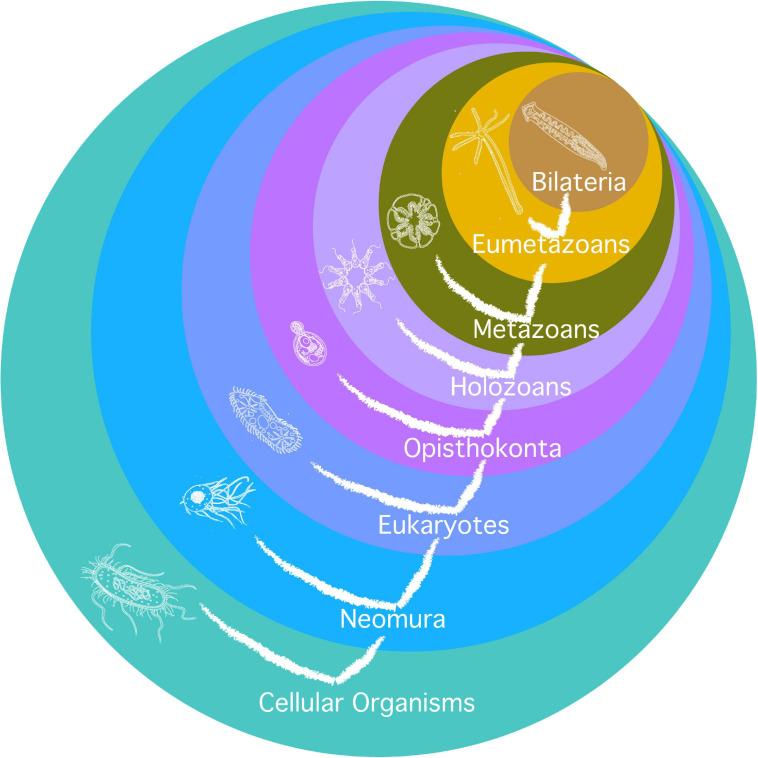
The evolutionary theory of aging has set the foundations for a comprehensive understanding of aging. The biology of aging has listed and described the "hallmarks of aging," i.e., cellular and molecular mechanisms involved in human aging. The present paper is the first to infer the order of appearance of the hallmarks of bilaterian and thereby human aging throughout evolution from their presence in progressively narrower clades. Its first result is that all organisms, even non-senescent, have to deal with at least one mechanism of aging - the progressive accumulation of misfolded or unstable proteins. Due to their cumulation, these mechanisms are called "layers of aging." A difference should be made between the first four layers of , present in some unicellular organisms and in all multicellular opisthokonts, that stem and strike "from the inside" of individual cells and span from increasingly abnormal protein folding to deregulated nutrient sensing, and the last four layers of , progressively appearing in metazoans, that strike the cells of a multicellular organism "from the outside," i.e., because of other cells, and span from transcriptional alterations to the disruption of intercellular communication. The evolution of metazoans and eumetazoans probably solved the problem of aging along with the problem of unicellular aging. However, metacellular aging originates in the mechanisms by which the effects of unicellular aging are kept under control - e.g., the exhaustion of stem cells that contribute to replace damaged somatic cells. In bilaterians, additional functions have taken a toll on generally useless potentially limited lifespan to increase the fitness of organisms at the price of a progressively less efficient containment of the damage of unicellular aging. In the end, this picture suggests that geroscience should be more efficient in targeting conditions of metacellular aging rather than unicellular aging itself.
衰老的进化理论为全面理解衰老奠定了基础。衰老生物学已经列出并描述了“衰老的标志”,即涉及人类衰老的细胞和分子机制。本文首次从两侧对称动物衰老标志在进化过程中出现在越来越窄的进化枝中的情况,推断出两侧对称动物进而人类衰老标志出现的顺序。其第一个结果是,所有生物,甚至非衰老生物,都必须应对至少一种衰老机制——错误折叠或不稳定蛋白质的逐渐积累。由于这些机制的累积,它们被称为“衰老层”。应区分前四层衰老机制,它们存在于一些单细胞生物和所有多细胞后鞭毛生物中,起源并作用于单个细胞的“内部”,范围从越来越异常的蛋白质折叠到失调的营养感应;以及后四层衰老机制,它们在后生动物中逐渐出现,从“外部”作用于多细胞生物的细胞,即由于其他细胞的原因,范围从转录改变到细胞间通讯的破坏。后生动物和真后生动物的进化可能在解决单细胞衰老问题的同时也解决了衰老问题。然而,多细胞衰老起源于控制单细胞衰老影响的机制,例如有助于替换受损体细胞的干细胞耗竭。在两侧对称动物中,额外的功能对通常无用且可能有限的寿命造成了损害,以逐渐降低对单细胞衰老损伤的控制效率为代价,提高了生物体的适应性。最后,这幅图景表明,老年科学在针对多细胞衰老状况而非单细胞衰老本身时应该更有效。


 Zotero 插件