
23 年间法国的演变,1996 年至 2018 年。
Evolution of over a 23-year period in France, 1996 to 2018.
机构信息
Institut Pasteur, Biodiversity and Epidemiology of Bacterial Pathogens, Paris, France.
Institut Pasteur, National Reference Center for Whooping Cough and other Bordetella infections, Paris, France.
出版信息
Euro Surveill. 2021 Sep;26(37). doi: 10.2807/1560-7917.ES.2021.26.37.2001213.
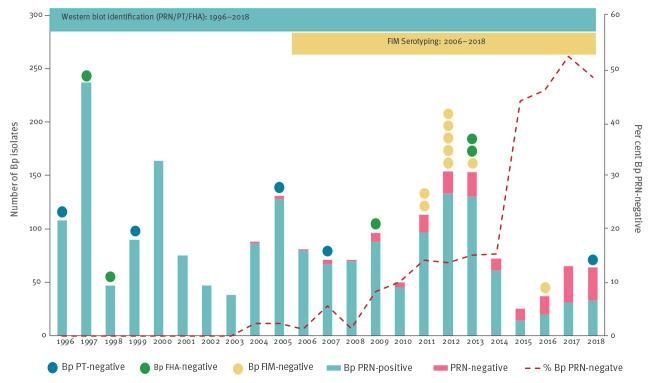
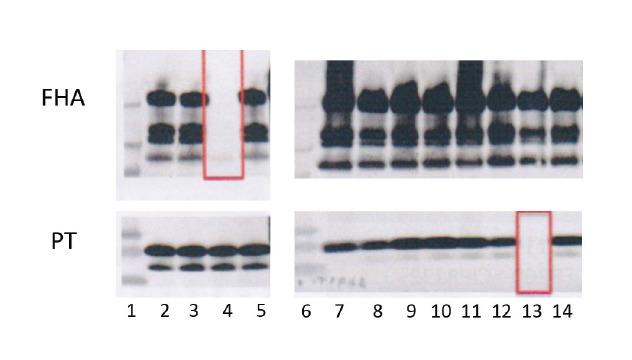
Background is the main agent of whooping cough. Vaccination with acellular pertussis vaccines has been largely implemented in high-income countries. These vaccines contain 1 to 5 antigens: pertussis toxin (PT), filamentous haemagglutinin (FHA), pertactin (PRN) and/or fimbrial proteins (FIM2 and FIM3). Monitoring the emergence of isolates that might partially escape vaccine-induced immunity is an essential component of public health strategies to control whooping cough.AimWe aimed to investigate temporal trends of fimbriae serotypes and vaccine antigen-expression in over a 23-year period in France (1996-2018).MethodsIsolates (n = 2,280) were collected through hospital surveillance, capturing one third of hospitalised paediatric pertussis cases. We assayed PT, FHA and PRN production by Western blot (n = 1,428) and fimbriae production by serotyping (n = 1,058). Molecular events underlying antigen deficiency were investigated by genomic sequencing.ResultsThe proportion of PRN-deficient isolates has increased steadily from 0% (0/38) in 2003 to 48.4% (31/64) in 2018 (chi-squared test for trend, p < 0.0001), whereas only 5 PT-, 5 FHA- and 9 FIM-deficient isolates were found. Impairment of PRN production was predominantly due to IS insertion within the gene or a 22 kb genomic inversion involving the promoter sequence, indicative of convergent evolution. FIM2-expressing isolates have emerged since 2011 at the expense of FIM3.Conclusions is evolving through the rapid increase of PRN-deficient isolates and a recent shift from FIM3 to FIM2 expression. Excluding PRN, the loss of vaccine antigen expression by circulating isolates is epidemiologically insignificant.
背景是百日咳的主要病原体。在高收入国家,已广泛使用无细胞百日咳疫苗进行接种。这些疫苗含有 1 至 5 种抗原:百日咳毒素(PT)、丝状血凝素(FHA)、 pertactin(PRN)和/或菌毛蛋白(FIM2 和 FIM3)。监测可能部分逃避疫苗诱导免疫的分离株的出现是控制百日咳的公共卫生策略的重要组成部分。
目的 我们旨在调查 23 年间法国(1996-2018 年)分离株的菌毛血清型和疫苗抗原表达的时间趋势。
方法 通过医院监测收集分离株(n=2280),捕获三分之一的住院儿童百日咳病例。我们通过 Western blot 检测 PT、FHA 和 PRN 的产生(n=1428)和菌毛产生的血清分型(n=1058)。通过基因组测序研究抗原缺陷的分子事件。
结果 自 2003 年以来,PRN 缺陷分离株的比例从 0%(0/38)稳步增加至 48.4%(31/64)(趋势卡方检验,p<0.0001),而仅发现 5 株 PT-、5 株 FHA-和 9 株 FIM-缺陷分离株。PRN 产生受损主要是由于 IS 插入 基因内或涉及 启动子序列的 22kb 基因组倒位,表明趋同进化。自 2011 年以来,表达 FIM2 的分离株出现,而 FIM3 的表达减少。
结论 通过 PRN 缺陷分离株的迅速增加和最近从 FIM3 向 FIM2 表达的转变,在进化。排除 PRN 后,循环 分离株的疫苗抗原表达缺失在流行病学上无意义。


 Zotero 插件