
用于博德特氏菌基因组流行病学和生物多样性研究的综合资源。
A comprehensive resource for Bordetella genomic epidemiology and biodiversity studies.
机构信息
Institut Pasteur, Université Paris Cité, Biodiversity and Epidemiology of Bacterial Pathogens, Paris, France.
National Reference Center for Whooping Cough and other Bordetella Infections, Institut Pasteur, Paris, France.
出版信息
Nat Commun. 2022 Jul 1;13(1):3807. doi: 10.1038/s41467-022-31517-8.
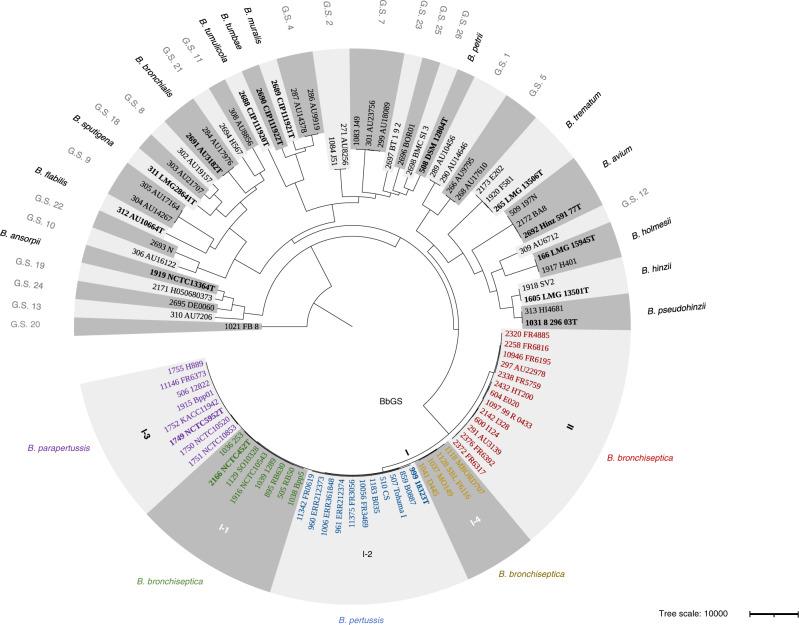
The genus Bordetella includes bacteria that are found in the environment and/or associated with humans and other animals. A few closely related species, including Bordetella pertussis, are human pathogens that cause diseases such as whooping cough. Here, we present a large database of Bordetella isolates and genomes and develop genotyping systems for the genus and for the B. pertussis clade. To generate the database, we merge previously existing databases from Oxford University and Institut Pasteur, import genomes from public repositories, and add 83 newly sequenced B. bronchiseptica genomes. The public database currently includes 2582 Bordetella isolates and their provenance data, and 2085 genomes ( https://bigsdb.pasteur.fr/bordetella/ ). We use core-genome multilocus sequence typing (cgMLST) to develop genotyping systems for the whole genus and for B. pertussis, as well as specific schemes to define antigenic, virulence and macrolide resistance profiles. Phylogenetic analyses allow us to redefine evolutionary relationships among known Bordetella species, and to propose potential new species. Our database provides an expandable resource for genotyping of environmental and clinical Bordetella isolates, thus facilitating evolutionary and epidemiological research on whooping cough and other Bordetella infections.
博德特氏菌属包括存在于环境中和/或与人类和其他动物相关的细菌。少数密切相关的物种,包括百日咳博德特氏菌,是人类病原体,可引起百日咳等疾病。在这里,我们提供了一个大型博德特氏菌分离株和基因组数据库,并为该属和百日咳博德特氏菌进化枝开发了基因分型系统。为了生成该数据库,我们合并了牛津大学和巴斯德研究所以前存在的数据库,从公共存储库中导入基因组,并添加了 83 个新测序的支气管败血博德特氏菌基因组。该公共数据库目前包括 2582 个博德特氏菌分离株及其来源数据,以及 2085 个基因组(https://bigsdb.pasteur.fr/bordetella/)。我们使用核心基因组多位点序列分型(cgMLST)为整个属和百日咳博德特氏菌开发基因分型系统,以及用于定义抗原性、毒力和大环内酯类药物耐药性谱的特定方案。系统发育分析使我们能够重新定义已知博德特氏菌物种之间的进化关系,并提出潜在的新物种。我们的数据库为环境和临床博德特氏菌分离株的基因分型提供了一个可扩展的资源,从而促进了百日咳和其他博德特氏菌感染的进化和流行病学研究。


 Zotero 插件