
互联网接入、社会风险因素与基于网络的社会支持寻求行为:评估马里兰州各社区间“数字鸿沟”的相关因素。
Internet Access, Social Risk Factors, and Web-Based Social Support Seeking Behavior: Assessing Correlates of the "Digital Divide" Across Neighborhoods in The State of Maryland.
机构信息
Center for Population Health Information Technology, Department of Health Policy and Management, Johns Hopkins Bloomberg School of Public Health, Baltimore, MD, US.
Johns Hopkins Center for Health Disparities Solutions, Baltimore, MD, US.
出版信息
J Med Syst. 2021 Sep 19;45(11):94. doi: 10.1007/s10916-021-01769-w.
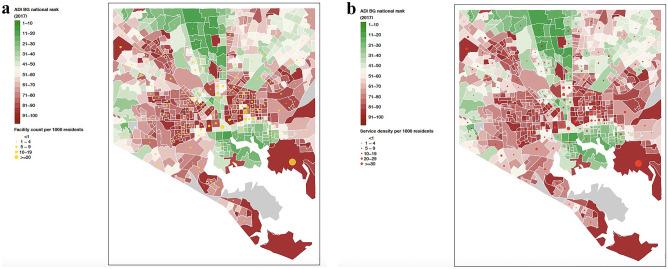
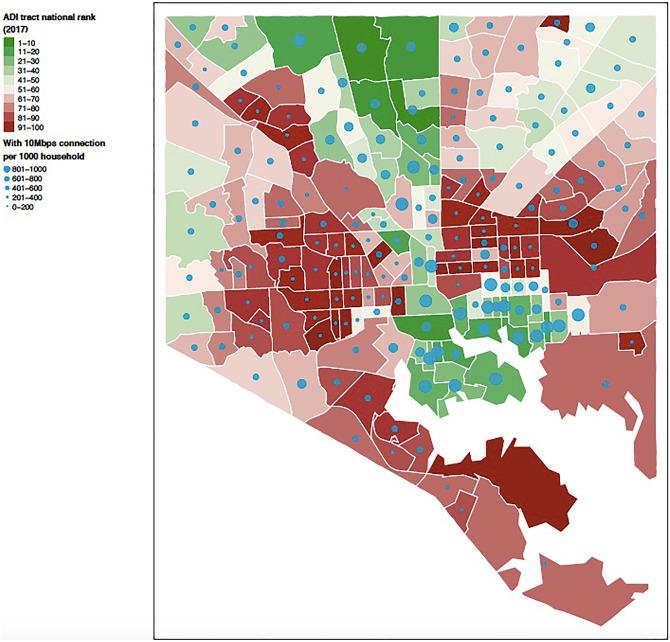
We aimed to empirically measure the degree to which there is a "digital divide" in terms of access to the internet at the small-area community level within the State of Maryland and the City of Baltimore and to assess the relationship and association of this divide with community-level SDOH risk factors, community-based social service agency location, and web-mediated support service seeking behavior. To assess the socio-economic characteristics of the neighborhoods across the state, we calculated the Area Deprivation Index (ADI) using the U.S. Census, American Community Survey (5-year estimates) of 2017. To assess the digital divide, at the community level, we used the Federal Communications Commission (FCC) data on the number of residential fixed Internet access service connections. We assessed the availability of and web-based access to community-based social service agencies using data provided by the "Aunt Bertha" information platform. We performed community and regional level descriptive and special analyses for ADI social risk factors, connectivity, and both the availability of and web-based searches for community-based social services. To help assess potential neighborhood linked factors associated with the rates of web-based social services searches by individuals in need, we applied logistic regression using generalized estimating equation modeling. Baltimore City contained more disadvantaged neighborhoods compared to other areas in Maryland. In Baltimore City, 20.3% of neighborhoods (defined by census block groups) were disadvantaged with ADI at the 90th percentile while only 6.6% of block groups across Maryland were in this disadvantaged category. Across the State, more than half of all census tracts had 801-1000 households (per 1000 households) with internet subscription. In contrast, in Baltimore City about half of all census tracts had only 401-600 of the households (per 1000 households) with internet subscriptions. Most block groups in Maryland and Baltimore City lacked access to social services facilities (61% of block groups at the 90th percentile of disadvantage in Maryland and 61.3% of block groups at the 90th percentile of disadvantage in Baltimore City). After adjusting for other variables, a 1% increase in the ADI measure of social disadvantage, resulting in a 1.7% increase in the number of individuals seeking social services. While more work is needed, our findings support the premise that the digital divide is closely associated with other SDOH factors. The policymakers must propose policies to address the digital divide on a national level and also in disadvantaged communities experiencing the digital divide in addition to other SDOH challenges.
我们旨在从马里兰州和巴尔的摩市的社区层面上实证测量互联网接入方面的“数字鸿沟”程度,并评估这种鸿沟与社区层面的社会决定因素健康差异(SDOH)风险因素、社区内社会服务机构的位置以及通过网络寻求支持服务的行为之间的关系和关联。为了评估全州各社区的社会经济特征,我们使用美国人口普查和 2017 年美国社区调查(5 年估计数)计算了区域剥夺指数(ADI)。为了评估社区层面的数字鸿沟,我们使用联邦通信委员会(FCC)的数据评估了住宅固定互联网接入服务连接的数量。我们使用“Bertha 阿姨”信息平台提供的数据评估了社区内社会服务机构的可用性和基于网络的访问。我们对 ADI 社会风险因素、连通性以及社区内社会服务的可用性和基于网络的搜索进行了社区和区域级别的描述性和专项分析。为了帮助评估与有需要的个人进行基于网络的社会服务搜索率相关的潜在邻里关联因素,我们使用广义估计方程模型应用逻辑回归。与马里兰州的其他地区相比,巴尔的摩市的贫困社区更多。在巴尔的摩市,20.3%的社区(按人口普查块组定义)处于 ADI 处于第 90 个百分位的劣势地位,而马里兰州只有 6.6%的块组处于这种劣势类别。在全州范围内,超过一半的普查区每 1000 户家庭(每 1000 户家庭)有 801-1000 户家庭有互联网订阅。相比之下,在巴尔的摩市,大约一半的普查区每 1000 户家庭只有 401-600 户家庭(每 1000 户家庭)有互联网订阅。马里兰州和巴尔的摩市的大多数块组都无法获得社会服务设施(马里兰州劣势 90 百分位的 61%的块组和巴尔的摩市劣势 90 百分位的 61.3%的块组)。在调整其他变量后,社会劣势 ADI 衡量指标增加 1%,导致寻求社会服务的人数增加 1.7%。尽管还需要做更多的工作,但我们的研究结果支持这样一个前提,即数字鸿沟与其他 SDOH 因素密切相关。政策制定者必须在全国范围内提出解决数字鸿沟的政策,并且还要在面临数字鸿沟和其他 SDOH 挑战的弱势社区提出解决数字鸿沟的政策。
 Zotero 插件