
脑转移中的肿瘤相关巨噬细胞:鼠与人的分子特征。
TAMs in Brain Metastasis: Molecular Signatures in Mouse and Man.
机构信息
Institute for Tumor Biology and Experimental Therapy, Georg-Speyer-Haus, Frankfurt am Main, Germany.
Biological Sciences, Faculty 15, Goethe University Frankfurt, Frankfurt am Main, Germany.
出版信息
Front Immunol. 2021 Sep 3;12:716504. doi: 10.3389/fimmu.2021.716504. eCollection 2021.
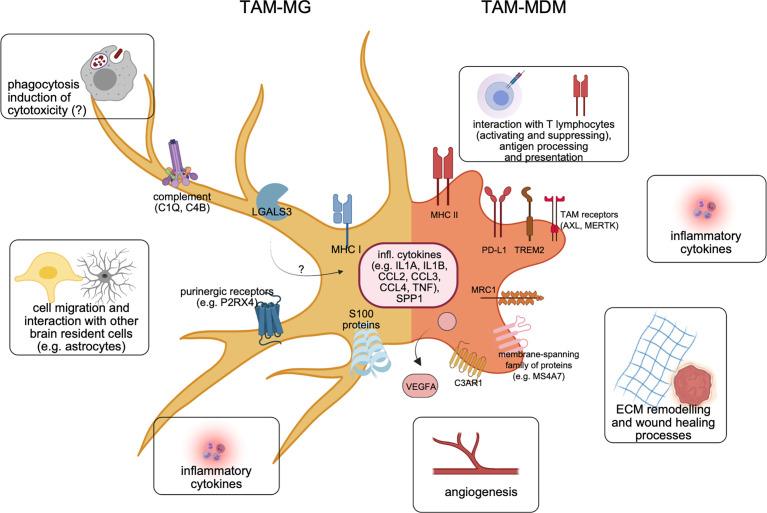
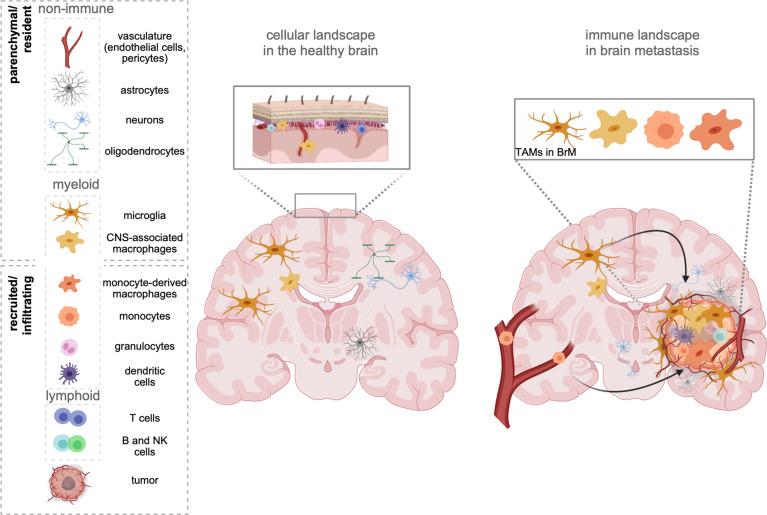
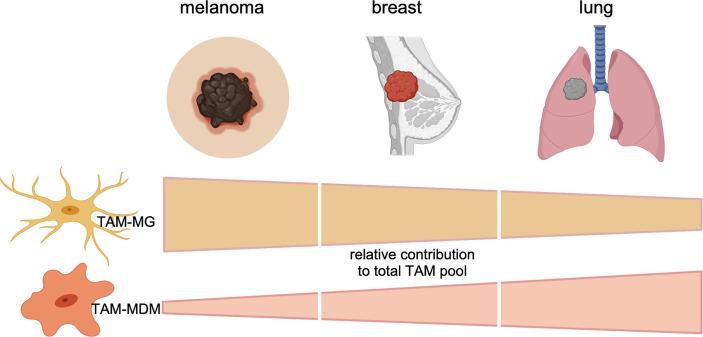
Macrophages not only represent an integral part of innate immunity but also critically contribute to tissue and organ homeostasis. Moreover, disease progression is accompanied by macrophage accumulation in many cancer types and is often associated with poor prognosis and therapy resistance. Given their critical role in modulating tumor immunity in primary and metastatic brain cancers, macrophages are emerging as promising therapeutic targets. Different types of macrophages infiltrate brain cancers, including (i) CNS resident macrophages that comprise microglia (TAM-MG) as well as border-associated macrophages and (ii) monocyte-derived macrophages (TAM-MDM) that are recruited from the periphery. Controversy remained about their disease-associated functions since classical approaches did not reliably distinguish between macrophage subpopulations. Recent conceptual and technological advances, such as large-scale omic approaches, provided new insight into molecular profiles of TAMs based on their cellular origin. In this review, we summarize insight from recent studies highlighting similarities and differences of TAM-MG and TAM-MDM at the molecular level. We will focus on data obtained from RNA sequencing and mass cytometry approaches. Together, this knowledge significantly contributes to our understanding of transcriptional and translational programs that define disease-associated TAM functions. Cross-species meta-analyses will further help to evaluate the translational significance of preclinical findings as part of the effort to identify candidates for macrophage-targeted therapy against brain metastasis.
巨噬细胞不仅是先天免疫的重要组成部分,而且对组织和器官稳态也起着至关重要的作用。此外,在许多癌症类型中,疾病的进展伴随着巨噬细胞的积累,这往往与预后不良和治疗耐药有关。鉴于其在调节原发性和转移性脑癌中的肿瘤免疫方面的关键作用,巨噬细胞已成为有前途的治疗靶点。不同类型的巨噬细胞浸润脑癌,包括(i)中枢神经系统驻留巨噬细胞,包括小胶质细胞(TAM-MG)以及边界相关巨噬细胞和(ii)单核细胞衍生的巨噬细胞(TAM-MDM),它们从外周招募而来。由于经典方法不能可靠地区分巨噬细胞亚群,因此它们与疾病相关的功能仍然存在争议。最近的概念和技术进步,如大规模组学方法,为基于细胞起源的 TAMs 的分子特征提供了新的见解。在这篇综述中,我们总结了最近的研究的见解,强调了 TAM-MG 和 TAM-MDM 在分子水平上的相似性和差异性。我们将重点介绍从 RNA 测序和质谱细胞术方法中获得的数据。总的来说,这些知识极大地有助于我们理解转录和翻译程序,这些程序定义了与疾病相关的 TAM 功能。跨物种的荟萃分析将有助于评估临床前发现的转化意义,作为确定针对脑转移的巨噬细胞靶向治疗候选物的努力的一部分。
 Zotero 插件