
脑转移瘤的免疫微环境——小胶质细胞和其他脑巨噬细胞有帮助吗?
Immune Microenvironment of Brain Metastases-Are Microglia and Other Brain Macrophages Little Helpers?
机构信息
Affiliated Cancer Hospital & Institute of Guangzhou Medical University, Guangzhou, China.
School of Laboratory Medicine, YouJiang Medical University for Nationalities, Baise, China.
出版信息
Front Immunol. 2019 Aug 20;10:1941. doi: 10.3389/fimmu.2019.01941. eCollection 2019.
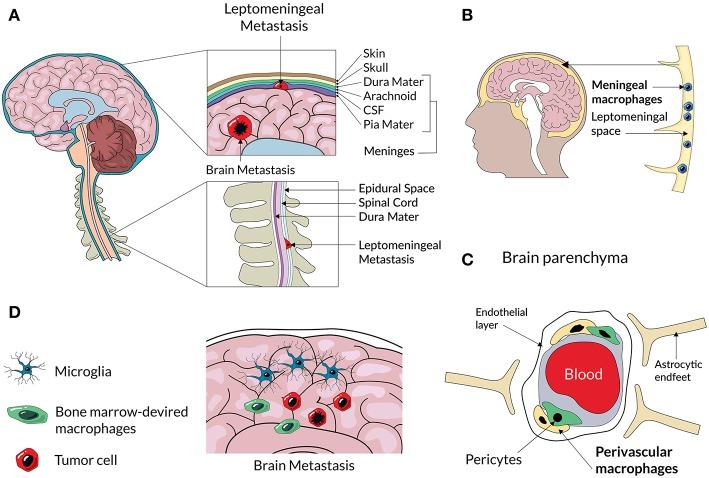
Brain metastases are common intracranial neoplasms and their frequency increases with prolonged survival of cancer patients. New pharmaceuticals targeting oncogenic kinases and immune checkpoint inhibitors augment both overall and progression-free survival in patients with brain metastases, but are not fully successful in reducing metastatic burden and still a majority of oncologic patients die due to dissemination of the disease. Despite therapy advancements, median survival of patients with brain metastases is several months, although it may vary in different types or subtypes of cancer. Contribution of the innate immune system to cancer progression is well established. Tumor-associated macrophages (TAMs), instead of launching antitumor responses, promote extracellular matrix degradation, secrete immunosuppressive cytokines, promote neoangiogenesis and tumor growth. While their roles as pro-tumorigenic cells facilitating tissue remodeling, invasion and metastasis is well documented, much less is known about the immune microenvironment of brain metastases and roles of specific immune cells in those processes. The central nervous system (CNS) is armed in resident myeloid cells: microglia and perivascular macrophages which colonize CNS in early development and maintain homeostasis in brain parenchyma and at brain-blood vessels interfaces. In this study we discuss available data on the immune composition of most common brain metastases, focusing on interactions between metastatic cancer cells and microglia, perivascular and meningeal macrophages. Cancer cells 'highjack' several CNS protective mechanisms and may employ microglia and CNS-border associated macrophages into helping cancer cells to colonize a pre-metastatic niche. We describe emerging molecular insights into mechanisms governing communication between microglia and metastatic cancer cells that culminate in activation of CNS resident microglia and trafficking of monocytic cells from the periphery. We present mechanisms controlling those processes in brain metastases and hypothesize on potential therapeutic approaches. In summary, microglia and non-parenchymal brain macrophages are involved in multiple stages of a metastatic disease and, unlike tumor cells, are genetically stable and predictable, which makes them an attractive target for anticancer therapies.
脑转移瘤是常见的颅内肿瘤,随着癌症患者生存时间的延长,其发病率逐渐升高。针对致癌激酶的新型药物和免疫检查点抑制剂在提高脑转移瘤患者总生存期和无进展生存期方面都有显著作用,但在降低转移瘤负荷方面并不完全成功,大多数肿瘤患者仍因疾病的扩散而死亡。尽管治疗方法不断进步,但脑转移瘤患者的中位生存期仍只有几个月,不过不同类型或亚型的癌症患者可能会有所差异。先天免疫系统对癌症进展的作用已得到充分证实。肿瘤相关巨噬细胞(TAMs)非但没有启动抗肿瘤反应,反而促进细胞外基质降解、分泌免疫抑制细胞因子、促进新生血管生成和肿瘤生长。虽然它们作为促进组织重塑、浸润和转移的促肿瘤细胞的作用已得到充分证实,但对于脑转移瘤的免疫微环境以及特定免疫细胞在这些过程中的作用,我们的了解还非常有限。中枢神经系统(CNS)中存在着定居的髓样细胞:小胶质细胞和血管周巨噬细胞,它们在早期发育时就定植于 CNS,并在脑实质和脑血管界面维持脑内环境稳定。在本研究中,我们讨论了最常见脑转移瘤的免疫组成的现有数据,重点关注了转移性癌细胞与小胶质细胞、血管周和脑膜巨噬细胞之间的相互作用。癌细胞“劫持”了几种中枢神经系统的保护机制,并可能利用小胶质细胞和与中枢神经系统相关的巨噬细胞帮助癌细胞定植于转移前微环境。我们描述了控制小胶质细胞与转移性癌细胞之间通讯的分子机制的新见解,这些机制最终导致中枢神经系统内的小胶质细胞被激活,以及单核细胞从外周向中枢神经系统迁移。我们介绍了控制这些过程的机制,并提出了潜在的治疗方法。总之,小胶质细胞和非实质脑巨噬细胞参与了转移性疾病的多个阶段,与肿瘤细胞不同的是,它们的遗传稳定性和可预测性使其成为癌症治疗的一个有吸引力的靶点。

 Zotero 插件