
针对使用基于智能手机成像的工具进行即时检测无症状低密度疟原虫血症的研究。
Towards the use of a smartphone imaging-based tool for point-of-care detection of asymptomatic low-density malaria parasitaemia.
机构信息
Weldon School of Biomedical Engineering, Purdue University, West Lafayette, IN, 47907, USA.
Indiana University School of Medicine, Indiana University, Indianapolis, IN, 46202, USA.
出版信息
Malar J. 2021 Sep 25;20(1):380. doi: 10.1186/s12936-021-03894-w.
BACKGROUND
Globally, there are over 200 million cases of malaria annually and over 400,000 deaths. Early and accurate detection of low-density parasitaemia and asymptomatic individuals is key to achieving the World Health Organization (WHO) 2030 sustainable development goals of reducing malaria-related deaths by 90% and eradication in 35 countries. Current rapid diagnostic tests are neither sensitive nor specific enough to detect the low parasite concentrations in the blood of asymptomatic individuals.
METHODS
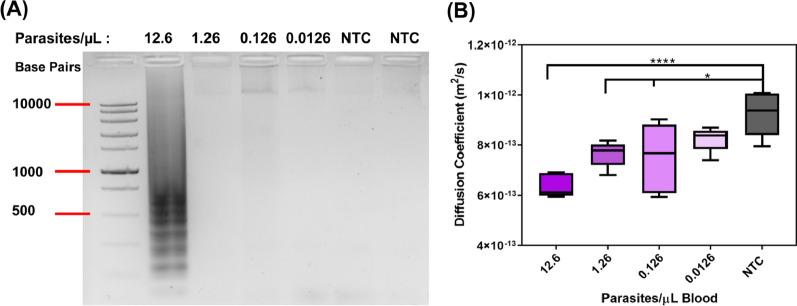
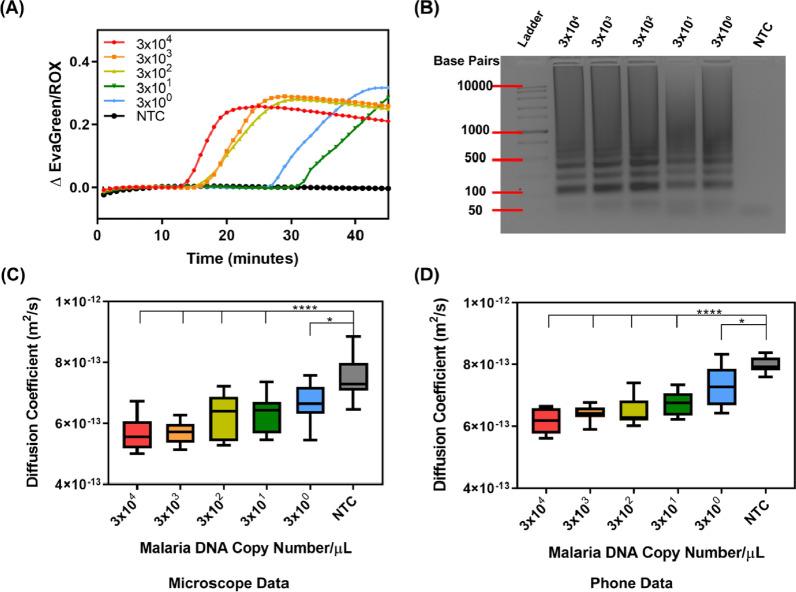
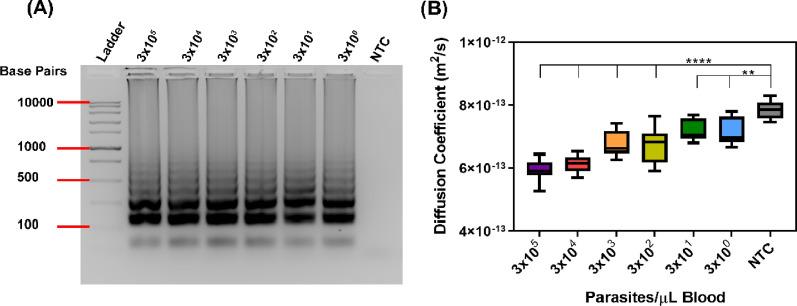
Here, an imaging-based sensing technique, particle diffusometry (PD), is combined with loop mediated isothermal amplification (LAMP) on a smartphone-enabled device to detect low levels of parasitaemia often associated with asymptomatic malaria. After amplification, PD quantifies the Brownian motion of fluorescent nanoparticles in the solution during a 30 s video taken on the phone. The resulting diffusion coefficient is used to detect the presence of Plasmodium DNA amplicons. The coefficients of known negative samples are compared to positive samples using a one-way ANOVA post-hoc Dunnett's test for confirmation of amplification.
RESULTS
As few as 3 parasite/µL of blood was detectable in 45 min without DNA extraction. Plasmodium falciparum parasites were detected from asymptomatic individuals' whole blood samples with 89% sensitivity and 100% specificity when compared to quantitative polymerase chain reaction (qPCR).
CONCLUSIONS
PD-LAMP is of value for the detection of low density parasitaemia especially in areas where trained personnel may be scarce. The demonstration of this smartphone biosensor paired with the sensitivity of LAMP provides a proof of concept to achieve widespread asymptomatic malaria testing at the point of care.
背景
全球每年有超过 2 亿例疟疾病例,超过 40 万人死亡。早期准确检测低密度寄生虫血症和无症状个体是实现世界卫生组织(WHO)2030 年可持续发展目标的关键,该目标旨在将与疟疾相关的死亡人数减少 90%,并在 35 个国家消除疟疾。目前的快速诊断测试既不够敏感也不够特异,无法检测无症状个体血液中的低寄生虫浓度。
方法
在这里,基于成像的传感技术——粒子扩散测量(PD)与智能手机启用设备上的环介导等温扩增(LAMP)相结合,用于检测通常与无症状疟疾相关的低寄生虫血症水平。扩增后,PD 在手机上拍摄的 30 秒视频中定量测量溶液中荧光纳米粒子的布朗运动。所得扩散系数用于检测疟原虫 DNA 扩增子的存在。使用单向方差分析(ANOVA)后 Dunnett 检验比较已知阴性样本的系数和阳性样本,以确认扩增。
结果
无需 DNA 提取,在 45 分钟内可检测到低至 3 个寄生虫/μL 的血液。与定量聚合酶链反应(qPCR)相比,PD-LAMP 从无症状个体的全血样本中检测到恶性疟原虫,灵敏度为 89%,特异性为 100%。
结论
PD-LAMP 可用于检测低密度寄生虫血症,特别是在缺乏训练有素的人员的地区。该智能手机生物传感器与 LAMP 的灵敏度相结合的演示提供了一个概念验证,可在护理点实现广泛的无症状疟疾检测。


 Zotero 插件