
受伤年龄决定雄性大鼠弥漫性脑损伤后长期神经病理学和小胶质细胞增生的程度。
Age-at-Injury Determines the Extent of Long-Term Neuropathology and Microgliosis After a Diffuse Brain Injury in Male Rats.
作者信息
Doust Yasmine V, Rowe Rachel K, Adelson P David, Lifshitz Jonathan, Ziebell Jenna M
机构信息
Wicking Dementia Research and Education Centre, College of Health and Medicine, University of Tasmania, Hobart, TAS, Australia.
Department of Integrative Physiology at University of Colorado, Boulder, CO, United States.
出版信息
Front Neurol. 2021 Sep 8;12:722526. doi: 10.3389/fneur.2021.722526. eCollection 2021.
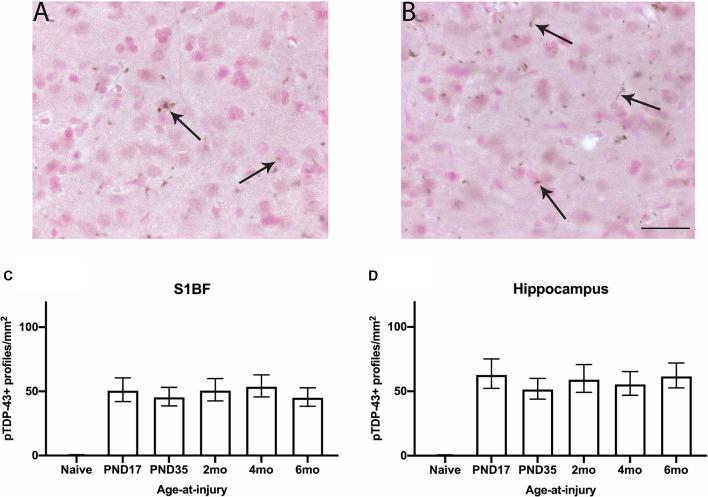
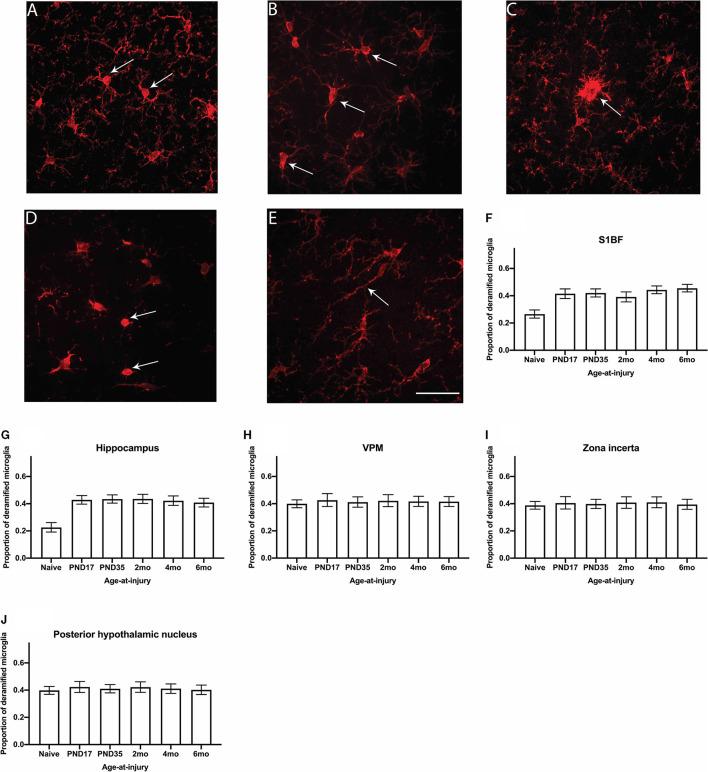
Traumatic brain injury (TBI) can occur at any age, from youth to the elderly, and its contribution to age-related neuropathology remains unknown. Few studies have investigated the relationship between age-at-injury and pathophysiology at a discrete biological age. In this study, we report the immunohistochemical analysis of naïve rat brains compared to those subjected to diffuse TBI by midline fluid percussion injury (mFPI) at post-natal day (PND) 17, PND35, 2-, 4-, or 6-months of age. All brains were collected when rats were 10-months of age ( = 6-7/group). Generalized linear mixed models were fitted to analyze binomial proportion and count data with R Studio. Amyloid precursor protein (APP) and neurofilament (SMI34, SMI32) neuronal pathology were counted in the corpus callosum (CC) and primary sensory barrel field (S1BF). Phosphorylated TAR DNA-binding protein 43 (pTDP-43) neuropathology was counted in the S1BF and hippocampus. There was a significantly greater extent of APP and SMI34 axonal pathology and pTDP-43 neuropathology following a TBI compared with naïves regardless of brain region or age-at-injury. However, age-at-injury did determine the extent of dendritic neurofilament (SMI32) pathology in the CC and S1BF where all brain-injured rats exhibited a greater extent of pathology compared with naïve. No significant differences were detected in the extent of astrocyte activation between brain-injured and naïve rats. Microglia counts were conducted in the S1BF, hippocampus, ventral posteromedial (VPM) nucleus, zona incerta, and posterior hypothalamic nucleus. There was a significantly greater proportion of deramified microglia, regardless of whether the TBI was recent or remote, but this only occurred in the S1BF and hippocampus. The proportion of microglia with colocalized CD68 and TREM2 in the S1BF was greater in all brain-injured rats compared with naïve, regardless of whether the TBI was recent or remote. Only rats with recent TBI exhibited a greater proportion of CD68-positive microglia compared with naive in the hippocampus and posterior hypothalamic nucleus. Whilst, only rats with a remote brain-injury displayed a greater proportion of microglia colocalized with TREM2 in the hippocampus. Thus, chronic alterations in neuronal and microglial characteristics are evident in the injured brain despite the recency of a diffuse brain injury.
创伤性脑损伤(TBI)可发生于任何年龄,从青少年到老年人,但其对与年龄相关的神经病理学的影响尚不清楚。很少有研究在离散的生物学年龄阶段探究受伤时年龄与病理生理学之间的关系。在本研究中,我们报告了对新生大鼠脑与在出生后第17天、35天、2个月、4个月或6个月龄时通过中线流体冲击伤(mFPI)遭受弥漫性TBI的大鼠脑进行的免疫组织化学分析。所有大鼠在10个月龄时(每组n = 6 - 7)采集大脑。使用R Studio拟合广义线性混合模型来分析二项比例和计数数据。在胼胝体(CC)和初级感觉桶状区(S1BF)中对淀粉样前体蛋白(APP)和神经丝(SMI34、SMI32)神经元病理学进行计数。在S1BF和海马体中对磷酸化TAR DNA结合蛋白43(pTDP - 43)神经病理学进行计数。与未受伤的大鼠相比,无论脑区或受伤时年龄如何,TBI后APP和SMI34轴突病理学以及pTDP - 43神经病理学的程度均显著更高。然而,受伤时年龄确实决定了CC和S1BF中树突状神经丝(SMI32)病理学的程度,所有脑损伤大鼠在这些区域的病理学程度均高于未受伤的大鼠。在脑损伤大鼠和未受伤大鼠之间未检测到星形胶质细胞激活程度的显著差异。在S1BF、海马体、腹后内侧(VPM)核、未定带和下丘脑后核中进行小胶质细胞计数。无论TBI是近期还是远期发生,脱枝小胶质细胞的比例均显著更高,但仅在S1BF和海马体中出现这种情况。与未受伤的大鼠相比,所有脑损伤大鼠S1BF中CD68和TREM2共定位的小胶质细胞比例更高,无论TBI是近期还是远期发生。仅近期TBI的大鼠在海马体和下丘脑后核中CD68阳性小胶质细胞的比例高于未受伤的大鼠。同时,仅远期脑损伤的大鼠在海马体中与TREM2共定位的小胶质细胞比例更高。因此,尽管是弥漫性脑损伤,但在受伤的大脑中神经元和小胶质细胞特征的慢性改变是明显的。





 Zotero 插件