
解读孟德尔随机化分析中分类暴露(如疾病状态和教育程度)效应的估计值。
Interpreting Mendelian-randomization estimates of the effects of categorical exposures such as disease status and educational attainment.
机构信息
Medical Research Council Integrative Epidemiology Unit, University of Bristol, Bristol, UK.
Population Health Sciences, University of Bristol, Bristol, UK.
出版信息
Int J Epidemiol. 2022 Jun 13;51(3):948-957. doi: 10.1093/ije/dyab208.
BACKGROUND
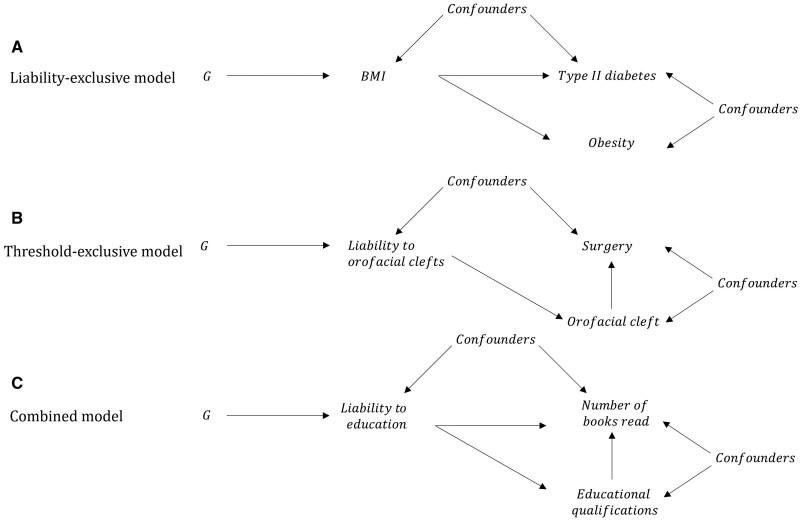
Mendelian randomization has been previously used to estimate the effects of binary and ordinal categorical exposures-e.g. Type 2 diabetes or educational attainment defined by qualification-on outcomes. Binary and categorical phenotypes can be modelled in terms of liability-an underlying latent continuous variable with liability thresholds separating individuals into categories. Genetic variants influence an individual's categorical exposure via their effects on liability, thus Mendelian-randomization analyses with categorical exposures will capture effects of liability that act independently of exposure category.
METHODS AND RESULTS
We discuss how groups in which the categorical exposure is invariant can be used to detect liability effects acting independently of exposure category. For example, associations between an adult educational-attainment polygenic score (PGS) and body mass index measured before the minimum school leaving age (e.g. age 10 years), cannot indicate the effects of years in full-time education on this outcome. Using UK Biobank data, we show that a higher educational-attainment PGS is strongly associated with lower smoking initiation and higher odds of glasses use at age 15 years. These associations were replicated in sibling models. An orthogonal approach using the raising of the school leaving age (ROSLA) policy change found that individuals who chose to remain in education to age 16 years before the reform likely had higher liability to educational attainment than those who were compelled to remain in education to age 16 years after the reform, and had higher income, lower pack-years of smoking, higher odds of glasses use and lower deprivation in adulthood. These results suggest that liability to educational attainment is associated with health and social outcomes independently of years in full-time education.
CONCLUSIONS
Mendelian-randomization studies with non-continuous exposures should be interpreted in terms of liability, which may affect the outcome via changes in exposure category and/or independently.
背景
孟德尔随机化此前曾被用于估计二分类和有序分类暴露(例如,2 型糖尿病或通过资格定义的教育程度)对结局的影响。二分类和分类表型可以根据易感性来建模——易感性是一种潜在的连续潜在变量,易感性阈值将个体分为不同类别。遗传变异通过对易感性的影响来影响个体的分类暴露,因此,使用分类暴露进行孟德尔随机化分析将捕获独立于暴露类别的易感性效应。
方法和结果
我们讨论了如何使用分类暴露不变的组来检测独立于暴露类别的易感性效应。例如,成人教育程度多基因评分(PGS)与在校最低离校年龄(例如 10 岁)之前测量的体重指数之间的关联,并不能表明全日制教育年限对该结果的影响。使用英国生物库数据,我们发现,教育程度较高的 PGS 与较低的吸烟起始率和 15 岁时戴眼镜的几率较高强烈相关。这些关联在同胞模型中得到了复制。使用提高离校年龄(ROSLA)政策变化的正交方法发现,在改革前选择在教育中待到 16 岁的个体,其对教育程度的易感性可能高于在改革后被迫留在教育中到 16 岁的个体,他们的收入较高,吸烟量较少,戴眼镜的几率较高,成年后贫困程度较低。这些结果表明,教育程度的易感性与健康和社会结果独立于全日制教育年限相关。
结论
对于非连续暴露,孟德尔随机化研究应根据易感性进行解释,易感性可能通过暴露类别和/或独立的变化来影响结局。


 Zotero 插件