
高等级神经胶质瘤中肿瘤浸润 CD8 T 细胞/PD-L1 轴的系统评价:迈向个体化免疫肿瘤学。
A Systematic Review of the Tumor-Infiltrating CD8 T-Cells/PD-L1 Axis in High-Grade Glial Tumors: Toward Personalized Immuno-Oncology.
机构信息
Research Center for Evidence-Based Medicine, Faculty of Medicine, Tabriz University of Medical Sciences, Tabriz, Iran.
Immunology Research Center, Tabriz University of Medical Sciences, Tabriz, Iran.
出版信息
Front Immunol. 2021 Sep 17;12:734956. doi: 10.3389/fimmu.2021.734956. eCollection 2021.
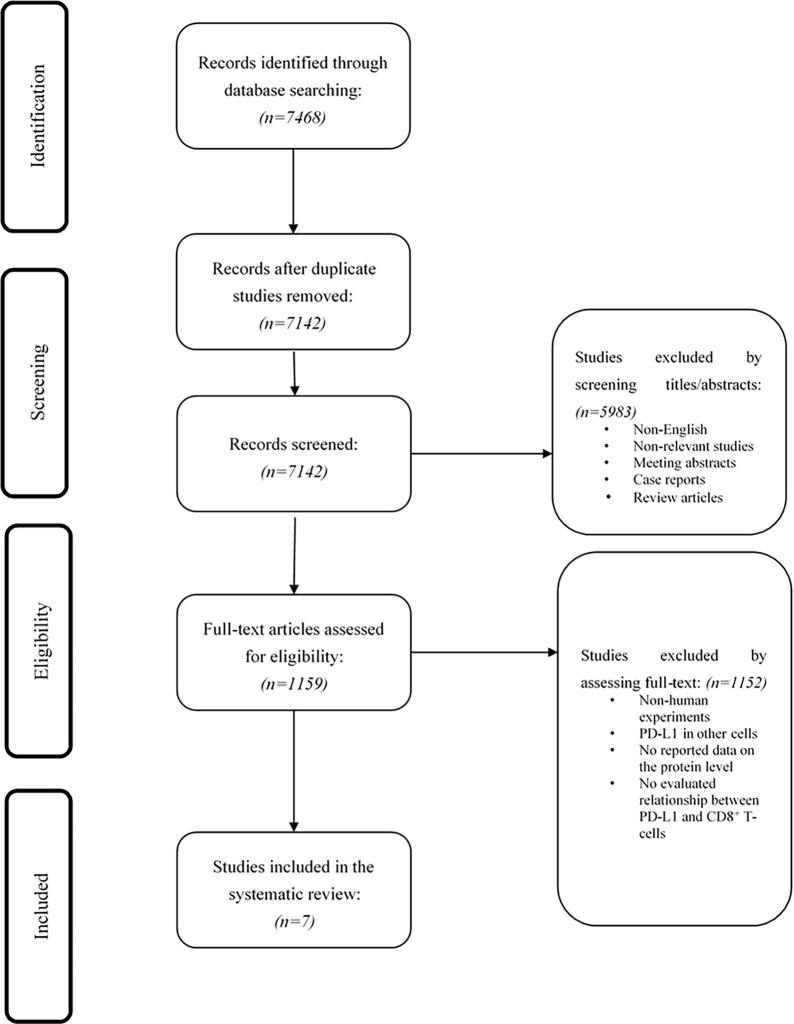
Based on preclinical findings, programmed death-ligand 1 (PD-L1) can substantially attenuate CD8 T-cell-mediated anti-tumoral immune responses. However, clinical studies have reported controversial results regarding the significance of the tumor-infiltrating CD8 T-cells/PD-L1 axis on the clinical picture and the response rate of patients with high-grade glial tumors to anti-cancer therapies. Herein, we conducted a systematic review according to the preferred reporting items for systematic reviews and meta-analyses (PRISMA) statements to clarify the clinical significance of the tumor-infiltrating CD8 T-cells/PD-L1 axis and elucidate the impact of this axis on the response rate of affected patients to anti-cancer therapies. Indeed, a better understanding of the impact of this axis on the response rate of affected patients to anti-cancer therapies can provide valuable insights to address the futile response rate of immune checkpoint inhibitors in patients with high-grade glial tumors. For this purpose, we systematically searched Scopus, Web of Science, Embase, and PubMed to obtain peer-reviewed studies published before 1 January 2021. We have observed that PD-L1 overexpression can be associated with the inferior prognosis of glioblastoma patients who have not been exposed to chemo-radiotherapy. Besides, exposure to anti-cancer therapies, e.g., chemo-radiotherapy, can up-regulate inhibitory immune checkpoint molecules in tumor-infiltrating CD8 T-cells. Therefore, unlike unexposed patients, increased tumor-infiltrating CD8 T-cells in anti-cancer therapy-exposed tumoral tissues can be associated with the inferior prognosis of affected patients. Because various inhibitory immune checkpoints can regulate anti-tumoral immune responses, the single-cell sequencing of the cells residing in the tumor microenvironment can provide valuable insights into the expression patterns of inhibitory immune checkpoints in the tumor micromovement. Thus, administrating immune checkpoint inhibitors based on the data from the single-cell sequencing of these cells can increase patients' response rates, decrease the risk of immune-related adverse events development, prevent immune-resistance development, and reduce the risk of tumor recurrence.
基于临床前研究结果,程序性死亡配体 1(PD-L1)可显著减弱 CD8 T 细胞介导的抗肿瘤免疫反应。然而,临床研究报告了关于肿瘤浸润 CD8 T 细胞/PD-L1 轴对高级别神经胶质瘤患者临床特征和抗癌治疗反应率的意义的争议性结果。在此,我们根据系统评价和荟萃分析的首选报告项目(PRISMA)声明进行了系统综述,以阐明肿瘤浸润 CD8 T 细胞/PD-L1 轴的临床意义,并阐明该轴对受影响患者对癌症治疗反应率的影响。事实上,更好地了解该轴对受影响患者对癌症治疗反应率的影响,可以为解决高级别神经胶质瘤患者免疫检查点抑制剂无效反应率提供有价值的见解。为此,我们系统地搜索了 Scopus、Web of Science、Embase 和 PubMed,以获取 2021 年 1 月 1 日之前发表的同行评议研究。我们观察到,PD-L1 过表达与未接受化疗放疗的胶质母细胞瘤患者预后不良相关。此外,暴露于抗癌治疗(如化疗放疗)可上调肿瘤浸润 CD8 T 细胞中抑制性免疫检查点分子。因此,与未暴露患者不同,在接受抗癌治疗的肿瘤组织中,肿瘤浸润 CD8 T 细胞增加与受影响患者的预后不良相关。由于各种抑制性免疫检查点可以调节抗肿瘤免疫反应,因此对肿瘤微环境中细胞的单细胞测序可以为肿瘤微运动中抑制性免疫检查点的表达模式提供有价值的见解。因此,基于这些细胞的单细胞测序数据施用免疫检查点抑制剂可以提高患者的反应率,降低免疫相关不良事件发展的风险,防止免疫抵抗的发展,并降低肿瘤复发的风险。

 Zotero 插件