
在钨酸锆负载钌催化剂上温和条件下聚乙烯的氢解反应
Polyethylene Hydrogenolysis at Mild Conditions over Ruthenium on Tungstated Zirconia.
作者信息
Wang Cong, Xie Tianjun, Kots Pavel A, Vance Brandon C, Yu Kewei, Kumar Pawan, Fu Jiayi, Liu Sibao, Tsilomelekis George, Stach Eric A, Zheng Weiqing, Vlachos Dionisios G
机构信息
Center for Plastics Innovation, University of Delaware, 221 Academy Street, Newark, Delaware 19716, United States.
Department of Chemical and Biomolecular Engineering, University of Delaware, 150 Academy Street, Newark, Delaware 19716, United States.
出版信息
JACS Au. 2021 Aug 30;1(9):1422-1434. doi: 10.1021/jacsau.1c00200. eCollection 2021 Sep 27.
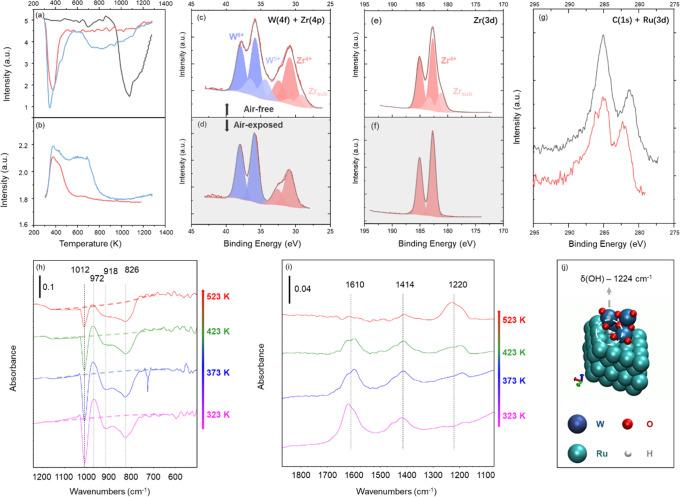
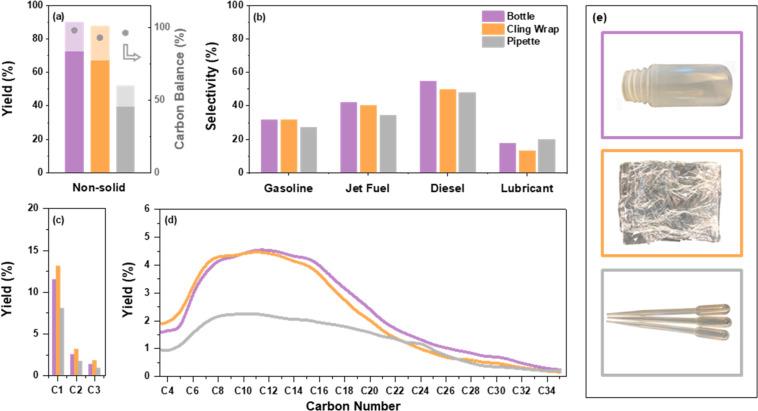
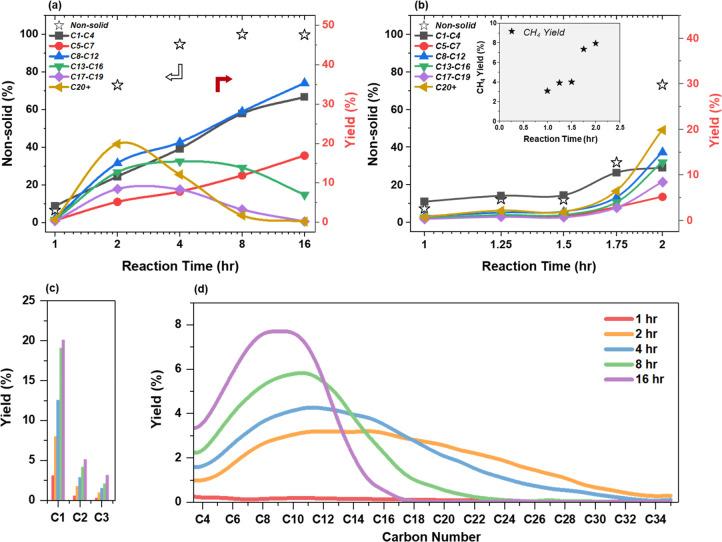
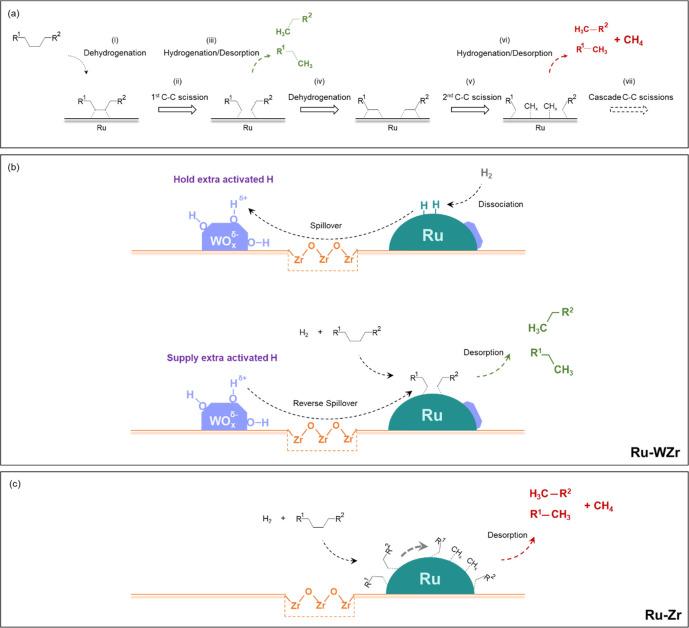
Plastics waste has become a major environmental threat, with polyethylene being one of the most produced and hardest to recycle plastics. Hydrogenolysis is potentially the most viable catalytic technology for recycling. Ruthenium (Ru) is one of the most active hydrogenolysis catalysts but yields too much methane. Here we introduce ruthenium supported on tungstated zirconia (Ru-WZr) for hydrogenolysis of low-density polyethylene (LDPE). We show that the Ru-WZr catalysts suppress methane formation and produce a product distribution in the diesel and wax/lubricant base-oil range unattainable by Ru-Zr and other Ru-supported catalysts. Importantly, the enhanced performance is showcased for real-world, single-use LDPE consumables. Reactivity studies combined with characterization and density functional theory calculations reveal that highly dispersed (WO ) clusters store H as surface hydroxyls by spillover. We correlate this hydrogen storage mechanism with hydrogenation and desorption of long alkyl intermediates that would otherwise undergo further C-C scission to produce methane.
塑料垃圾已成为主要的环境威胁,聚乙烯是产量最高且最难回收的塑料之一。氢解可能是最可行的回收催化技术。钌(Ru)是最具活性的氢解催化剂之一,但会产生过多的甲烷。在此,我们引入负载在钨酸锆上的钌(Ru-WZr)用于低密度聚乙烯(LDPE)的氢解。我们表明,Ru-WZr催化剂抑制了甲烷的形成,并产生了柴油以及蜡/润滑油基础油范围内的产物分布,这是Ru-Zr和其他负载型Ru催化剂无法实现的。重要的是,对于实际的一次性LDPE消费品,展示了其增强的性能。反应性研究结合表征和密度泛函理论计算表明,高度分散的(WO )簇通过溢流将H储存为表面羟基。我们将这种储氢机制与长链烷基中间体的氢化和解吸相关联,否则这些中间体会进一步发生C-C断裂以产生甲烷。


 Zotero 插件