
新冠后综合征中抑郁的发病和频率:系统评价。
Onset and frequency of depression in post-COVID-19 syndrome: A systematic review.
机构信息
Mood Disorder Psychopharmacology Unit, University Health Network; University of Toronto, Toronto, ON, Canada; Faculty of Medicine and Health Sciences, McGill University, Montreal, QC, Canada.
Mood Disorder Psychopharmacology Unit, University Health Network; University of Toronto, Toronto, ON, Canada; Institute of Medical Science, University of Toronto, Toronto, ON, Canada.
出版信息
J Psychiatr Res. 2021 Dec;144:129-137. doi: 10.1016/j.jpsychires.2021.09.054. Epub 2021 Sep 30.
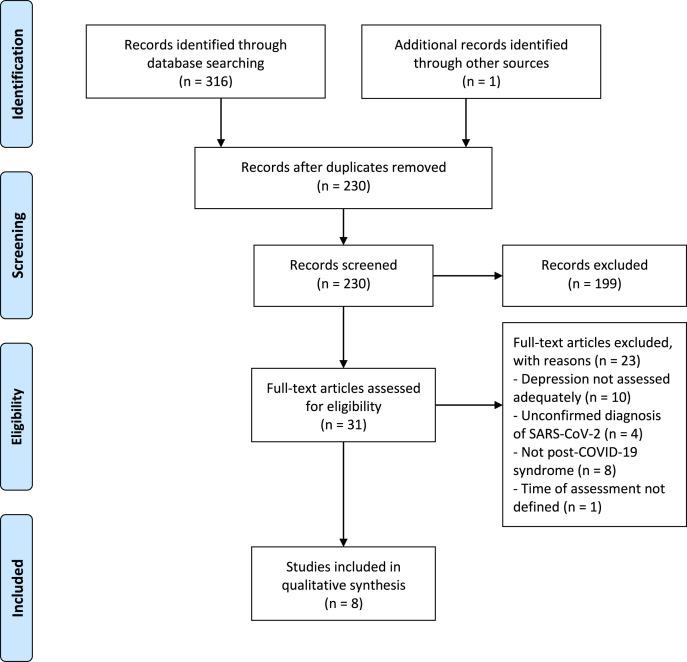
Following recovery from COVID-19, an increasing proportion of individuals have reported the persistence and/or new onset of symptoms which collectively have been identified as post-COVID-19 syndrome by the National Institute for Health and Care Excellence. Although depressive symptoms in the acute phase of COVID-19 have been well characterized, the frequency of depression following recovery of the acute phase remains unknown. Herein, we sought to determine the frequency of depressive symptoms and clinically-significant depression more than 12 weeks following SARS-CoV-2 infection. A systematic search of PubMed, Ovid Medline and Google Scholar for studies published between January 1, 2020 and June 5, 2021 was conducted. Frequency and factors associated with depression in post-COVID-19 syndrome were recorded and qualitatively assessed through narrative synthesis. Methodological quality and risk of bias was assessed using a modified version of the Newcastle-Ottawa Scale (NOS) for prospective cohort studies. Of 316 articles identified through our systematic search, eight studies were included. The frequency of depressive symptoms +12 weeks following SARS-CoV-2 infection ranged from 11 to 28%. The frequency of clinically-significant depression and/or severe depressive symptoms ranged from 3 to 12%. The severity of acute COVID-19 was not associated with the frequency of depressive symptoms. However, the component studies were highly heterogeneous with respect to mode of ascertainment, time of assessment, and location and age of patients. The majority of studies did not include an unexposed control group. Future research should endeavour to produce a standardized classification of post-COVID-19 syndrome, and as well as include unexposed control groups.
在 COVID-19 康复后,越来越多的人报告称持续存在和/或新出现症状,这些症状被国家卫生与保健卓越研究所(National Institute for Health and Care Excellence)统称为 COVID-19 后综合征。尽管 COVID-19 急性期的抑郁症状已经得到很好的描述,但急性期恢复后出现抑郁的频率仍不清楚。在此,我们旨在确定 SARS-CoV-2 感染后 12 周以上出现抑郁症状和临床显著抑郁的频率。通过对 PubMed、Ovid Medline 和 Google Scholar 进行系统检索,检索了 2020 年 1 月 1 日至 2021 年 6 月 5 日期间发表的研究。记录了 COVID-19 后综合征中抑郁的频率和相关因素,并通过叙述性综合进行定性评估。使用改良的纽卡斯尔-渥太华量表(Newcastle-Ottawa Scale,NOS)对前瞻性队列研究进行方法学质量和偏倚风险评估。通过系统检索共确定了 316 篇文章,其中 8 篇研究符合纳入标准。SARS-CoV-2 感染后 12 周时出现抑郁症状的频率为 11%至 28%。出现临床显著抑郁和/或重度抑郁症状的频率为 3%至 12%。急性 COVID-19 的严重程度与抑郁症状的频率无关。然而,这些纳入的研究在确定方法、评估时间、患者地点和年龄方面存在很大的异质性。大多数研究未纳入未暴露的对照组。未来的研究应努力制定 COVID-19 后综合征的标准化分类,并纳入未暴露的对照组。
 Zotero 插件