
用于 SARS-CoV-2 感染诊断的快速、即时抗原检测。
Rapid, point-of-care antigen tests for diagnosis of SARS-CoV-2 infection.
机构信息
Test Evaluation Research Group, Institute of Applied Health Research, University of Birmingham, Birmingham, UK.
NIHR Birmingham Biomedical Research Centre, University Hospitals Birmingham NHS Foundation Trust and University of Birmingham, Birmingham, UK.
出版信息
Cochrane Database Syst Rev. 2022 Jul 22;7(7):CD013705. doi: 10.1002/14651858.CD013705.pub3.
BACKGROUND
Accurate rapid diagnostic tests for SARS-CoV-2 infection would be a useful tool to help manage the COVID-19 pandemic. Testing strategies that use rapid antigen tests to detect current infection have the potential to increase access to testing, speed detection of infection, and inform clinical and public health management decisions to reduce transmission. This is the second update of this review, which was first published in 2020.
OBJECTIVES
To assess the diagnostic accuracy of rapid, point-of-care antigen tests for diagnosis of SARS-CoV-2 infection. We consider accuracy separately in symptomatic and asymptomatic population groups. Sources of heterogeneity investigated included setting and indication for testing, assay format, sample site, viral load, age, timing of test, and study design.
SEARCH METHODS
We searched the COVID-19 Open Access Project living evidence database from the University of Bern (which includes daily updates from PubMed and Embase and preprints from medRxiv and bioRxiv) on 08 March 2021. We included independent evaluations from national reference laboratories, FIND and the Diagnostics Global Health website. We did not apply language restrictions.
SELECTION CRITERIA
We included studies of people with either suspected SARS-CoV-2 infection, known SARS-CoV-2 infection or known absence of infection, or those who were being screened for infection. We included test accuracy studies of any design that evaluated commercially produced, rapid antigen tests. We included evaluations of single applications of a test (one test result reported per person) and evaluations of serial testing (repeated antigen testing over time). Reference standards for presence or absence of infection were any laboratory-based molecular test (primarily reverse transcription polymerase chain reaction (RT-PCR)) or pre-pandemic respiratory sample.
DATA COLLECTION AND ANALYSIS
We used standard screening procedures with three people. Two people independently carried out quality assessment (using the QUADAS-2 tool) and extracted study results. Other study characteristics were extracted by one review author and checked by a second. We present sensitivity and specificity with 95% confidence intervals (CIs) for each test, and pooled data using the bivariate model. We investigated heterogeneity by including indicator variables in the random-effects logistic regression models. We tabulated results by test manufacturer and compliance with manufacturer instructions for use and according to symptom status.
MAIN RESULTS
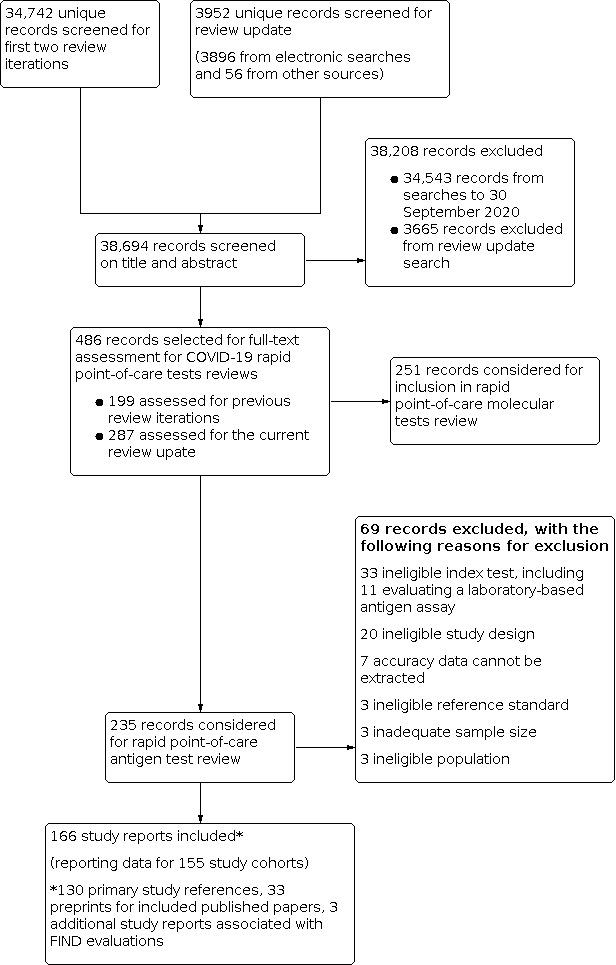
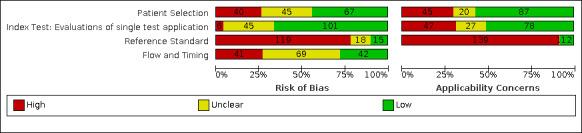
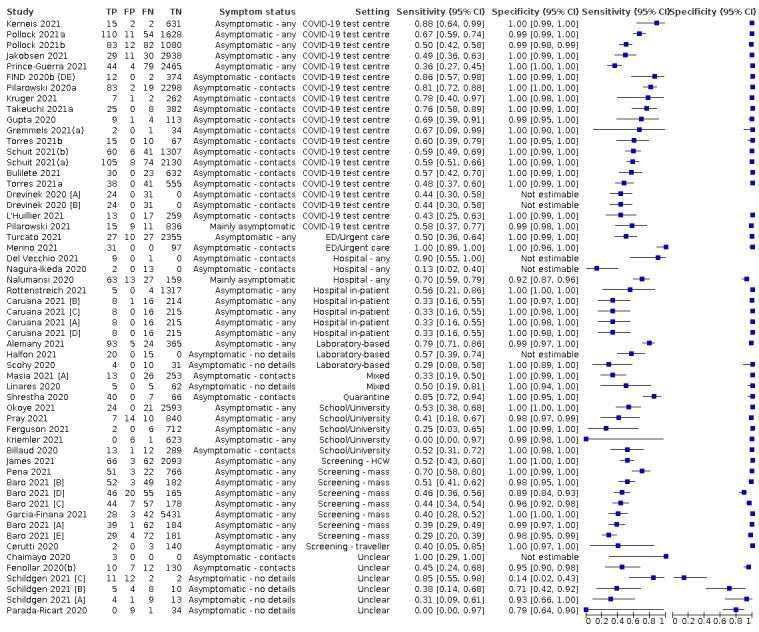
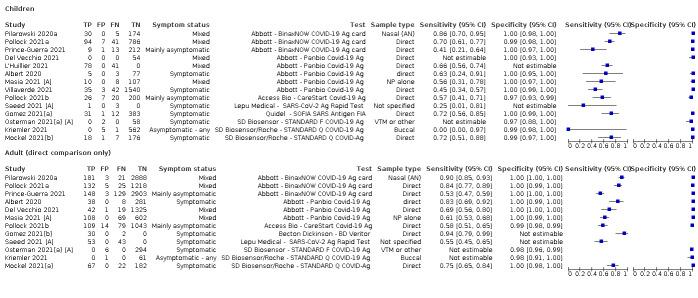
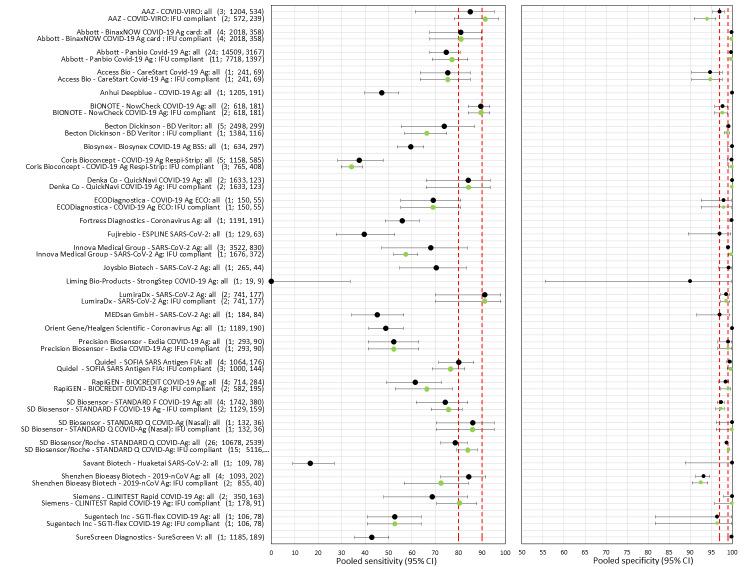
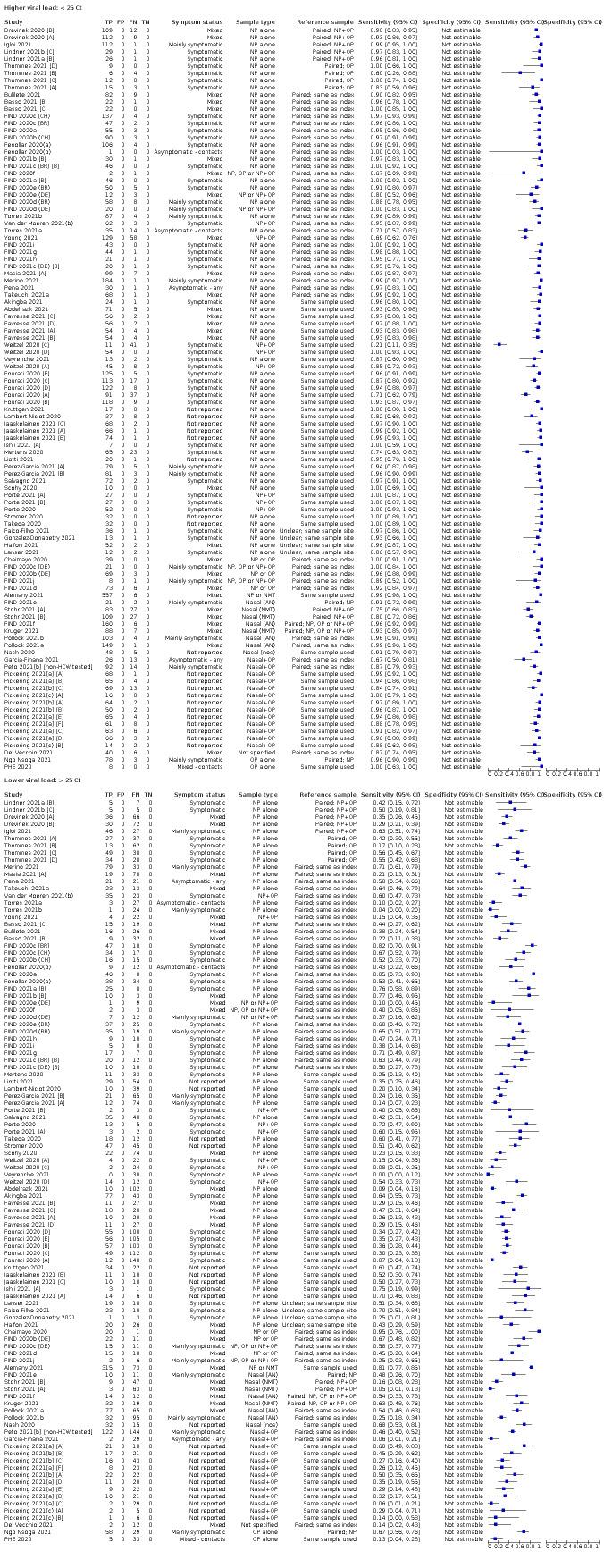
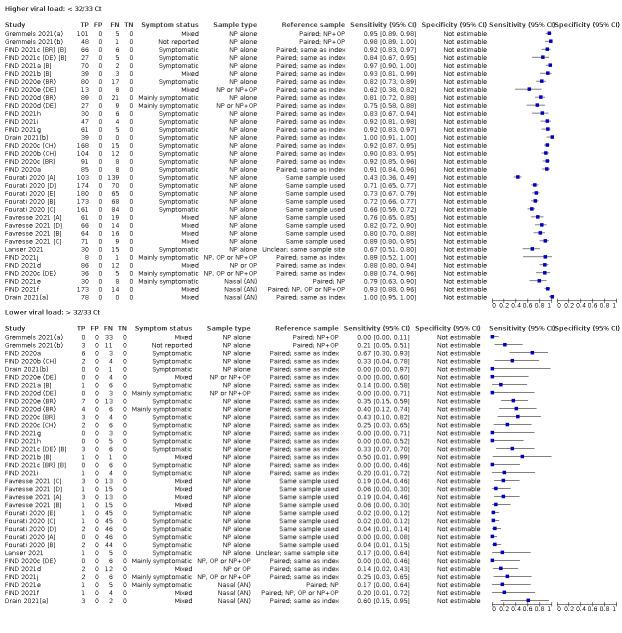
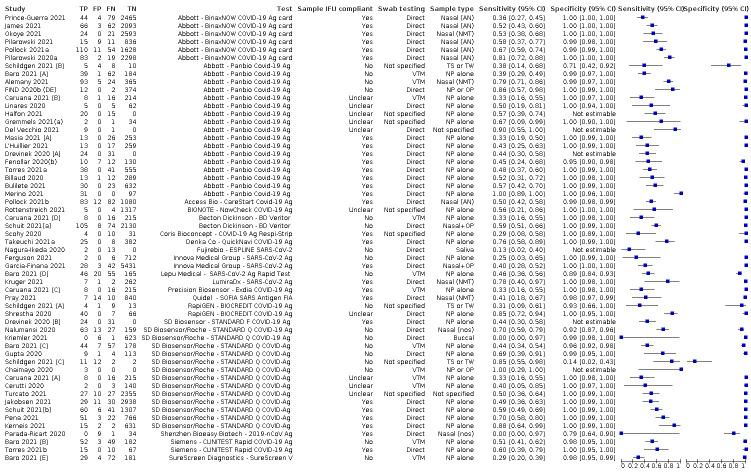
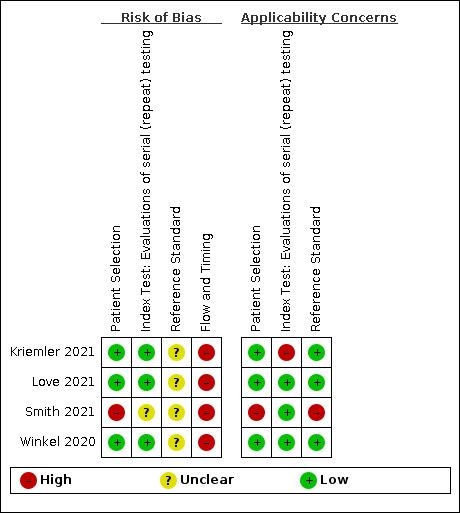
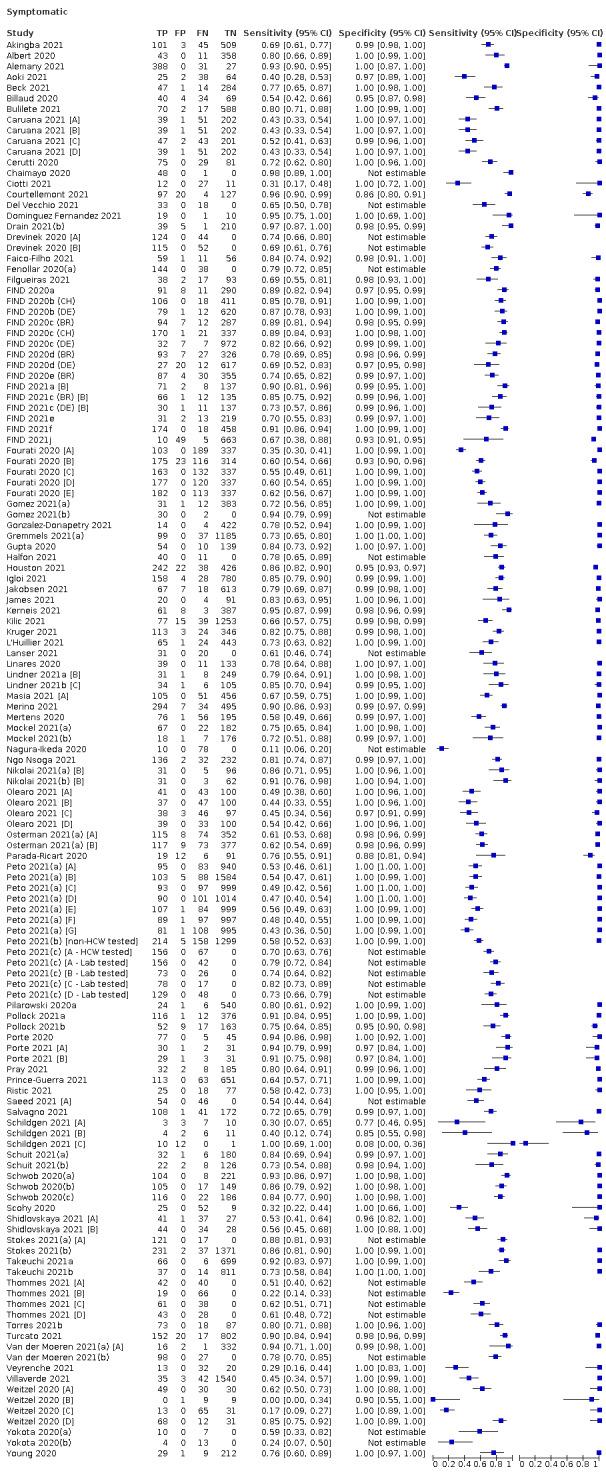
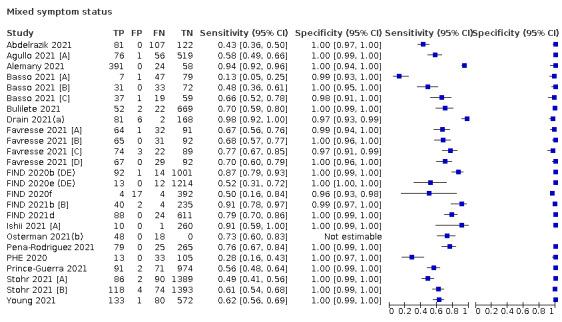
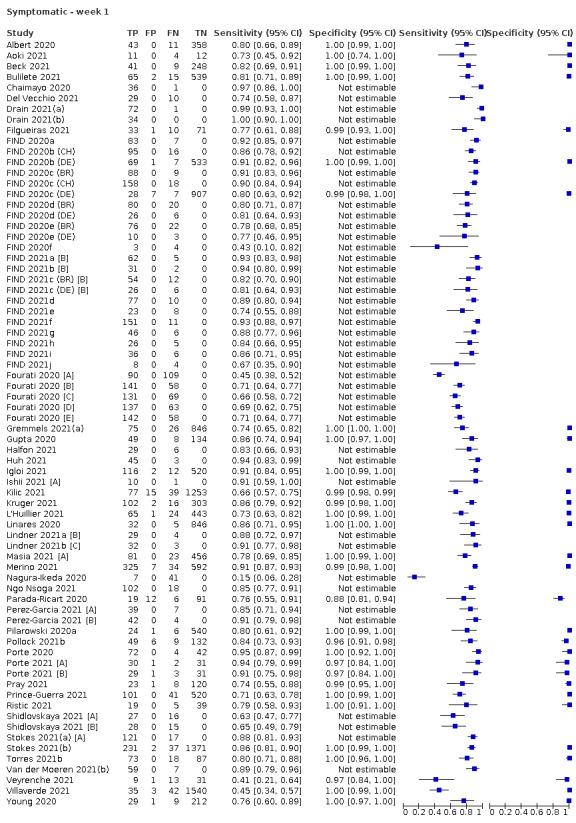
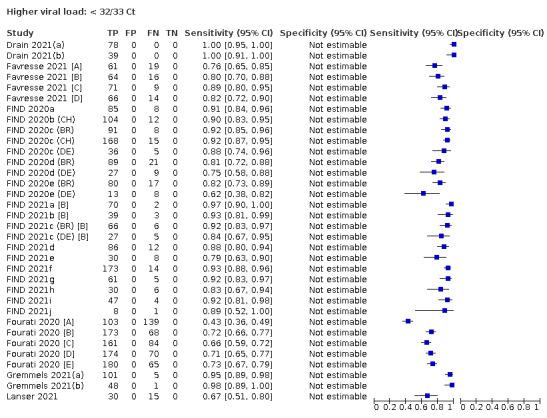
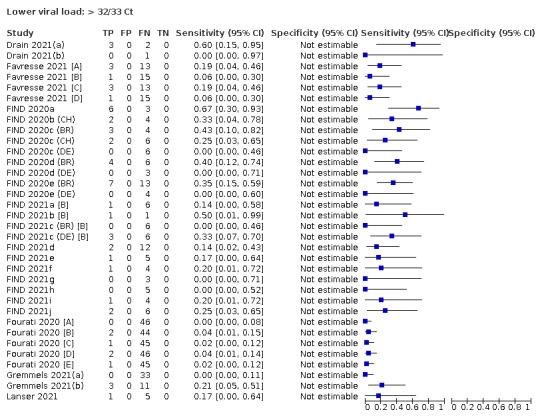
We included 155 study cohorts (described in 166 study reports, with 24 as preprints). The main results relate to 152 evaluations of single test applications including 100,462 unique samples (16,822 with confirmed SARS-CoV-2). Studies were mainly conducted in Europe (101/152, 66%), and evaluated 49 different commercial antigen assays. Only 23 studies compared two or more brands of test. Risk of bias was high because of participant selection (40, 26%); interpretation of the index test (6, 4%); weaknesses in the reference standard for absence of infection (119, 78%); and participant flow and timing 41 (27%). Characteristics of participants (45, 30%) and index test delivery (47, 31%) differed from the way in which and in whom the test was intended to be used. Nearly all studies (91%) used a single RT-PCR result to define presence or absence of infection. The 152 studies of single test applications reported 228 evaluations of antigen tests. Estimates of sensitivity varied considerably between studies, with consistently high specificities. Average sensitivity was higher in symptomatic (73.0%, 95% CI 69.3% to 76.4%; 109 evaluations; 50,574 samples, 11,662 cases) compared to asymptomatic participants (54.7%, 95% CI 47.7% to 61.6%; 50 evaluations; 40,956 samples, 2641 cases). Average sensitivity was higher in the first week after symptom onset (80.9%, 95% CI 76.9% to 84.4%; 30 evaluations, 2408 cases) than in the second week of symptoms (53.8%, 95% CI 48.0% to 59.6%; 40 evaluations, 1119 cases). For those who were asymptomatic at the time of testing, sensitivity was higher when an epidemiological exposure to SARS-CoV-2 was suspected (64.3%, 95% CI 54.6% to 73.0%; 16 evaluations; 7677 samples, 703 cases) compared to where COVID-19 testing was reported to be widely available to anyone on presentation for testing (49.6%, 95% CI 42.1% to 57.1%; 26 evaluations; 31,904 samples, 1758 cases). Average specificity was similarly high for symptomatic (99.1%) or asymptomatic (99.7%) participants. We observed a steady decline in summary sensitivities as measures of sample viral load decreased. Sensitivity varied between brands. When tests were used according to manufacturer instructions, average sensitivities by brand ranged from 34.3% to 91.3% in symptomatic participants (20 assays with eligible data) and from 28.6% to 77.8% for asymptomatic participants (12 assays). For symptomatic participants, summary sensitivities for seven assays were 80% or more (meeting acceptable criteria set by the World Health Organization (WHO)). The WHO acceptable performance criterion of 97% specificity was met by 17 of 20 assays when tests were used according to manufacturer instructions, 12 of which demonstrated specificities above 99%. For asymptomatic participants the sensitivities of only two assays approached but did not meet WHO acceptable performance standards in one study each; specificities for asymptomatic participants were in a similar range to those observed for symptomatic people. At 5% prevalence using summary data in symptomatic people during the first week after symptom onset, the positive predictive value (PPV) of 89% means that 1 in 10 positive results will be a false positive, and around 1 in 5 cases will be missed. At 0.5% prevalence using summary data for asymptomatic people, where testing was widely available and where epidemiological exposure to COVID-19 was suspected, resulting PPVs would be 38% to 52%, meaning that between 2 in 5 and 1 in 2 positive results will be false positives, and between 1 in 2 and 1 in 3 cases will be missed.
AUTHORS' CONCLUSIONS: Antigen tests vary in sensitivity. In people with signs and symptoms of COVID-19, sensitivities are highest in the first week of illness when viral loads are higher. Assays that meet appropriate performance standards, such as those set by WHO, could replace laboratory-based RT-PCR when immediate decisions about patient care must be made, or where RT-PCR cannot be delivered in a timely manner. However, they are more suitable for use as triage to RT-PCR testing. The variable sensitivity of antigen tests means that people who test negative may still be infected. Many commercially available rapid antigen tests have not been evaluated in independent validation studies. Evidence for testing in asymptomatic cohorts has increased, however sensitivity is lower and there is a paucity of evidence for testing in different settings. Questions remain about the use of antigen test-based repeat testing strategies. Further research is needed to evaluate the effectiveness of screening programmes at reducing transmission of infection, whether mass screening or targeted approaches including schools, healthcare setting and traveller screening.
背景
准确快速的 SARS-CoV-2 感染诊断测试将有助于管理 COVID-19 大流行。使用快速抗原检测来检测当前感染的检测策略有可能增加检测的可及性,加快感染的检测速度,并为临床和公共卫生管理决策提供信息,以减少传播。这是对该综述的第二次更新,该综述于 2020 年首次发表。
目的
评估快速、即时检测 SARS-CoV-2 感染的快速抗原检测的诊断准确性。我们分别评估了有症状和无症状人群的准确性。纳入的异质性来源包括检测的地点和目的、检测方法、样本采集部位、病毒载量、年龄、检测时间和研究设计。
检索方法
我们于 2021 年 3 月 8 日检索了伯尔尼大学 COVID-19 开放获取项目的实时证据数据库(该数据库包括来自 PubMed 和 Embase 的每日更新,以及来自 medRxiv 和 bioRxiv 的预印本)。我们还纳入了来自国家参考实验室、FIND 和 Diagnostics Global Health 网站的独立评估。我们没有语言限制。
纳入排除标准
我们纳入了疑似 SARS-CoV-2 感染、已知 SARS-CoV-2 感染或明确无感染的人群,或正在进行感染筛查的人群的研究。我们纳入了评估任何商业生产的快速抗原检测的研究,无论其设计如何。我们纳入了单次检测应用的评估(每人报告一次检测结果)和重复检测(随时间重复抗原检测)的评估。感染的存在或不存在的参考标准是任何基于实验室的分子检测(主要是逆转录聚合酶链反应(RT-PCR))或大流行前的呼吸道样本。
数据收集与分析
我们使用三人标准筛查程序。两人独立进行质量评估(使用 QUADAS-2 工具)并提取研究结果。其他研究特征由一名综述作者提取并由第二名综述作者核对。我们以 95%置信区间(CI)报告每个检测的敏感性和特异性,并使用双变量模型汇总数据。我们通过纳入指示变量来调查异质性,这些指示变量用于随机效应逻辑回归模型中。我们根据制造商和制造商使用说明的合规性以及症状状态来对结果进行制表。
主要结果
我们纳入了 152 项研究队列(描述在 166 项研究报告中,其中 24 项为预印本)。主要结果涉及 100,462 个独特样本(16822 个样本中确认有 SARS-CoV-2)的 152 项单一检测应用评估,包括 100,462 个独特样本(16822 个样本中确认有 SARS-CoV-2)。研究主要在欧洲进行(101/152,66%),并评估了 49 种不同的商业抗原检测。只有 23 项研究比较了两种或两种以上品牌的检测。由于参与者选择(40/152,26%);检测结果的解释(6/152,4%);对无感染的参考标准的弱点(119/152,78%);以及参与者的流动和时间安排(41/152,27%),因此存在高偏倚风险。参与者特征(45/152,30%)和检测交付(47/152,31%)与检测的使用方式和目的不同。几乎所有的研究(91%)都使用单一的 RT-PCR 结果来定义感染的存在或不存在。对 152 项单一检测应用的研究报告了 228 项抗原检测的评估。研究间的估计敏感性差异很大,特异性很高。有症状参与者的平均敏感性明显高于无症状参与者(73.0%,95%CI 69.3%至 76.4%;109 项评估;50574 个样本,11662 个病例)(54.7%,95%CI 47.7%至 61.6%;50 项评估;40956 个样本,2641 个病例)。症状出现后第一周的平均敏感性(80.9%,95%CI 76.9%至 84.4%;30 项评估;2408 个病例)高于第二周(53.8%,95%CI 48.0%至 59.6%;40 项评估;1119 个病例)。对于那些在检测时无症状的人,如果怀疑有 SARS-CoV-2 的流行病学暴露,敏感性更高(64.3%,95%CI 54.6%至 73.0%;16 项评估;7677 个样本,703 个病例),而对于那些报道 COVID-19 检测广泛提供给任何前来检测的人,敏感性较低(49.6%,95%CI 42.1%至 57.1%;26 项评估;31904 个样本,1758 个病例)。有症状或无症状参与者的特异性相似,均很高。随着样本病毒载量的降低,综合敏感性的汇总值呈下降趋势。品牌之间的敏感性存在差异。当根据制造商的说明使用检测时,品牌的平均敏感性在有症状的参与者中范围为 34.3%至 91.3%(20 项具有合格数据的检测),在无症状的参与者中范围为 28.6%至 77.8%(12 项检测)。对于有症状的参与者,七种检测的汇总敏感性在 80%或更高(符合世界卫生组织(WHO)设定的可接受标准)。当根据制造商的说明使用检测时,20 项检测中有 17 项达到了 97%特异性的可接受性能标准,其中 12 项的特异性超过 99%。对于无症状参与者,只有两项检测在一项研究中接近但未达到 WHO 可接受的性能标准,特异性与有症状人群观察到的相似。在症状出现后第一周的第一个 5%的流行率中,89%的阳性预测值(PPV)意味着 10 个阳性结果中会有 1 个是假阳性,约有 10 个病例会被漏诊。在无症状人群中,0.5%的流行率中,在 COVID-19 疑似有流行病学暴露的情况下,检测广泛可用,阳性预测值为 38%至 52%,这意味着 5 个阳性结果中会有 2 个是假阳性,每 2 个阳性结果中会有 1 个漏诊,每 3 个病例中会有 1 个漏诊。
作者结论
抗原检测的敏感性各不相同。在有 COVID-19 症状和体征的人群中,在疾病的第一周,当病毒载量较高时,敏感性最高。符合适当性能标准的检测,如世界卫生组织(WHO)设定的标准,可以替代基于实验室的 RT-PCR,当必须立即做出患者护理决策时,或者当不能及时进行 RT-PCR 检测时。然而,它们更适合作为 RT-PCR 检测的辅助手段。抗原检测的可变敏感性意味着检测结果为阴性的人仍可能被感染。许多商业上可获得的快速抗原检测尚未在独立的验证研究中进行评估。在无症状人群中,证据有所增加,但敏感性较低,而且关于在不同环境中使用抗原检测的证据有限。关于抗原检测重复检测策略的使用问题仍然存在。需要进一步研究来评估筛查方案对减少感染传播的有效性,无论是大规模筛查还是针对学校、医疗保健场所和旅行者的有针对性的方法。






















 Zotero 插件