
低骨转换与透析前患者的X线平片血管钙化有关。
Low bone turnover is associated with plain X-ray vascular calcification in predialysis patients.
作者信息
Neto Ricardo, Pereira Luciano, Magalhães Juliana, Quelhas-Santos Janete, Frazão João
机构信息
Institute for Innovation and Health Research (I3S), Institute of Biomedical Engineering (INEB), Nephrology and Infectious Diseases Research Group, University of Porto, Porto, Portugal.
Department of Nephrology, Centro Hospitalar Universitário São João, Porto, Portugal.
出版信息
PLoS One. 2021 Oct 13;16(10):e0258284. doi: 10.1371/journal.pone.0258284. eCollection 2021.
BACKGROUND
Vascular calcification (VC) is a common finding in chronic kidney disease (CKD) patients and predicts subsequent cardiovascular morbidity and mortality in this population. Vascular calcification is linked to disordered mineral metabolism and has been associated with bone histomorphometry changes in CKD. However, data on predialysis patients is scarce.
METHODS
A cross-sectional study was conducted on a cohort of 56 CKD patients not yet on dialysis, who underwent a transiliac bone biopsy for histomorphometric evaluation after double tetracycline labeling. Patients had no previous exposure to calcium salts, vitamin D agents, steroids or bisphosphonates. Vascular calcification was assessed at the time of biopsy, using Kauppila (plain X-ray of the lateral lumbar spine) and Adragão (plain X-ray of the pelvis and hands) scores.
RESULTS
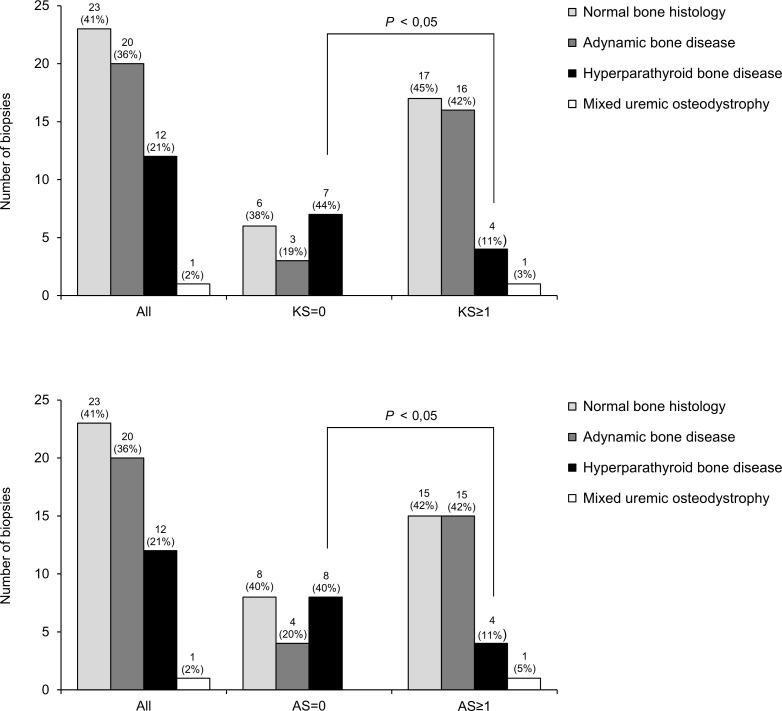
Vascular calcification was seen in two-thirds of the cohort. Subjects with VC were more likely to be male and have diabetes, and had significantly higher sclerostin and osteoprotegerin circulating levels than those without VC. The histomorphometric analysis showed that bone formation rate was significantly lower in VC compared to non-VC patients. In the multivariable logistic regression analysis, bone formation rate was independently associated with the presence of VC.
CONCLUSIONS
Vascular calcification is highly prevalent in predialysis patients, especially in those with diabetes. The independent association between bone formation rate and VC provides evidence of an important interaction between bone and vessel in CKD. Our results suggest that low bone turnover is a non-traditional risk factor for cardiovascular disease in predialysis patients.
背景
血管钙化(VC)在慢性肾脏病(CKD)患者中很常见,并可预测该人群随后的心血管发病率和死亡率。血管钙化与矿物质代谢紊乱有关,并且与CKD患者的骨组织形态计量学变化有关。然而,关于透析前患者的数据很少。
方法
对一组56例尚未接受透析的CKD患者进行了横断面研究,这些患者在双四环素标记后接受了经髂骨活检以进行组织形态计量学评估。患者既往未接触过钙盐、维生素D制剂、类固醇或双膦酸盐。在活检时,使用考皮拉(腰椎侧位平片)和阿德拉贡(骨盆和手部平片)评分评估血管钙化情况。
结果
该队列中有三分之二的患者出现血管钙化。患有VC的受试者更可能为男性且患有糖尿病,并且其血清硬化蛋白和骨保护素循环水平显著高于未患VC的受试者。组织形态计量学分析显示,与非VC患者相比,VC患者的骨形成率显著更低。在多变量逻辑回归分析中,骨形成率与VC的存在独立相关。
结论
血管钙化在透析前患者中非常普遍,尤其是在糖尿病患者中。骨形成率与VC之间的独立关联为CKD患者骨与血管之间的重要相互作用提供了证据。我们的结果表明,低骨转换是透析前患者心血管疾病的一个非传统危险因素。
 Zotero 插件