
神经认知长新冠综合征的神经心理学特征和脑葡萄糖代谢。
Neuropsychologic Profiles and Cerebral Glucose Metabolism in Neurocognitive Long COVID Syndrome.
机构信息
Department of Neurology and Clinical Neuroscience, Medical Center - University of Freiburg, Faculty of Medicine, University of Freiburg, Freiburg, Germany.
Freiburg Brain Imaging Center, Medical Center - University of Freiburg, Faculty of Medicine, University of Freiburg, Freiburg, Germany.
出版信息
J Nucl Med. 2022 Jul;63(7):1058-1063. doi: 10.2967/jnumed.121.262677. Epub 2021 Oct 14.
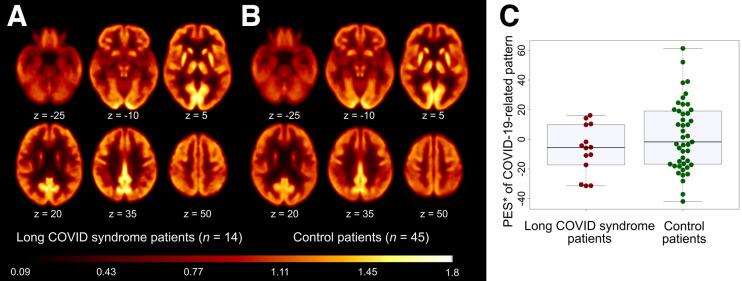
During the coronavirus disease 2019 (COVID-19) pandemic, Long COVID syndrome, which impairs patients through cognitive deficits, fatigue, and exhaustion, has become increasingly relevant. Its underlying pathophysiology, however, is unknown. In this study, we assessed cognitive profiles and regional cerebral glucose metabolism as a biomarker of neuronal function in outpatients with long-term neurocognitive symptoms after COVID-19. Outpatients seeking neurologic counseling with neurocognitive symptoms persisting for more than 3 mo after polymerase chain reaction (PCR)-confirmed COVID-19 were included prospectively between June 16, 2020, and January 29, 2021. Patients ( = 31; age, 53.6 ± 2.0 y) in the long-term phase after COVID-19 (202 ± 58 d after positive PCR) were assessed with a neuropsychologic test battery. Cerebral F-FDG PET imaging was performed in 14 of 31 patients. Patients self-reported impaired attention, memory, and multitasking abilities (31/31), word-finding difficulties (27/31), and fatigue (24/31). Twelve of 31 patients could not return to the previous level of independence/employment. For all cognitive domains, average group results of the neuropsychologic test battery showed no impairment, but deficits ( score < -1.5) were present on a single-patient level mainly in the domain of visual memory (in 7/31; other domains ≤ 2/31). Mean Montreal Cognitive Assessment performance (27/30 points) was above the cutoff value for detection of cognitive impairment (<26 points), although 9 of 31 patients performed slightly below this level (23-25 points). In the subgroup of patients who underwent F-FDG PET, we found no significant changes of regional cerebral glucose metabolism. Long COVID patients self-report uniform symptoms hampering their ability to work in a relevant fraction. However, cognitive testing showed minor impairments only on a single-patient level approximately 6 mo after the infection, whereas functional imaging revealed no distinct pathologic changes. This clearly deviates from previous findings in subacute COVID-19 patients, suggesting that underlying neuronal causes are different and possibly related to the high prevalence of fatigue.
在 2019 年冠状病毒病(COVID-19)大流行期间,长新冠综合征通过认知缺陷、疲劳和疲惫损害患者,变得越来越相关。然而,其潜在的病理生理学尚不清楚。在这项研究中,我们评估了认知特征和区域脑葡萄糖代谢作为 COVID-19 后长期神经认知症状患者的神经元功能生物标志物。
2020 年 6 月 16 日至 2021 年 1 月 29 日期间,前瞻性纳入因聚合酶链反应(PCR)确诊 COVID-19 后持续 3 个月以上出现神经认知症状并寻求神经科咨询的门诊患者。31 例长新冠患者(新冠病毒 PCR 阳性后 202±58 天)接受神经心理测试。14 例患者行脑 F-FDG PET 成像。31 例患者中有 31 例自述注意力、记忆力和多任务处理能力受损(31/31)、找词困难(27/31)和疲劳(24/31)。31 例患者中有 12 例无法恢复到以前的独立/就业水平。对于所有认知领域,神经心理测试的平均组结果均无损伤,但在单个患者水平上存在缺陷(< -1.5 分),主要在视觉记忆领域(31 例中的 7 例;其他领域≤31 例中的 2 例)。蒙特利尔认知评估的平均表现(27/30 分)高于认知障碍检测的临界值(<26 分),尽管 31 例患者中有 9 例略低于该水平(23-25 分)。在接受 F-FDG PET 的患者亚组中,我们未发现区域性脑葡萄糖代谢的显著变化。
长新冠患者自述症状一致,严重影响其工作能力。然而,大约在感染后 6 个月进行认知测试仅发现少数患者有轻微损伤,而功能成像未发现明显的病理变化。这与亚急性 COVID-19 患者的先前发现明显不同,表明潜在的神经元原因不同,可能与疲劳的高患病率有关。

 Zotero 插件