
微小RNA-100通过靶向叉头框蛋白A1抑制乳腺癌细胞的增殖、侵袭和迁移。
MicroRNA-100 inhibits breast cancer cell proliferation, invasion and migration by targeting FOXA1.
作者信息
Xie Haihui, Xiao Ruobing, He Yaolin, He Lingzhi, Xie Changjun, Chen Juan, Hong Yan
机构信息
Department of Radiation Oncology, The Second Affiliated Hospital University of South China, Hengyang, Hunan 421001, P.R. China.
Clinical Research Center for Prevention and Treatment of Breast & Thyroid Disease in Hunan Province, Hengyang, Hunan 421001, P.R. China.
出版信息
Oncol Lett. 2021 Dec;22(6):816. doi: 10.3892/ol.2021.13077. Epub 2021 Oct 1.
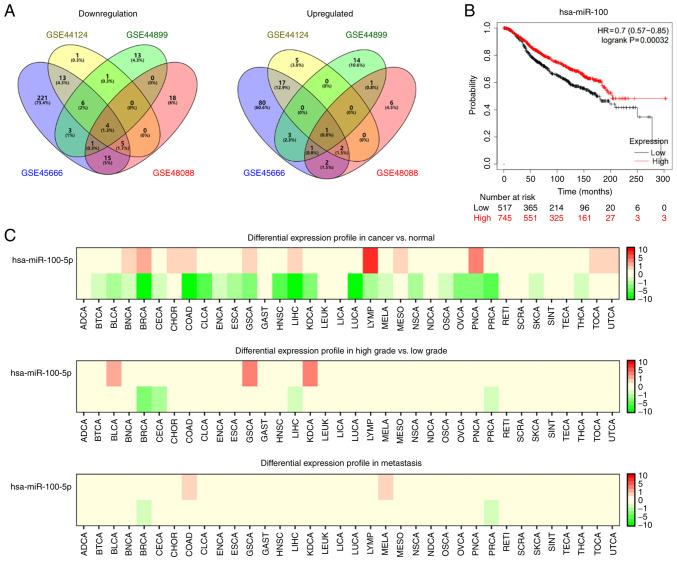
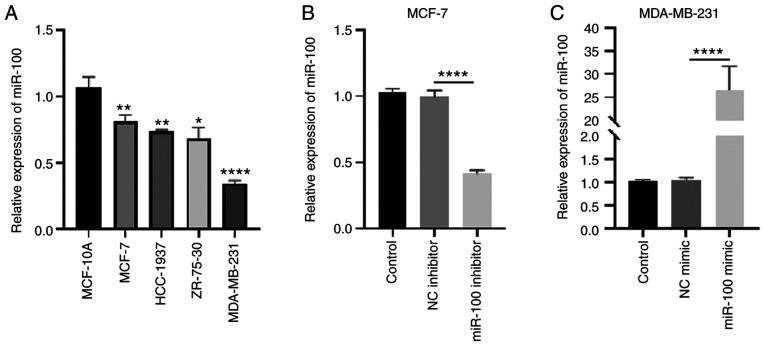
MicroRNAs (miRNAs/miRs) are highly conserved single-stranded small non-coding RNAs, which are involved in the physiological and pathological processes of breast cancer, and affect the prognosis of patients with breast cancer. The present study used the Gene Expression Omnibus (GEO)2R tool to detect miR-100 expression in breast cancer tissues obtained from GEO breast cancer-related datasets. Bioinformatics analysis revealed that miR-100 expression was downregulated in different stages, grades and lymph node metastasis stages of breast cancer, and patients with high miR-100 expression had a more favorable prognosis. Based on these analyses, Cell Counting Kit-8, wound healing and Transwell assays were performed, and the results demonstrated that overexpression of miR-100 inhibited the proliferation, migration and invasion of breast cancer cells. To verify the tumor-suppressive effect of miR-100 in breast cancer, the LinkedOmics and PITA databases were used to assess the association between miR-100 and forkhead box A1 (FOXA1). The results demonstrated that miR-100 had binding sites within the FOXA1 gene, and FOXA1 expression was negatively associated with miR-100 expression in breast cancer tissues. Similarly, a negative association was observed between miR-100 and FOXA1 expression, using the StarBase V3.0 database. The association between miR-100 and FOXA1 was further verified via reverse transcription-quantitative PCR and western blot analyses, and the dual-luciferase reporter assay. The results demonstrated that miR-100 targeted the 3'-untranslated region of FOXA1 in breast cancer cells. Furthermore, rescue experiments were performed to confirm whether miR-100 exerts its antitumor effects by regulating FOXA1. The results demonstrated that overexpression of FOXA1 promoted the proliferation, migration and invasion of breast cancer cells; thus, the antitumor effects of miR-100 in breast cancer were reversed following overexpression of FOXA1. Taken together, the results of the present study suggest that miR-100 inhibits the proliferation, migration and invasion of breast cancer cells by targeting FOXA1 expression. These results may provide a novel insight and an experimental basis for identifying effective therapeutic targets of high specificity for breast cancer.
微小RNA(miRNA/miR)是高度保守的单链小非编码RNA,其参与乳腺癌的生理和病理过程,并影响乳腺癌患者的预后。本研究使用基因表达综合数据库(GEO)2R工具检测从GEO乳腺癌相关数据集中获取的乳腺癌组织中miR-100的表达。生物信息学分析显示,miR-100在乳腺癌的不同分期、分级和淋巴结转移阶段表达下调,且miR-100高表达的患者预后更佳。基于这些分析,进行了细胞计数试剂盒-8、伤口愈合和Transwell实验,结果表明miR-100过表达抑制了乳腺癌细胞的增殖、迁移和侵袭。为验证miR-100在乳腺癌中的肿瘤抑制作用,使用LinkedOmics和PITA数据库评估miR-100与叉头框A1(FOXA1)之间的关联。结果表明,miR-100在FOXA1基因内具有结合位点,且在乳腺癌组织中FOXA1表达与miR-100表达呈负相关。同样,使用StarBase V3.0数据库观察到miR-100与FOXA1表达之间存在负相关。通过逆转录定量PCR、蛋白质免疫印迹分析和双荧光素酶报告基因实验进一步验证了miR-100与FOXA1之间的关联。结果表明,miR-100靶向乳腺癌细胞中FOXA1的3'-非翻译区。此外,进行了拯救实验以确认miR-100是否通过调节FOXA1发挥其抗肿瘤作用。结果表明,FOXA1过表达促进了乳腺癌细胞的增殖、迁移和侵袭;因此,FOXA1过表达后,miR-100在乳腺癌中的抗肿瘤作用被逆转。综上所述,本研究结果表明,miR-100通过靶向FOXA1表达抑制乳腺癌细胞的增殖、迁移和侵袭。这些结果可能为确定乳腺癌高特异性有效治疗靶点提供新的见解和实验依据。




 Zotero 插件