
一年的基因组监测揭示了 SARS-CoV-2 大流行在非洲的发展情况。
A year of genomic surveillance reveals how the SARS-CoV-2 pandemic unfolded in Africa.
机构信息
KwaZulu-Natal Research Innovation and Sequencing Platform (KRISP), Nelson R Mandela School of Medicine, University of KwaZulu-Natal, Durban, South Africa.
Centre for Epidemic Response and Innovation (CERI), School of Data Science and Computational Thinking, Stellenbosch University, Stellenbosch, South Africa.
出版信息
Science. 2021 Oct 22;374(6566):423-431. doi: 10.1126/science.abj4336. Epub 2021 Sep 9.
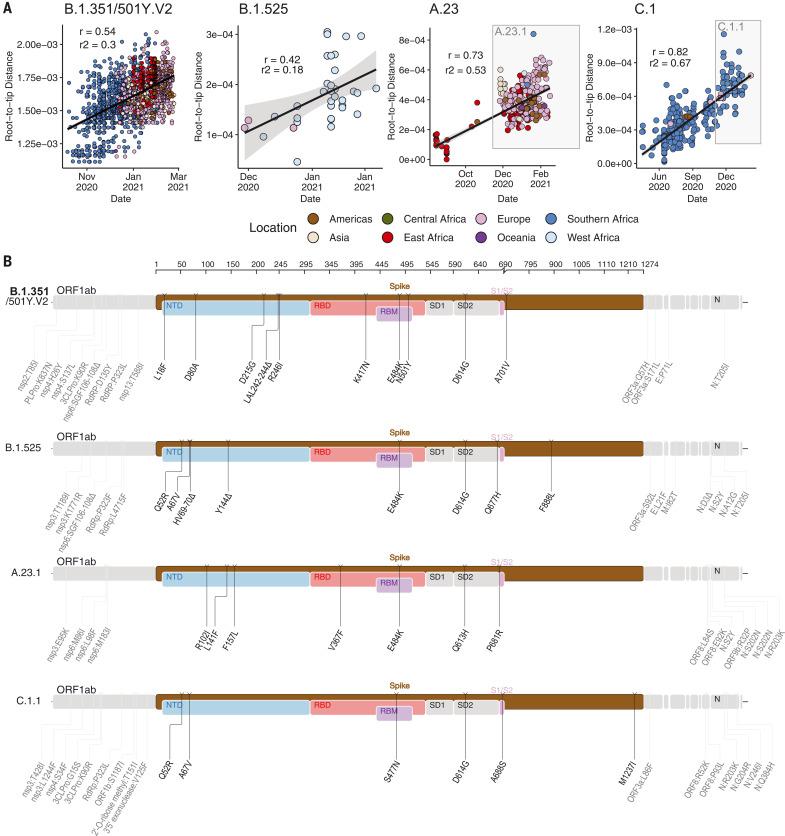
The progression of the severe acute respiratory syndrome coronavirus 2 (SARS-CoV-2) pandemic in Africa has so far been heterogeneous, and the full impact is not yet well understood. In this study, we describe the genomic epidemiology using a dataset of 8746 genomes from 33 African countries and two overseas territories. We show that the epidemics in most countries were initiated by importations predominantly from Europe, which diminished after the early introduction of international travel restrictions. As the pandemic progressed, ongoing transmission in many countries and increasing mobility led to the emergence and spread within the continent of many variants of concern and interest, such as B.1.351, B.1.525, A.23.1, and C.1.1. Although distorted by low sampling numbers and blind spots, the findings highlight that Africa must not be left behind in the global pandemic response, otherwise it could become a source for new variants.
严重急性呼吸综合征冠状病毒 2(SARS-CoV-2)在非洲的流行情况目前呈现出异质性,其全面影响尚不完全清楚。在这项研究中,我们利用来自 33 个非洲国家和两个海外领地的 8746 个基因组数据集,描述了其基因组流行病学特征。结果表明,大多数国家的疫情主要由来自欧洲的输入病例引发,这些输入病例在早期实施国际旅行限制后减少。随着疫情的发展,许多国家的持续传播和流动性增加,导致许多关注和感兴趣的变异株(如 B.1.351、B.1.525、A.23.1 和 C.1.1)在非洲大陆内部出现和传播。尽管受到采样数量低和盲点的扭曲,这些发现强调了非洲在全球大流行应对中绝不能落后,否则它可能成为新变异株的来源。


 Zotero 插件