
COVID-19 住院患者中应用秋水仙碱(RECOVERY):一项随机、对照、开放标签、平台试验。
Colchicine in patients admitted to hospital with COVID-19 (RECOVERY): a randomised, controlled, open-label, platform trial.
出版信息
Lancet Respir Med. 2021 Dec;9(12):1419-1426. doi: 10.1016/S2213-2600(21)00435-5. Epub 2021 Oct 18.
BACKGROUND
Colchicine has been proposed as a treatment for COVID-19 based on its anti-inflammatory actions. We aimed to evaluate the efficacy and safety of colchicine in patients admitted to hospital with COVID-19.
METHODS
In this streamlined, randomised, controlled, open-label trial, underway at 177 hospitals in the UK, two hospitals in Indonesia, and two hospitals in Nepal, several possible treatments were compared with usual care in patients hospitalised with COVID-19. Patients were eligible for inclusion in the study if they were admitted to hospital with clinically suspected or laboratory confirmed SARS-CoV-2 infection and had no medical history that might, in the opinion of the attending clinician, put the patient at significant risk if they were to participate in the trial. Eligible and consenting adults were randomly assigned (1:1) to receive either usual standard of care alone (usual care group) or usual standard of care plus colchicine (colchicine group) using web-based simple (unstratified) randomisation with allocation concealment. Participants received colchicine 1 mg after randomisation followed by 500 μg 12 h later and then 500 μg twice a day by mouth or nasogastric tube for 10 days in total or until discharge. Dose frequency was halved for patients receiving a moderate CYP3A4 inhibitor (eg, diltiazem), patients with an estimated glomerular filtration rate of less than 30 mL/min per 1·73m, and those with an estimated bodyweight of less than 70 kg. The primary outcome was 28-day mortality, secondary endpoints included time to discharge, the proportion of patients discharged from hospital within 28 days, and, in patients not on invasive mechanical ventilation at randomisation, a composite endpoint of invasive mechanical ventilation or death. All analyses were by intention-to-treat. The trial is registered with ISRCTN, 50189673, and ClinicalTrials.gov, NCT04381936.
FINDINGS
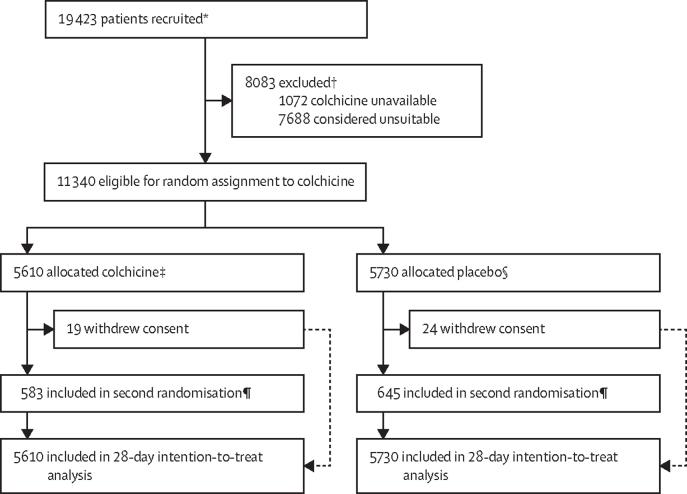
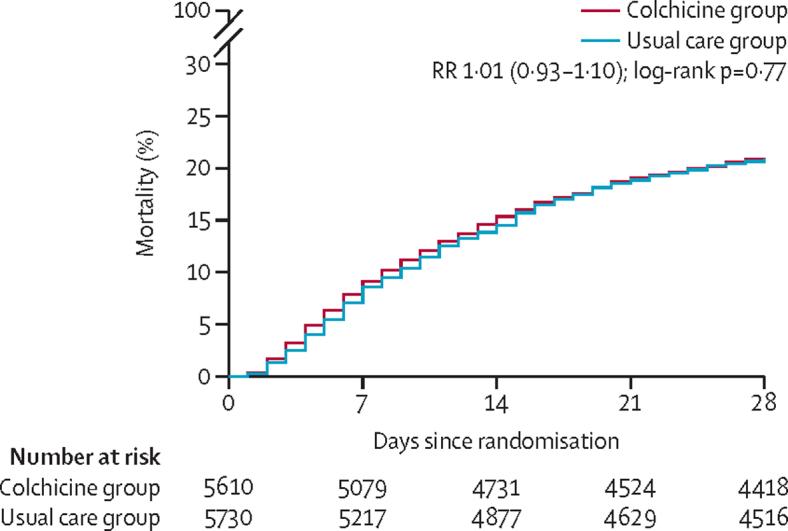
Between Nov 27, 2020, and March 4, 2021, 11 340 (58%) of 19 423 patients enrolled into the RECOVERY trial were eligible to receive colchicine; 5610 (49%) patients were randomly assigned to the colchicine group and 5730 (51%) to the usual care group. Overall, 1173 (21%) patients in the colchicine group and 1190 (21%) patients in the usual care group died within 28 days (rate ratio 1·01 [95% CI 0·93 to 1·10]; p=0·77). Consistent results were seen in all prespecified subgroups of patients. Median time to discharge alive (10 days [IQR 5 to >28]) was the same in both groups, and there was no significant difference in the proportion of patients discharged from hospital alive within 28 days (3901 [70%] patients in the colchicine group and 4032 [70%] usual care group; rate ratio 0·98 [95% CI 0·94 to 1·03]; p=0·44). In those not on invasive mechanical ventilation at baseline, there was no significant difference in the proportion meeting the composite endpoint of invasive mechanical ventilation or death (1344 [25%] in the colchicine group vs 1343 [25%] patients in the usual care group; risk ratio 1·02 [95% CI 0·96 to 1·09]; p=0·47).
INTERPRETATION
In adults hospitalised with COVID-19, colchicine was not associated with reductions in 28-day mortality, duration of hospital stay, or risk of progressing to invasive mechanical ventilation or death.
FUNDING
UK Research and Innovation (Medical Research Council), National Institute of Health Research, and Wellcome Trust.
背景
秋水仙碱基于其抗炎作用被提议用于治疗 COVID-19。我们旨在评估秋水仙碱在因 COVID-19 住院的患者中的疗效和安全性。
方法
在这项在英国 177 家医院、印度尼西亚的 2 家医院和尼泊尔的 2 家医院进行的简化、随机、对照、开放性试验中,将几种可能的治疗方法与因 COVID-19 住院的患者的常规护理进行比较。如果患者因疑似或实验室确诊的 SARS-CoV-2 感染而住院,且根据主治临床医生的意见,他们没有可能使其在参加试验时处于重大风险的病史,则患者有资格参加研究。合格且同意的成年人被随机分配(1:1)接受单独的常规标准护理(常规护理组)或常规标准护理加秋水仙碱(秋水仙碱组),使用基于网络的简单(未分层)随机化和分配隐藏。参与者在随机分组后接受秋水仙碱 1 mg,然后 12 小时后再接受 500 μg,然后每天两次通过口或鼻胃管服用 500 μg,总共 10 天或直到出院。对于接受中度 CYP3A4 抑制剂(例如地尔硫卓)的患者、估计肾小球滤过率低于 30 mL/min/1.73m 的患者和估计体重低于 70 kg 的患者,剂量频率减半。主要结局是 28 天死亡率,次要终点包括出院时间、28 天内出院的患者比例,以及在随机分组时未接受有创机械通气的患者中,有创机械通气或死亡的复合终点。所有分析均按意向治疗进行。该试验在 ISRCTN、50189673 和 ClinicalTrials.gov 上注册,NCT04381936。
结果
在 2020 年 11 月 27 日至 2021 年 3 月 4 日之间,在 RECOVERY 试验中,19423 名入组患者中有 11340 名(58%)有资格接受秋水仙碱治疗;5610 名(49%)患者被随机分配到秋水仙碱组,5730 名(51%)患者被分配到常规护理组。总体而言,秋水仙碱组有 1173 名(21%)患者和常规护理组有 1190 名(21%)患者在 28 天内死亡(比率比 1.01 [95%CI 0.93 至 1.10];p=0.77)。在所有预先指定的患者亚组中均观察到一致的结果。存活出院的中位数时间(10 天[IQR 5 至>28])在两组中相同,28 天内出院的患者比例无显著差异(秋水仙碱组 3901 名[70%]患者和常规护理组 4032 名[70%]患者;比率比 0.98 [95%CI 0.94 至 1.03];p=0.44)。在基线时未接受有创机械通气的患者中,有创机械通气或死亡的复合终点的比例无显著差异(秋水仙碱组 1344 名[25%]患者和常规护理组 1343 名[25%]患者;风险比 1.02 [95%CI 0.96 至 1.09];p=0.47)。
解释
在因 COVID-19 住院的成年人中,秋水仙碱与 28 天死亡率、住院时间或进展为有创机械通气或死亡的风险降低无关。
资金
英国研究与创新署(医学研究理事会)、国家卫生研究院和惠康信托基金会。

 Zotero 插件