
弗吉尼亚州结直肠癌结局和社会经济因素的空间分析。
Spatial analysis of colorectal cancer outcomes and socioeconomic factors in Virginia.
机构信息
University Hospitals, Cleveland, OH, USA.
Department of Public Health Sciences, School of Medicine, University of Virginia, Charlottesville, USA.
出版信息
BMC Public Health. 2021 Oct 21;21(1):1908. doi: 10.1186/s12889-021-11875-6.
BACKGROUND
Colorectal cancer (CRC) disparities vary by country and population group, but often have spatial features. This study of the United States state of Virginia assessed CRC outcomes, and identified demographic, socioeconomic and healthcare access contributors to CRC disparities.
METHODS
County- and city-level cross-sectional data for 2011-2015 CRC incidence, mortality, and mortality-incidence ratio (MIR) were analyzed for geographically determined clusters (hotspots and cold spots) and their correlates. Spatial regression examined predictors including proportion of African American (AA) residents, rural-urban status, socioeconomic (SES) index, CRC screening rate, and densities of primary care providers (PCP) and gastroenterologists. Stationarity, which assesses spatial equality, was examined with geographically weighted regression.
RESULTS
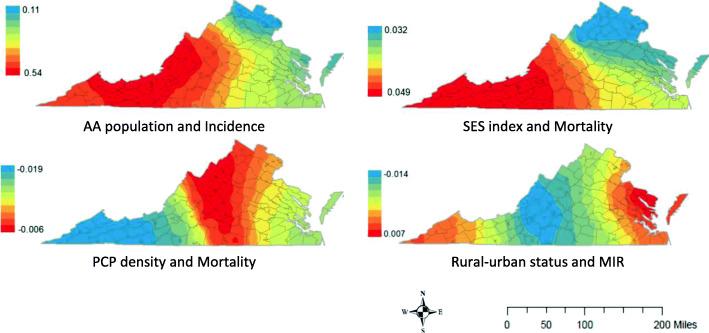
For incidence, one CRC hotspot and two cold spots were identified, including one large hotspot for MIR in southwest Virginia. In the spatial distribution of mortality, no clusters were found. Rurality and AA population were most associated with incidence. SES index, rurality, and PCP density were associated with spatial distribution of mortality. SES index and rurality were associated with MIR. Local coefficients indicated stronger associations of predictor variables in the southwestern region.
CONCLUSIONS
Rurality, low SES, and racial distribution were important predictors of CRC incidence, mortality, and MIR. Regions with concentrations of one or more factors of disparities face additional hurdles to improving CRC outcomes. A large cluster of high MIR in southwest Virginia region requires further investigation to improve early cancer detection and support survivorship. Spatial analysis can identify high-disparity populations and be used to inform targeted cancer control programming.
背景
结直肠癌(CRC)的差异因国家和人群群体而异,但通常具有空间特征。这项对美国弗吉尼亚州的研究评估了 CRC 的结果,并确定了导致 CRC 差异的人口统计学、社会经济和医疗保健获取因素。
方法
对 2011-2015 年 CRC 发病率、死亡率和死亡率-发病率比(MIR)的县和城市水平的横断面数据进行了分析,以确定地理上确定的聚类(热点和冷点)及其相关性。空间回归分析了包括非裔美国人(AA)居民比例、城乡状况、社会经济(SES)指数、CRC 筛查率以及初级保健提供者(PCP)和胃肠病学家密度在内的预测因子。通过地理加权回归评估了评估空间均等性的平稳性。
结果
对于发病率,确定了一个 CRC 热点和两个冷点,包括弗吉尼亚州西南部一个大的 MIR 热点。在死亡率的空间分布中,未发现聚类。农村地区和 AA 人口与发病率最相关。SES 指数、农村地区和 PCP 密度与死亡率的空间分布相关。SES 指数和农村地区与 MIR 相关。局部系数表明,在西南部地区,预测变量的相关性更强。
结论
农村地区、低 SES 和种族分布是 CRC 发病率、死亡率和 MIR 的重要预测因素。存在一个或多个差异因素的集中区域在改善 CRC 结果方面面临额外的障碍。弗吉尼亚州西南部地区一个 MIR 高的大型聚类需要进一步调查,以改善早期癌症检测并支持生存。空间分析可以识别高差异人群,并用于为有针对性的癌症控制规划提供信息。


 Zotero 插件