
2014 年至 2017 年伊朗南部地区乳腺癌和前列腺癌的时空分布。
Spatio-temporal mapping of breast and prostate cancers in South Iran from 2014 to 2017.
机构信息
Medical Informatics Research Center, Institute for Futures Studies in Health, Kerman University of Medical Sciences, Kerman, Iran.
Health Information Technology, School of Management and Medical Information Science, Kerman University of Medical Sciences, Kerman, Iran.
出版信息
BMC Cancer. 2020 Nov 30;20(1):1170. doi: 10.1186/s12885-020-07674-8.
BACKGROUND
The most common gender-specific malignancies are cancers of the breast and the prostate. In developing countries, cancer screening of all at risk is impractical because of healthcare resource limitations. Thus, determining high-risk areas might be an important first screening step. This study explores incidence patterns of potential high-risk clusters of breast and prostate cancers in southern Iran.
METHODS
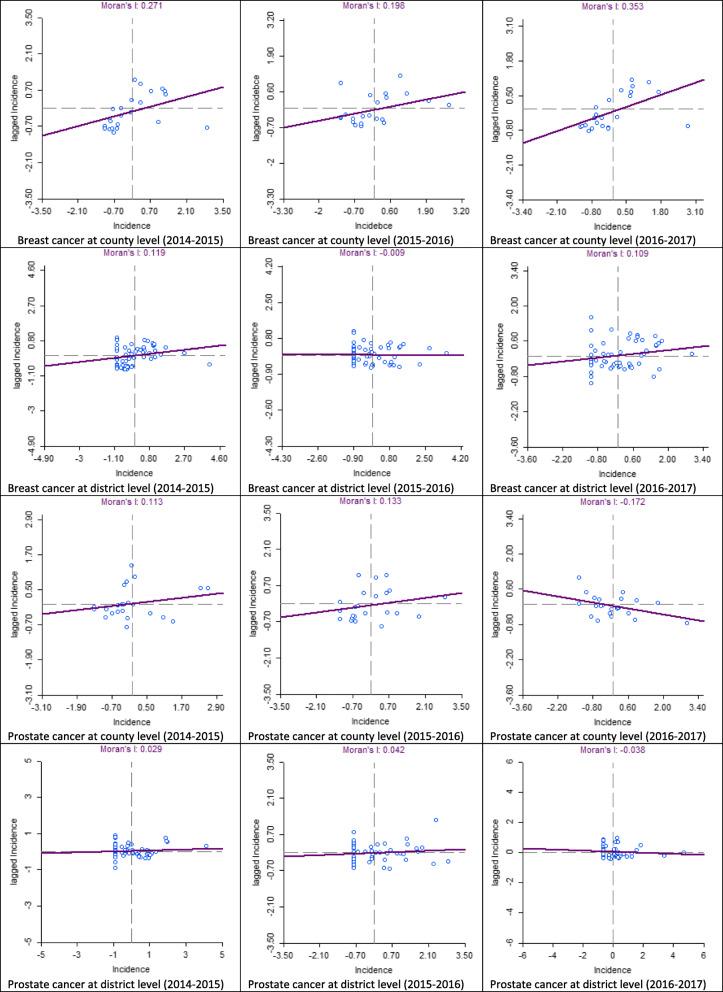
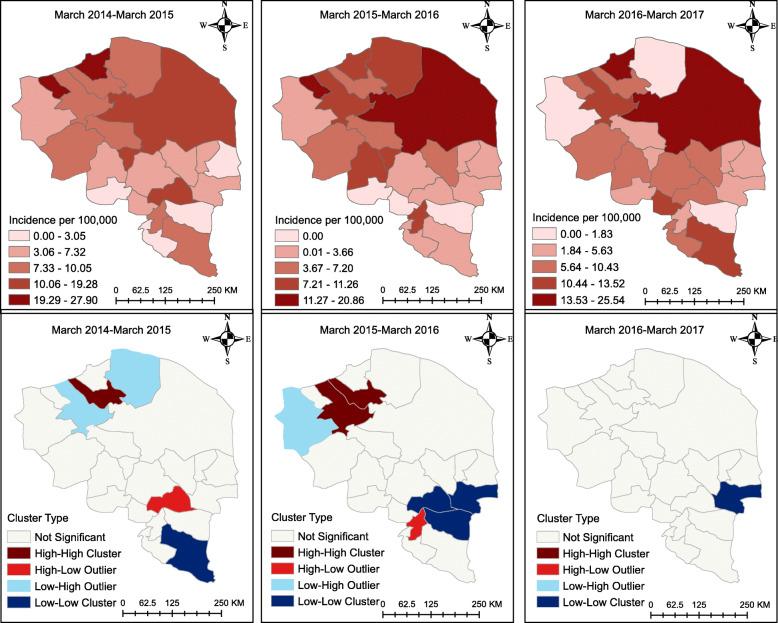
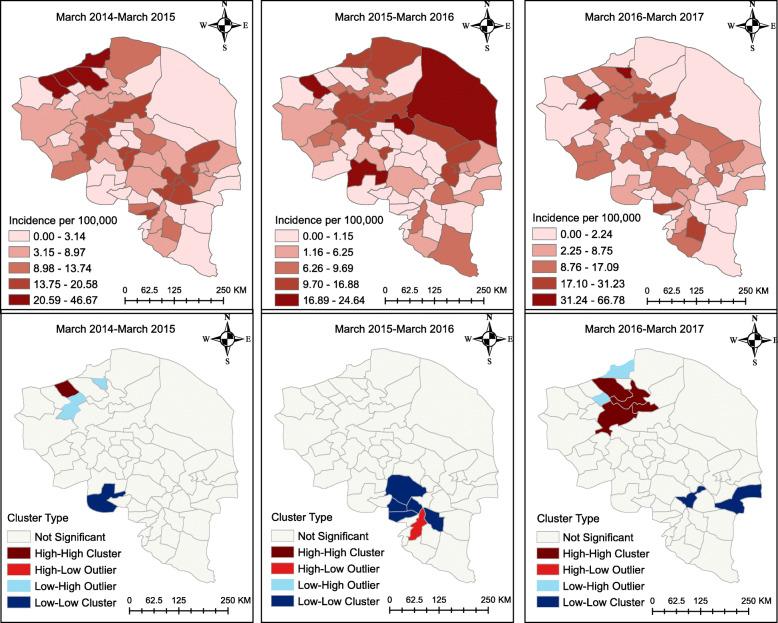
This cross-sectional study was conducted in the province of Kerman, South Iran. Patient data were aggregated at the county and district levels calculating the incidence rate per 100,000 people both for cancers of the breast and the prostate. We used the natural-break classification with five classes to produce descriptive maps. A spatial clustering analysis (Anselin Local Moran's I) was used to identify potential clusters and outliers in the pattern of these cancers from 2014 to 2017.
RESULTS
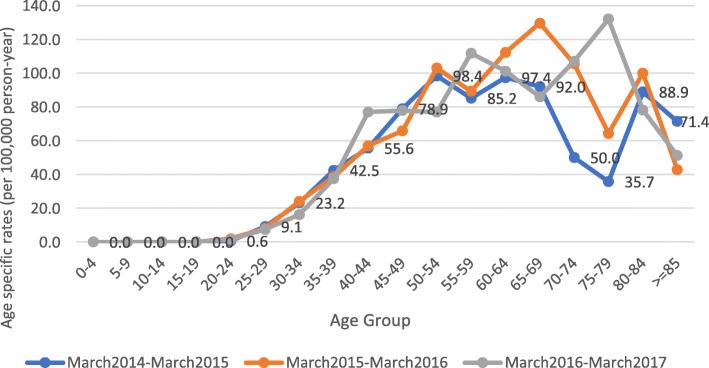
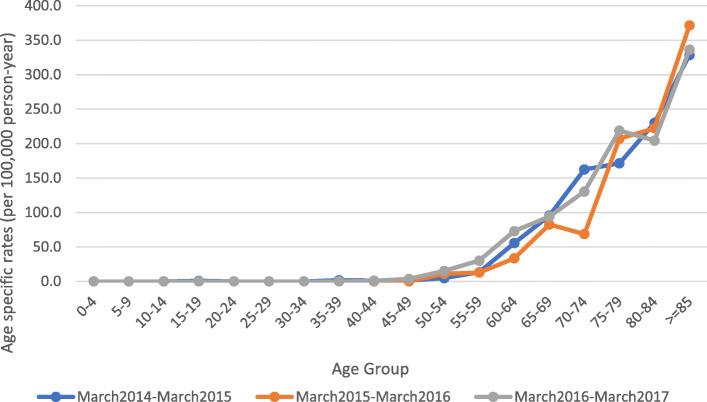
There were 1350 breast cancer patients (including, 42 male cases) and 478 prostate cancer patients in the province of Kerman, Iran during the study period. After 45 years of age, the number of men with diagnosed prostate cancer increased similarly to that of breast cancer for women after 25 years of age. The age-standardised incidence rate of breast cancer for women showed an increase from 29.93 to 32.27 cases per 100,000 people and that of prostate cancer from 13.93 to 15.47 cases per 100,000 during 2014-2017. Cluster analysis at the county level identified high-high clusters of breast cancer in the north-western part of the province for all years studied, but the analysis at the district level showed high-high clusters for only two of the years. With regard to prostate cancer, cluster analysis at the county and district levels identified high-high clusters in this area of the province for two of the study years.
CONCLUSIONS
North-western Kerman had a significantly higher incidence rate of both breast and prostate cancer than the average, which should help in designing tailored screening and surveillance systems. Furthermore, this study generates new hypotheses regarding the potential relationship between increased incidence of cancers in certain geographical areas and environmental risk factors.
背景
最常见的性别特异性恶性肿瘤是乳腺癌和前列腺癌。在发展中国家,由于医疗保健资源有限,对所有高危人群进行癌症筛查是不切实际的。因此,确定高风险地区可能是重要的第一步筛查。本研究探讨了伊朗南部乳腺癌和前列腺癌高危人群的发病模式。
方法
本横断面研究在伊朗南部克尔曼省进行。在县和区两级汇总患者数据,计算乳腺癌和前列腺癌每 10 万人的发病率。我们使用自然断裂分类法(五个类别)生成描述性地图。使用空间聚类分析(Anselin 局部 Moran's I)来识别 2014 年至 2017 年期间这些癌症模式中的潜在聚类和异常值。
结果
在研究期间,伊朗克尔曼省有 1350 名乳腺癌患者(包括 42 名男性病例)和 478 名前列腺癌患者。45 岁以后,男性确诊前列腺癌的人数与 25 岁以后女性乳腺癌的人数相似。女性乳腺癌的年龄标准化发病率从 2014 年至 2017 年从 29.93 例/10 万人增加到 32.27 例/10 万人,男性前列腺癌的发病率从 13.93 例/10 万人增加到 15.47 例/10 万人。县一级的聚类分析确定了该省西北部所有研究年份乳腺癌的高-高聚集区,但区一级的分析仅在两年的研究中显示出高-高聚集区。就前列腺癌而言,县和区一级的聚类分析在该省的这一地区确定了两个研究年份的高-高聚集区。
结论
克尔曼省西北部的乳腺癌和前列腺癌发病率明显高于平均水平,这有助于设计定制的筛查和监测系统。此外,本研究提出了关于某些地理区域癌症发病率增加与环境风险因素之间潜在关系的新假设。



 Zotero 插件