
与聚山梨醇酯80相比,乳化剂羧甲基纤维素在患有炎症性肠病微生物群的人源化小鼠中诱发更严重的结肠炎。
The Emulsifier Carboxymethylcellulose Induces More Aggressive Colitis in Humanized Mice with Inflammatory Bowel Disease Microbiota Than Polysorbate-80.
作者信息
Rousta Esmat, Oka Akihiko, Liu Bo, Herzog Jeremy, Bhatt Aadra P, Wang Jeremy, Habibi Najafi Mohammad B, Sartor Ryan Balfour
机构信息
Center for Gastrointestinal Biology and Disease, Division of Gastroenterology and Hepatology, School of Medicine, University of North Carolina at Chapel Hill, 111 Mason Farm Road, Chapel Hill, NC 27599, USA.
Department of Food Science and Technology, Faculty of Agriculture, Ferdowsi University of Mashhad, Mashhad 9177948974, Iran.
出版信息
Nutrients. 2021 Oct 12;13(10):3565. doi: 10.3390/nu13103565.
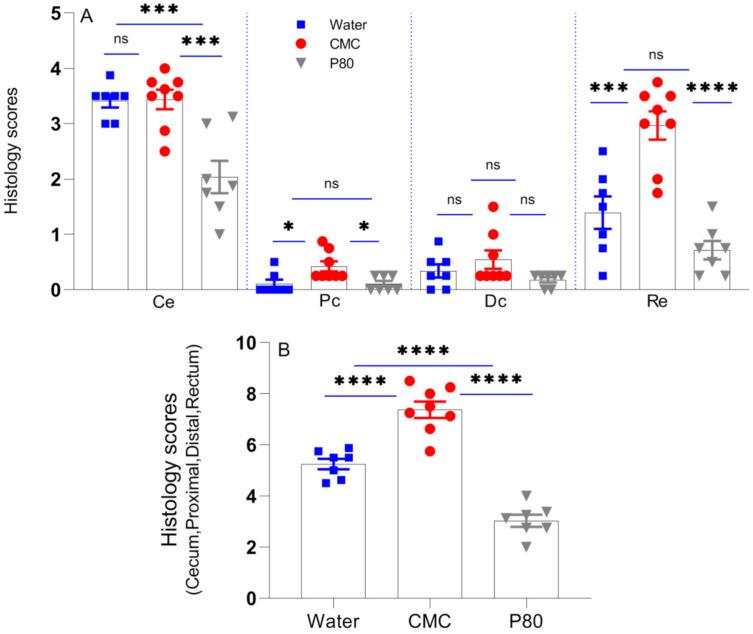
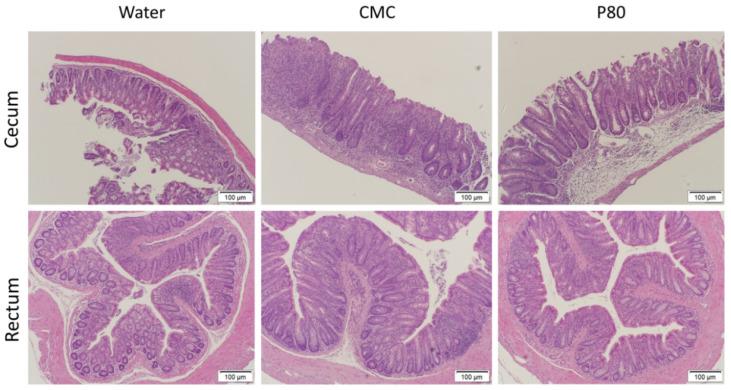
Commonly used synthetic dietary emulsifiers, including carboxymethylcellulose (CMC) and polysorbate-80 (P80), promote intestinal inflammation. We compared abilities of CMC vs. P80 to potentiate colitis and impact human microbiota in an inflammatory environment using a novel colitis model of ex-germ-free (GF) IL10 mice colonized by pooled fecal transplant from three patients with active inflammatory bowel diseases. After three days, mice received 1% CMC or P80 in drinking water or water alone for four weeks. Inflammation was quantified by serial fecal lipocalin 2 (Lcn-2) and after four weeks by blinded colonic histologic scores and colonic inflammatory cytokine gene expression. Microbiota profiles in cecal contents were determined by shotgun metagenomic sequencing. CMC treatment significantly increased fecal Lcn-2 levels compared to P80 and water treatment by one week and throughout the experiment. Likewise, CMC treatment increased histologic inflammatory scores and colonic inflammatory cytokine gene expression compared with P80 and water controls. The two emulsifiers differentially affected specific intestinal microbiota. CMC did not impact bacterial composition but significantly decreased Caudoviricetes (bacteriophages), while P80 exposure non-significantly increased the abundance of both Actinobacteria and Proteobacteria. Commonly used dietary emulsifiers have different abilities to induce colitis in humanized mice. CMC promotes more aggressive inflammation without changing bacterial composition.
常用的合成膳食乳化剂,包括羧甲基纤维素(CMC)和聚山梨酯80(P80),会促进肠道炎症。我们使用一种新型结肠炎模型,即对来自三名活动性炎症性肠病患者的粪便进行混合移植,使无菌(GF)IL10小鼠定殖,比较了CMC与P80在炎症环境中增强结肠炎和影响人类微生物群的能力。三天后,小鼠饮用含1% CMC或P80的水或只饮用普通水,持续四周。通过连续检测粪便中的脂质运载蛋白2(Lcn-2)来量化炎症,四周后通过盲法结肠组织学评分和结肠炎症细胞因子基因表达来评估。通过鸟枪法宏基因组测序确定盲肠内容物中的微生物群谱。与P80和水处理相比,CMC处理在一周及整个实验过程中显著提高了粪便Lcn-2水平。同样,与P80和水对照组相比,CMC处理增加了组织学炎症评分和结肠炎症细胞因子基因表达。这两种乳化剂对特定肠道微生物群有不同影响。CMC不影响细菌组成,但显著降低了有尾噬菌体目(噬菌体),而P80暴露则使放线菌和变形菌的丰度非显著增加。常用的膳食乳化剂在人源化小鼠中诱导结肠炎的能力不同。CMC在不改变细菌组成的情况下促进更严重的炎症。



 Zotero 插件