
六种干扰素调节因子家族成员在肺泡上皮细胞固有抗病毒反应中的比较分析。
Comparative Analysis of Six IRF Family Members in Alveolar Epithelial Cell-Intrinsic Antiviral Responses.
机构信息
Research Group "Dynamics of Viral Infection and the Innate Antiviral Response", Division F170, German Cancer Research Center (DKFZ), 69120 Heidelberg, Germany.
Faculty of Biosciences, Heidelberg University, 69120 Heidelberg, Germany.
出版信息
Cells. 2021 Sep 30;10(10):2600. doi: 10.3390/cells10102600.
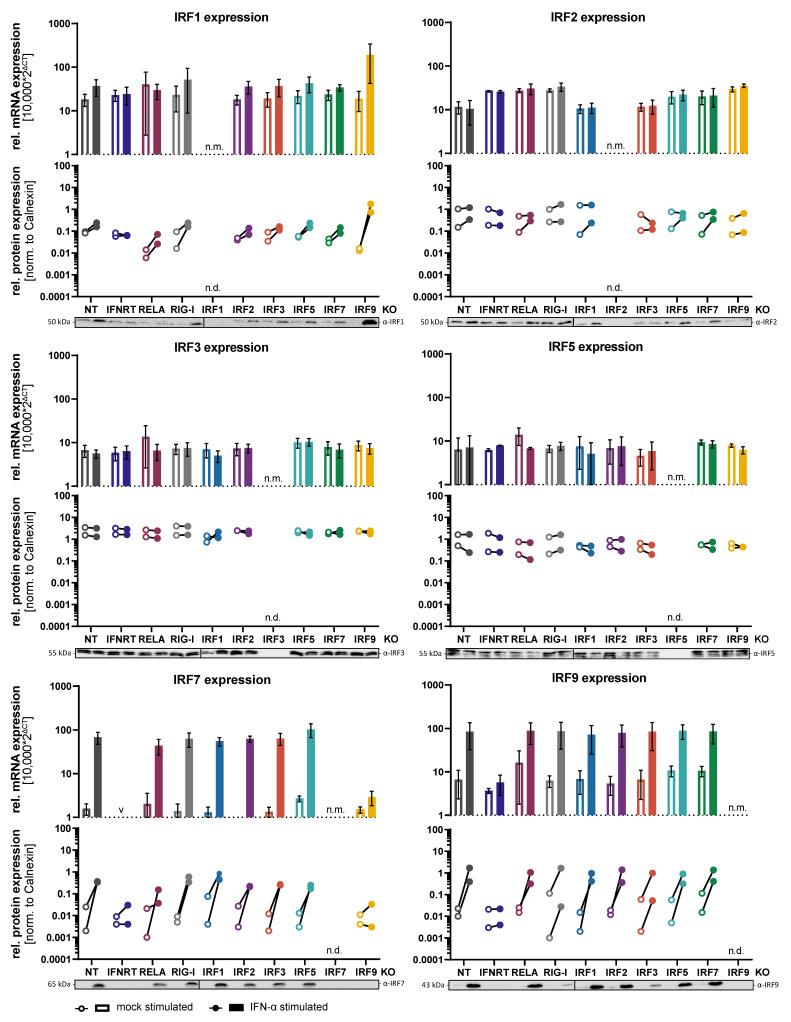
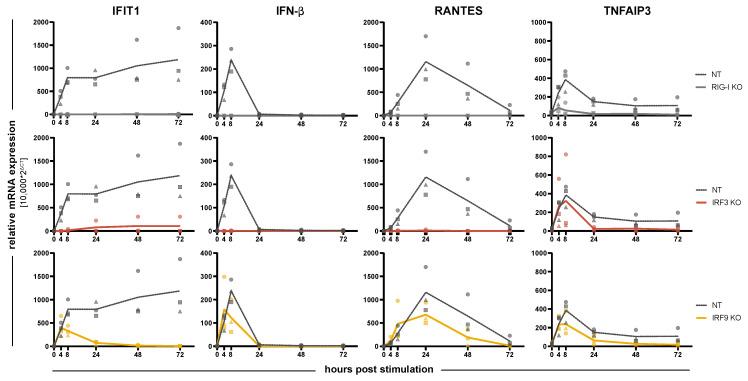
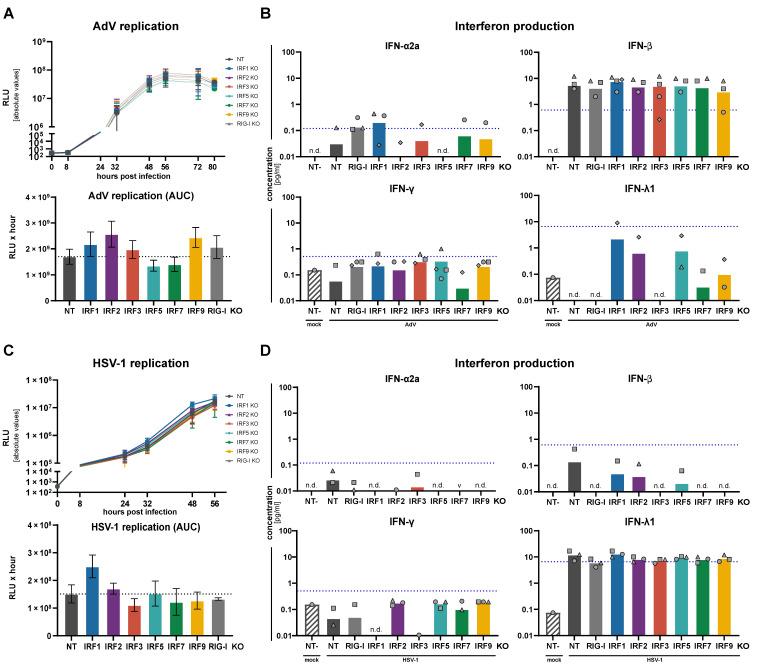
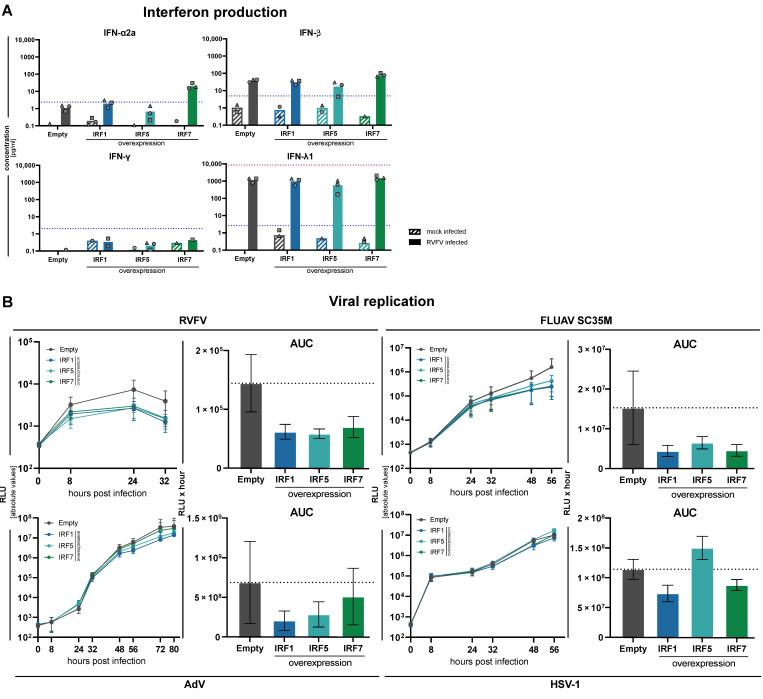
Host cell-intrinsic antiviral responses are largely mediated by pattern-recognition receptor (PRR) signaling and the interferon (IFN) system. The IFN regulatory factor (IRF) family of transcription factors takes up a central role in transcriptional regulation of antiviral innate immunity. IRF3 and IRF7 are known to be key players downstream of PRRs mediating the induction of type I and III IFNs. IFN signaling then requires IRF9 for the expression of the full array of interferon stimulated genes (ISGs) ultimately defining the antiviral state of the cell. Other members of the IRF family clearly play a role in mediating or modulating IFN responses, such as IRF1, IRF2 or IRF5, however their relative contribution to mounting a functional antiviral response is much less understood. In this study, we systematically and comparatively assessed the impact of six members of the IRF family on antiviral signaling in alveolar epithelial cells. We generated functional knockouts of IRF1, -2, -3, -5, -7, and -9 in A549 cells, and measured their impact on the expression of IFNs and further cytokines, ISGs and other IRFs, as well as on viral replication. Our results confirmed the vital importance of IRF3 and IRF9 in establishing an antiviral state, whereas IRF1, 5 and 7 were largely dispensable. The previously described inhibitory activity of IRF2 could not be observed in our experimental system.
宿主细胞固有抗病毒反应主要由模式识别受体 (PRR) 信号和干扰素 (IFN) 系统介导。干扰素调节因子 (IRF) 转录因子家族在抗病毒先天免疫的转录调控中起着核心作用。IRF3 和 IRF7 是已知的 PRR 介导 I 型和 III 型 IFN 诱导的关键下游因子。IFN 信号随后需要 IRF9 来表达干扰素刺激基因 (ISG) 的全套,最终定义细胞的抗病毒状态。IRF 家族的其他成员显然在介导或调节 IFN 反应中发挥作用,例如 IRF1、IRF2 或 IRF5,但它们对建立功能性抗病毒反应的相对贡献了解较少。在这项研究中,我们系统地和比较性地评估了 IRF 家族的六个成员对肺泡上皮细胞抗病毒信号的影响。我们在 A549 细胞中生成了 IRF1、IRF2、IRF3、IRF5、IRF7 和 IRF9 的功能性缺失突变体,并测量了它们对 IFN 和其他细胞因子、ISG 和其他 IRF 的表达以及病毒复制的影响。我们的结果证实了 IRF3 和 IRF9 在建立抗病毒状态中的至关重要性,而 IRF1、IRF5 和 IRF7 则在很大程度上是可有可无的。先前描述的 IRF2 的抑制活性在我们的实验系统中无法观察到。




 Zotero 插件