
生成羟基自由基激活型比率近红外双模探针,用于早期监测肿瘤对治疗的反应。
Generation of hydroxyl radical-activatable ratiometric near-infrared bimodal probes for early monitoring of tumor response to therapy.
机构信息
State Key Laboratory of Analytical Chemistry for Life Science, Chemistry and Biomedicine Innovation Center (ChemBIC), School of Chemistry and Chemical Engineering, Nanjing University, Nanjing, 210023, China.
Department of Chemistry, Faculty of Science, Hokkaido University, N10 W8, North-ward, Sapporo, 060-0810, Japan.
出版信息
Nat Commun. 2021 Oct 22;12(1):6145. doi: 10.1038/s41467-021-26380-y.
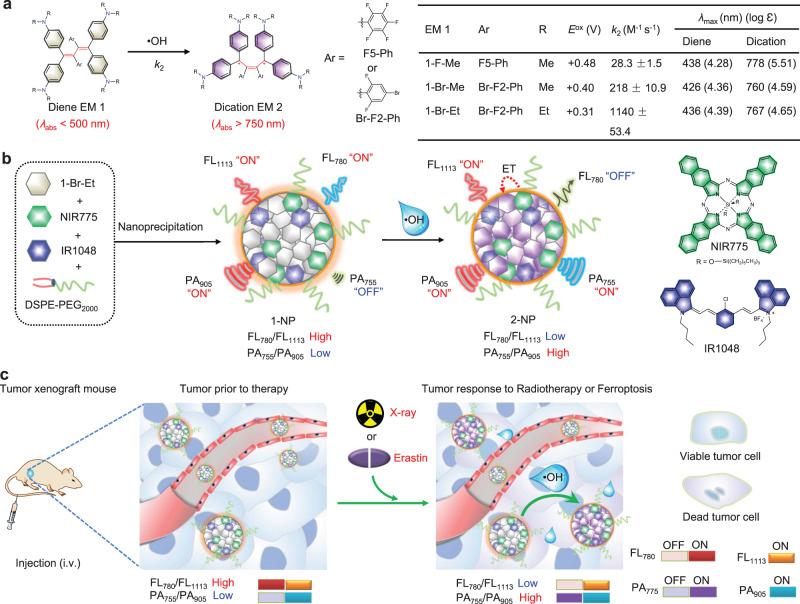
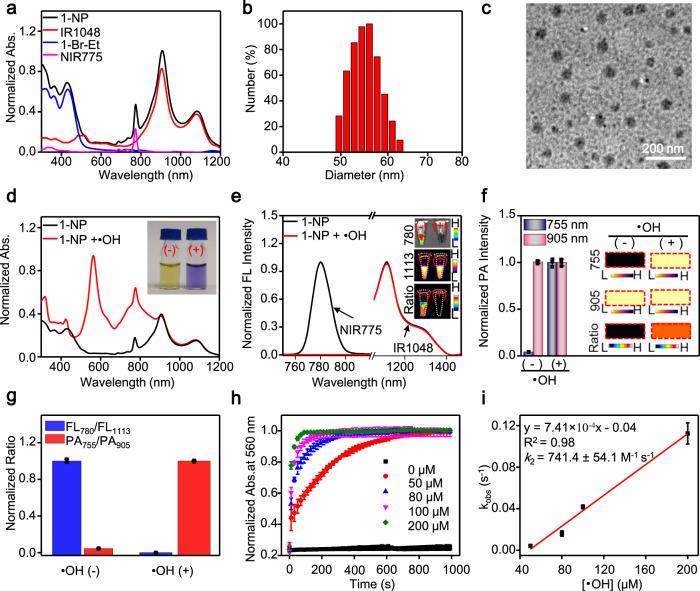
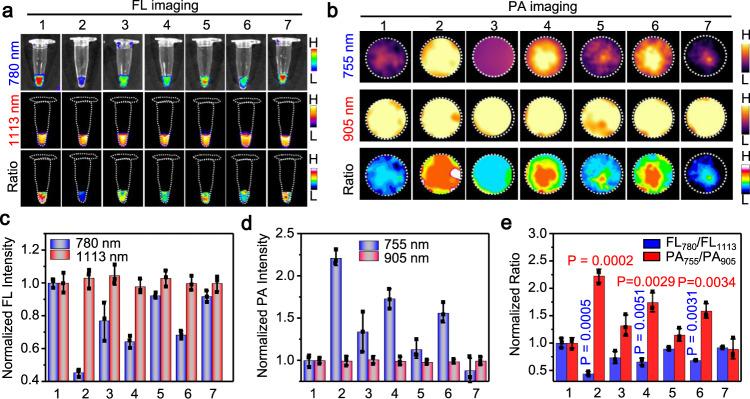
Tumor response to radiotherapy or ferroptosis is closely related to hydroxyl radical (•OH) production. Noninvasive imaging of •OH fluctuation in tumors can allow early monitoring of response to therapy, but is challenging. Here, we report the optimization of a diene electrochromic material (1-Br-Et) as a •OH-responsive chromophore, and use it to develop a near-infrared ratiometric fluorescent and photoacoustic (FL/PA) bimodal probe for in vivo imaging of •OH. The probe displays a large FL ratio between 780 and 1113 nm (FL/FL), but a small PA ratio between 755 and 905 nm (PA/PA). Oxidation of 1-Br-Et by •OH decreases the FL/FL while concurrently increasing the PA/PA, allowing the reliable monitoring of •OH production in tumors undergoing erastin-induced ferroptosis or radiotherapy.
肿瘤对放射治疗或铁死亡的反应与羟基自由基(•OH)的产生密切相关。非侵入性地对肿瘤中•OH 波动进行成像可以早期监测治疗反应,但具有挑战性。在这里,我们报告了二烯电致变色材料(1-Br-Et)作为•OH 响应性生色团的优化,并将其用于开发近红外比率荧光和光声(FL/PA)双模式探针,用于体内成像•OH。该探针在 780 和 1113nm 之间显示出较大的 FL 比(FL/FL),但在 755 和 905nm 之间显示出较小的 PA 比(PA/PA)。•OH 对 1-Br-Et 的氧化降低了 FL/FL,同时增加了 PA/PA,从而能够可靠地监测接受 erastin 诱导的铁死亡或放射治疗的肿瘤中•OH 的产生。



 Zotero 插件