
不同方法制备的用于生物医学应用的介孔硅纳米粒子:比较研究。
Mesoporous silica nanoparticles prepared by different methods for biomedical applications: Comparative study.
机构信息
Faculty of Engineering, Badr University in Cairo (BUC), Cairo, Egypt.
Refractories, Ceramics and Building Materials Department, National Research Centre, Giza, Egypt.
出版信息
IET Nanobiotechnol. 2021 May;15(3):291-300. doi: 10.1049/nbt2.12023. Epub 2021 Feb 22.
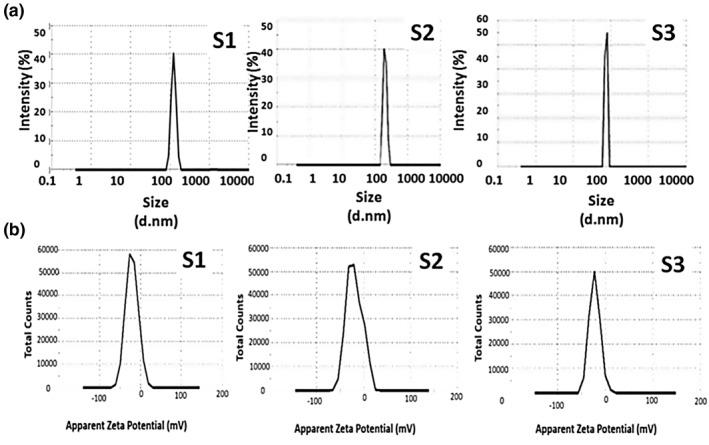
In the current investigation, mesoporous silica nanoparticles were obtained by various techniques, namely sol-gel (S1), micro-emulsion (S2) and hydrothermal synthesis (S3). The effect of those methods on the final features of the obtained mesoporous silica nanoparticles was studied. The obtained nanoparticles were investigated by TEM, BET surface area, Zetasizer, XRD and FTIR. The preparation method effect was evaluated on the drug release behaviour using doxycycline hyclate as a model drug. In addition, the degree of their compatibility against Saos-2 cell line was also determined. The morphology and microstructure of silica nanoparticles were found to be dependent on the utilised method. Those techniques produced particles with particle sizes of 50, 30-20 and 15 nm and also surface areas of 111.04, 164 and 538.72 m /g, respectively, for S1, S2 and S3. However, different preparation methods showed no remarkable changes for the physical and chemical integrities. The drug release test showed faster release from S2 compared with S1 and S3, which make them more applicable in cases require large doses for short periods. However, the release behaviour of S3 was satisfied for treatments which require long period with relatively highest release rate. The preparation method influenced the cell viability as S1 and S2 showed acceptable cell cytotoxicity compared with S3.
在当前的研究中,通过各种技术获得了介孔硅纳米粒子,分别为溶胶-凝胶法(S1)、微乳液法(S2)和水热合成法(S3)。研究了这些方法对所得到的介孔硅纳米粒子最终特性的影响。通过 TEM、BET 比表面积、Zetasizer、XRD 和 FTIR 对所得到的纳米粒子进行了研究。使用盐酸多西环素作为模型药物,评估了制备方法对药物释放行为的影响。此外,还确定了它们对 Saos-2 细胞系的相容性程度。发现硅纳米粒子的形态和微观结构取决于所使用的方法。这些技术分别产生了粒径为 50、30-20 和 15nm,比表面积为 111.04、164 和 538.72m2/g 的颗粒,用于 S1、S2 和 S3。然而,不同的制备方法对物理和化学完整性没有显著的变化。药物释放试验表明,与 S1 和 S3 相比,S2 的释放速度更快,这使得它们更适用于需要短时间内大剂量的情况。然而,S3 的释放行为满足了需要长时间相对较高释放率的治疗需求。制备方法影响细胞活力,S1 和 S2 与 S3 相比表现出可接受的细胞细胞毒性。




 Zotero 插件