
引起物体向量细胞活动的视觉刺激特征。
Visual stimulus features that elicit activity in object-vector cells.
机构信息
Kavli Institute for Systems Neuroscience and Centre for Neural Computation, Norwegian University of Science and Technology (NTNU), Trondheim, Norway.
出版信息
Commun Biol. 2021 Oct 25;4(1):1219. doi: 10.1038/s42003-021-02727-5.
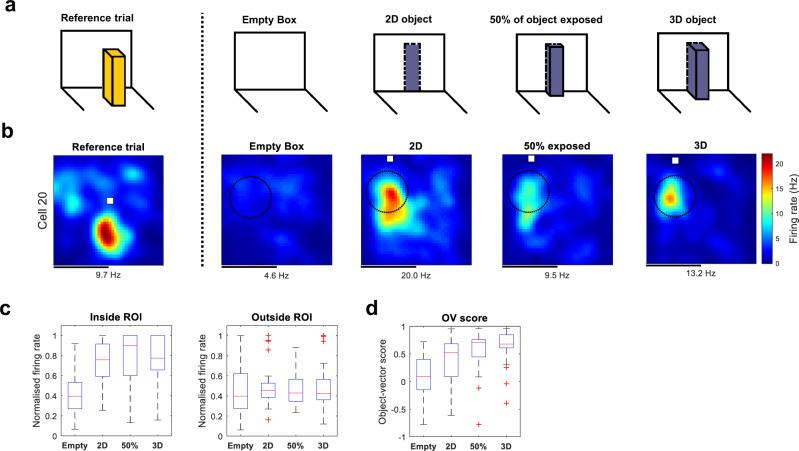
Object-vector (OV) cells are cells in the medial entorhinal cortex (MEC) that track an animal's distance and direction to objects in the environment. Their firing fields are defined by vectorial relationships to free-standing 3-dimensional (3D) objects of a variety of identities and shapes. However, the natural world contains a panorama of objects, ranging from discrete 3D items to flat two-dimensional (2D) surfaces, and it remains unclear what are the most fundamental features of objects that drive vectorial responses. Here we address this question by systematically changing features of experimental objects. Using an algorithm that robustly identifies OV firing fields, we show that the cells respond to a variety of 2D surfaces, with visual contrast as the most basic visual feature to elicit neural responses. The findings suggest that OV cells use plain visual features as vectorial anchoring points, allowing vector-guided navigation to proceed in environments with few free-standing landmarks.
物体-矢量 (OV) 细胞是内嗅皮层 (MEC) 中的细胞,它们追踪动物在环境中对物体的距离和方向。它们的发射场是通过与各种身份和形状的独立 3 维 (3D) 物体的矢量关系来定义的。然而,自然界包含了一系列物体,从离散的 3D 物品到平面的 2 维 (2D) 表面,目前尚不清楚是什么是驱动矢量响应的最基本的物体特征。在这里,我们通过系统地改变实验物体的特征来解决这个问题。使用一种能够稳健地识别 OV 发射场的算法,我们表明这些细胞对各种 2D 表面做出反应,视觉对比度是最基本的视觉特征,可以引起神经反应。研究结果表明,OV 细胞使用简单的视觉特征作为矢量锚定点,允许在没有独立地标物的环境中进行基于矢量的导航。




 Zotero 插件