
没食子儿茶素没食子酸酯通过提高自噬相关蛋白 4C 的表达来保护心肌细胞免受缺氧复氧损伤。
Epigallocatechin-3-gallate protects cardiomyocytes from hypoxia-reoxygenation damage via raising autophagy related 4C expression.
机构信息
Clinical Nursing Teaching and Research Section, The Second Xiangya Hospital, Central South University, Changsha, China.
Department of Pediatric Neurology and Cardiovasology, Children's Medical Center, The Second Xiangya Hospital, Central South University, Changsha, China.
出版信息
Bioengineered. 2021 Dec;12(2):9496-9506. doi: 10.1080/21655979.2021.1996018.
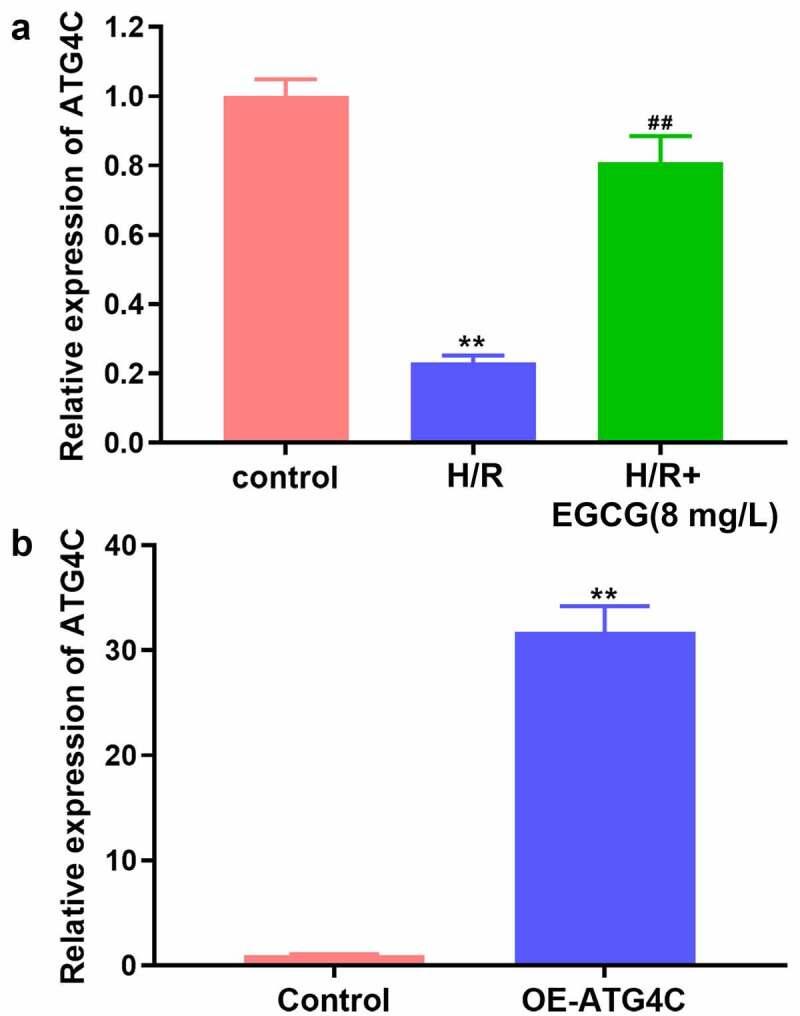
Myocardial ischemia/reperfusion (I/R) injury is a serious issue during the therapy of myocardial infarction. Herein, we explored the beneficial influence of Epigallocatechin-3-gallate (EGCG) on hypoxia/reoxygenation (H/R)-stimulated cardiomyocyte H9c2 cells damage, along with possible internal molecular mechanism related autophagy related 4C (ATG4C). H9c2 cells were subjected to H/R stimulation and/or EGCG treatment. ATG4C mRNA expression was measured via q-PCR assay. ATG4C overexpression plasmid (OE-ATG4C) was transfected to arise ATG4C level. Cell viability, apoptosis, reactive oxygen species (ROS) production, ATP level were tested via CCK-8 assay, Annexin V-FITC/PI staining, DCFH-DA staining and ATP Assay Kit, respectively. Western blotting was performed to test Cleaved-caspase 3, Cleaved-caspase 9, cytochrome C, and LC3B protein levels. H/R stimulation resulted in H9c2 cell viability loss, promoted cell apoptosis, and ROS overproduction, as well as lowered ATP level in cells. EGCG treatment alleviated H/R-resulted H9c2 cell viability loss, cell apoptosis, ROS overproduction, and reduction of ATP level. Moreover, H/R stimulation reduced the ATG4C expression in H9c2 cells, while EGCG raised the ATG4C expression. Overexpression of ATG4C strengthened the beneficial influence of EGCG on H/R-stimulated H9c2 cell viability, apoptosis and ROS production. Besides, ATG4C overexpression weakened the H/R-stimulated H9c2 cell autophagy via reducing LC3B II/I expression. EGCG exerted beneficial influence on H/R-stimulated cardiomyocytes, which protected cardiomyocytes from H/R-stimulated viability loss, apoptosis, and ROS overproduction via enhancing ATG4C expression.
心肌缺血/再灌注(I/R)损伤是心肌梗死治疗中的一个严重问题。在此,我们探讨了表没食子儿茶素没食子酸酯(EGCG)对缺氧/复氧(H/R)刺激的心肌细胞 H9c2 损伤的有益影响,以及可能与自噬相关的 4C(ATG4C)相关的内部分子机制。将 H9c2 细胞进行 H/R 刺激和/或 EGCG 处理。通过 q-PCR 测定测定 ATG4C mRNA 表达。转染 ATG4C 过表达质粒(OE-ATG4C)以提高 ATG4C 水平。通过 CCK-8 测定、Annexin V-FITC/PI 染色、DCFH-DA 染色和 ATP 测定试剂盒分别测试细胞活力、细胞凋亡、活性氧(ROS)产生和 ATP 水平。通过 Western blot 测定测定 Cleaved-caspase 3、Cleaved-caspase 9、细胞色素 C 和 LC3B 蛋白水平。H/R 刺激导致 H9c2 细胞活力丧失,促进细胞凋亡和 ROS 过度产生,并降低细胞中的 ATP 水平。EGCG 处理减轻了 H/R 引起的 H9c2 细胞活力丧失、细胞凋亡、ROS 过度产生和 ATP 水平降低。此外,H/R 刺激降低了 H9c2 细胞中的 ATG4C 表达,而 EGCG 提高了 ATG4C 表达。过表达 ATG4C 增强了 EGCG 对 H/R 刺激的 H9c2 细胞活力、凋亡和 ROS 产生的有益影响。此外,ATG4C 过表达通过降低 LC3B II/I 表达减弱了 H/R 刺激的 H9c2 细胞自噬。EGCG 对 H/R 刺激的心肌细胞发挥有益作用,通过增强 ATG4C 表达来保护心肌细胞免受 H/R 刺激引起的活力丧失、凋亡和 ROS 过度产生。


 Zotero 插件