
从家禽部门回收的携带可移动黏菌素耐药性()基因的细菌的潜在来源和特征性出现情况:针对高收入国家的文献综述
Potential sources and characteristic occurrence of mobile colistin resistance () gene-harbouring bacteria recovered from the poultry sector: a literature synthesis specific to high-income countries.
作者信息
Anyanwu Madubuike Umunna, Jaja Ishmael Festus, Okpala Charles Odilichukwu R, Jaja Chinwe-Juliana Iwu, Oguttu James Wabwire, Chah Kennedy Foinkfu, Shoyinka Vincent Shodeinde
机构信息
Department of Veterinary Pathology and Microbiology, University of Nigeria, Nsukka, Nsukka, Enugu, Nigeria.
Livestock and Pasture Science, University of Fort Hare, Alice, Eastern Cape, South Africa.
出版信息
PeerJ. 2021 Oct 5;9:e11606. doi: 10.7717/peerj.11606. eCollection 2021.
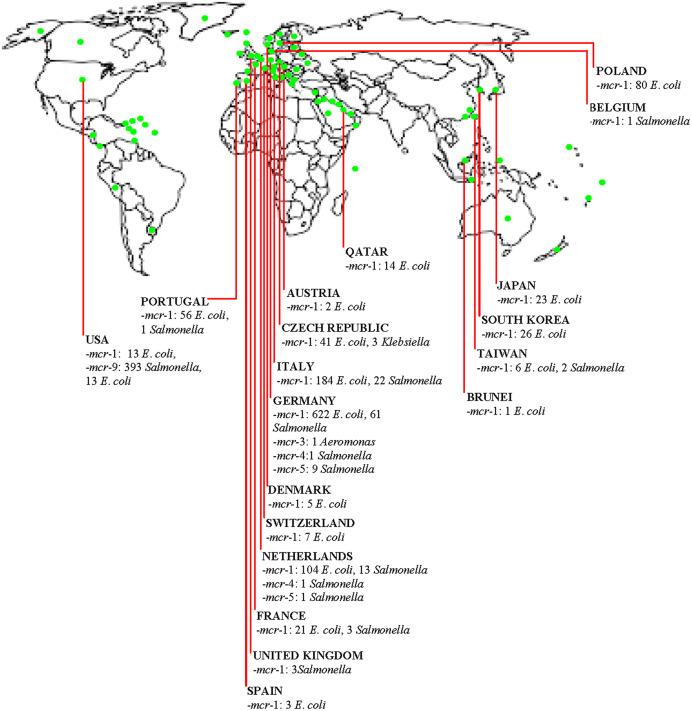
Understanding the sources, prevalence, phenotypic and genotypic characteristics of gene-harbouring bacteria (MGHB) in the poultry sector is crucial to supplement existing information. Through this, the plasmid-mediated colistin resistance (PMCR) could be tackled to improve food safety and reduce public health risks. Therefore, we conducted a literature synthesis of potential sources and characteristic occurrence of MGHB recovered from the poultry sector specific to the high-income countries (HICs). Colistin (COL) is a last-resort antibiotic used for treating deadly infections. For more than 60 years, COL has been used in the poultry sector globally, including the HICs. The emergence and rapid spread of mobile COL resistance () genes threaten the clinical use of COL. Currently, ten genes (-1 to -10) have been described. By horizontal and vertical transfer, the -1, -2, -3, -4, -5, and -9 genes have disseminated in the poultry sector in HICs, thus posing a grave danger to animal and human health, as harboured by , , species, and isolates. Conjugative and non-conjugative plasmids are the major backbones for in poultry isolates from HICs. The -1, -3 and -9 have been integrated into the chromosome, making them persist among the clones. Transposons, insertion sequences (IS), especially IS located downstream and upstream of , and integrons also drive the COL resistance in isolates recovered from the poultry sector in HICs. Genes coding multi-and extensive-drug resistance and virulence factors are often co-carried with on chromosome and plasmids in poultry isolates. Transmission of to/among poultry strains in HICs is clonally unrestricted. Additionally, the contact with poultry birds, manure, meat/egg, farmer's wears/farm equipment, consumption of contaminated poultry meat/egg and associated products, and trade of poultry-related products continue to serve as transmission routes of MGHB in HICs. Indeed, the policymakers, especially those involved in antimicrobial resistance and agricultural and poultry sector stakeholders-clinical microbiologists, farmers, veterinarians, occupational health clinicians and related specialists, consumers, and the general public will find this current literature synthesis very useful.
了解家禽业中携带基因的细菌(MGHB)的来源、流行情况、表型和基因型特征对于补充现有信息至关重要。通过这样做,可以应对质粒介导的黏菌素耐药性(PMCR),以提高食品安全并降低公共卫生风险。因此,我们对从高收入国家(HICs)家禽业中分离出的MGHB的潜在来源和特征出现情况进行了文献综述。黏菌素(COL)是用于治疗致命感染的最后一道防线抗生素。60多年来,COL一直在全球家禽业中使用,包括在HICs。移动性COL耐药()基因的出现和迅速传播威胁着COL的临床应用。目前,已经描述了10个基因(-1至-10)。通过水平和垂直转移,-1、-2、-3、-4、-5和-9基因已在HICs的家禽业中传播,因此对动物和人类健康构成严重危险,如、、物种和分离株所携带的那样。接合质粒和非接合质粒是HICs家禽分离株中耐药基因的主要载体。-1、-3和-9已整合到染色体中,使其在克隆中持续存在。转座子、插入序列(IS),特别是位于耐药基因下游和上游的IS,以及整合子也推动了从HICs家禽业中分离出的菌株中的COL耐药性。编码多重和广泛耐药性以及毒力因子的基因通常与家禽分离株染色体和质粒上的耐药基因共同携带。HICs家禽菌株之间的耐药基因传播不受克隆限制。此外,与家禽、粪便、肉/蛋、农民穿着/农场设备的接触、食用受污染的家禽肉/蛋及相关产品以及家禽相关产品的贸易继续作为HICs中MGHB的传播途径。事实上,政策制定者,尤其是那些参与抗菌药物耐药性的人员以及农业和家禽业利益相关者——临床微生物学家、农民、兽医、职业健康临床医生和相关专家、消费者以及普通公众,将会发现这份当前的文献综述非常有用。
 Zotero 插件