
急性精神卫生保健的居家治疗:居家治疗的财务产出、风险、疗效、满意度指数及守门作用研究(FORESIGHT研究)方案
Home Treatment for Acute Mental Health Care: Protocol for the Financial Outputs, Risks, Efficacy, Satisfaction Index and Gatekeeping of Home Treatment (FORESIGHT) Study.
作者信息
Levati Sara, Mellacqua Zefiro, Caiata-Zufferey Maria, Soldini Emiliano, Albanese Emiliano, Alippi Maddalena, Bolla Emilio, Colombo Raffaella Ada, Cordasco Severino, Kawohl Wolfram, Larghi Giuseppina, Lisi Angela, Lucchini Mario, Rossa Simona, Traber Rafael, Crivelli Luca
机构信息
Competence Centre for Healthcare Practices and Policies, Department of Business Economics, Health and Social Care, University of Applied Sciences and Arts of Southern Switzerland, Manno, Switzerland.
Organizzazione sociopsichiatrica cantonale, Mendrisio, Switzerland.
出版信息
JMIR Res Protoc. 2021 Nov 9;10(11):e28191. doi: 10.2196/28191.
BACKGROUND
Crisis Resolution and Home Treatment (CRHT) teams represent a community-based mental health service offering a valid alternative to hospitalization. CRHT teams have been widely implemented in various mental health systems worldwide, and their goal is to provide care for people with severe acute mental disorders who would be considered for admission to acute psychiatric wards. The evaluation of several home-treatment experiences shows promising results; however, it remains unclear which specific elements and characteristics of CRHT are more effective and acceptable.
OBJECTIVE
This study aims to assess the acceptability, effectiveness, and cost-effectiveness of a new CRHT intervention in Ticino, Southern Switzerland.
METHODS
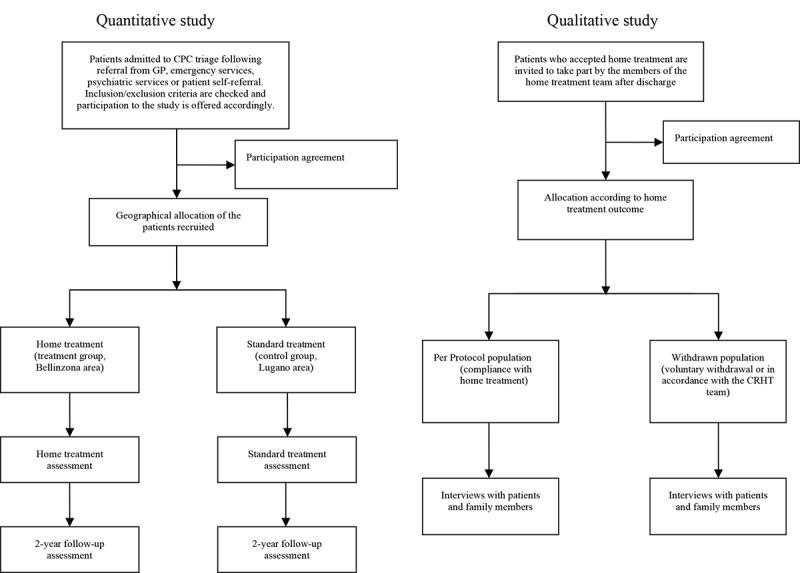
This study includes an interventional, nonrandomized, quasi-experimental study combined with a qualitative study and an economic evaluation to be conducted over a 48-month period. The quasi-experimental evaluation involves two groups: patients in the northern area of the region who were offered the CRHT service (ie, intervention group) and patients in the southern area of the region who received care as usual (ie, control group). Individual interviews will be conducted with patients receiving the home treatment intervention and their family members. CRHT members will also be asked to participate in a focus group. The economic evaluation will include a cost-effectiveness analysis.
RESULTS
The project is funded by the Swiss National Science Foundation as part of the National Research Program NRP74 for a period of 48 months starting from January 2017. As of October 2021, data for the nonrandomized, quasi-experimental study and the qualitative study have been collected, and the results are expected to be published by the end of the year. Data are currently being collected for the economic evaluation.
CONCLUSIONS
Compared to other Swiss CRHT experiences, the CRHT intervention in Ticino represents a unique case, as the introduction of the service is backed by the closing of one of its acute wards. The proposed study will address several areas where there are evidence gaps or contradictory findings relating to the home treatment of acute mental crisis. Findings from this study will allow local services to improve their effectiveness in a challenging domain of public health and contribute to improving access to more effective care for people with severe mental disorders.
TRIAL REGISTRATION
ISRCTN registry ISRCTN38472626; https://www.isrctn.com/ISRCTN38472626.
INTERNATIONAL REGISTERED REPORT IDENTIFIER (IRRID): DERR1-10.2196/28191.
背景
危机解决与家庭治疗(CRHT)团队是一种基于社区的心理健康服务,为住院治疗提供了一种有效的替代方案。CRHT团队已在全球各种心理健康系统中广泛实施,其目标是为那些会被考虑收治到急性精神科病房的严重急性精神障碍患者提供护理。对几种家庭治疗经验的评估显示出了有希望的结果;然而,CRHT的哪些具体要素和特征更有效且更易被接受仍不清楚。
目的
本研究旨在评估瑞士南部提契诺州一种新的CRHT干预措施的可接受性、有效性和成本效益。
方法
本研究包括一项干预性、非随机、准实验研究,同时结合一项定性研究和一项将在48个月内进行的经济评估。准实验评估涉及两组:该地区北部接受CRHT服务的患者(即干预组)和该地区南部接受常规护理的患者(即对照组)。将对接受家庭治疗干预的患者及其家庭成员进行个体访谈。CRHT成员也将被要求参加一个焦点小组。经济评估将包括成本效益分析。
结果
该项目由瑞士国家科学基金会资助,作为国家研究计划NRP74的一部分,从2017年1月开始为期48个月。截至2021年10月,非随机、准实验研究和定性研究的数据已收集完成,结果预计在年底公布。目前正在收集经济评估的数据。
结论
与瑞士其他CRHT经验相比,提契诺州的CRHT干预是一个独特的案例,因为该服务的引入是在关闭了其一个急性病房的背景下进行的。拟议的研究将解决几个与急性精神危机家庭治疗相关的证据空白或相互矛盾的发现的领域。本研究的结果将使当地服务机构在公共卫生这一具有挑战性的领域提高其有效性,并有助于改善为严重精神障碍患者提供更有效护理的可及性。
试验注册
ISRCTN注册库ISRCTN38472626;https://www.isrctn.com/ISRCTN38472626。
国际注册报告识别码(IRRID):DERR1-10.2196/28191。
 Zotero 插件