
急性精神危机管理中危机解决家庭治疗的患者满意度及结果:马德里新冠疫情期间的一项研究
Patient satisfaction and outcomes of crisis resolution home treatment for the management of acute psychiatric crises: a study during the COVID-19 pandemic in Madrid.
作者信息
Moreno-Alonso Irene, Nieves-Carnicer Manuel, Noguero-Alegre Alexandra, Alvarez-Mon Miguel Angel, Rodriguez-Quiroga Alberto, Dorado Juan F, Mora Fernando, Quintero Javier
机构信息
Department of Psychiatry and Mental Health, Hospital Universitario Infanta Leonor, Madrid, Spain.
Department of Medicine and Medical Specialities, University of Alcala, Alcala de Henares, Madrid, Spain.
出版信息
Front Psychiatry. 2023 Sep 5;14:1197833. doi: 10.3389/fpsyt.2023.1197833. eCollection 2023.
BACKGROUND
Crisis Resolution Home Treatment (CRHT) seem to offer comparable results to the traditional hospitalization model, at a lower cost and offering greater flexibility and scope. However, in Madrid, its implementation in Mental Health did not occur until the midst of the COVID-19 pandemic. In this work we analysed the effectiveness of a mental health CRHT unit promoted during the COVID-19 pandemic, as well as the degree of satisfaction of patients and their families.
METHODS
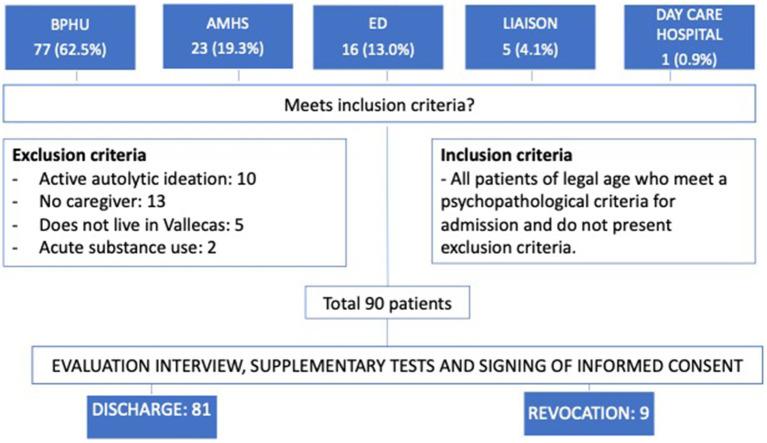
90 patients were treated by the CRHT unit in the period between October 2020 and June 2022. All patients met the inclusion criteria: (1) Acute psychopathological decompensation in patients suffering from psychotic disorders, major affective disorder, obsessive compulsive disorder, personality disorder and other severe mental disorders causing functional disability, according to ICD-10 diagnostic criteria; (2) Ages between 18-90 years old; (3) Living in the urban area of Vallecas, Madrid; and (4) Counting with sufficient social and family support. The effectiveness of the intervention was evaluated with the SF-36 health questionnaire, the caregiver burden with the Zarit questionnaire, and patient satisfaction with a survey specifically designed for this work.
RESULTS
55 (61.1%) patients completed the SF-36 at baseline and at the end of hospitalization. Statistically significant improvements were observed in the 8 dimensions of the SF-36 ( < 0.05). However, CRHT did not achieve a statistically significant decrease in caregiver burden. Regarding the satisfaction of the patients with the attention and care received, an average score of 47.72/50 was obtained.
CONCLUSION
The Crisis Resolution Home Treatment intervention resulted in significant improvement in patients' quality of life with high satisfaction scores. However, it did not effectively reduce caregiver burden. Future research should focus on randomized controlled trials with long-term follow-up to assess the effectiveness of CRHT compared to traditional hospitalization and utilize specific assessment scales for different mental disorders.
背景
危机解决家庭治疗(CRHT)似乎能产生与传统住院治疗模式相当的效果,且成本更低,灵活性和范围更大。然而,在马德里,直到新冠疫情期间,其在心理健康领域才得以实施。在这项研究中,我们分析了新冠疫情期间一个心理健康CRHT单元的有效性,以及患者及其家属的满意度。
方法
2020年10月至2022年6月期间,CRHT单元对90名患者进行了治疗。所有患者均符合纳入标准:(1)根据国际疾病分类第10版(ICD-10)诊断标准,患有精神分裂症、重度情感障碍、强迫症、人格障碍及其他导致功能残疾的严重精神障碍的患者出现急性精神病理失代偿;(2)年龄在18至90岁之间;(3)居住在马德里巴列卡斯市区;(4)有足够的社会和家庭支持。采用SF-36健康问卷评估干预效果,采用扎里特问卷评估照顾者负担,并通过专门为此项研究设计的调查评估患者满意度。
结果
55名(61.1%)患者在基线期和住院结束时完成了SF-36问卷。SF-36问卷的8个维度均有统计学意义的改善(<0.05)。然而,CRHT并未使照顾者负担在统计学上显著降低。关于患者对所接受护理的满意度,平均得分为47.72/50。
结论
危机解决家庭治疗干预显著改善了患者的生活质量,满意度得分较高。然而,它并未有效减轻照顾者负担。未来的研究应侧重于长期随访的随机对照试验,以评估CRHT与传统住院治疗相比的有效性,并针对不同精神障碍使用特定的评估量表。
 Zotero 插件