
新冠疫情无需封锁措施就能导致就业岗位减少:韩国局部疫情的影响。
COVID-19 doesn't need lockdowns to destroy jobs: The effect of local outbreaks in Korea.
作者信息
Aum Sangmin, Lee Sang Yoon Tim, Shin Yongseok
机构信息
Myongji University, Republic of Korea.
Queen Mary University of London, Toulouse School of Economics and CEPR, France.
出版信息
Labour Econ. 2021 Jun;70:101993. doi: 10.1016/j.labeco.2021.101993. Epub 2021 Apr 30.
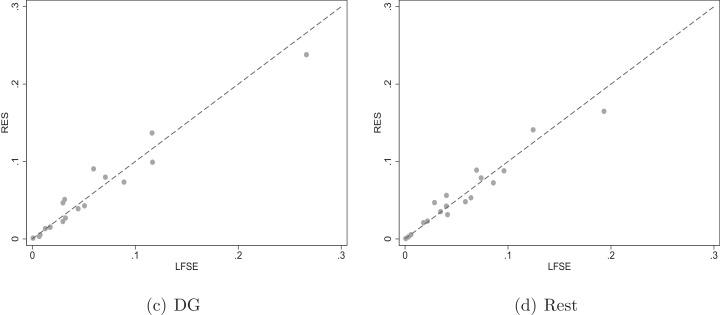
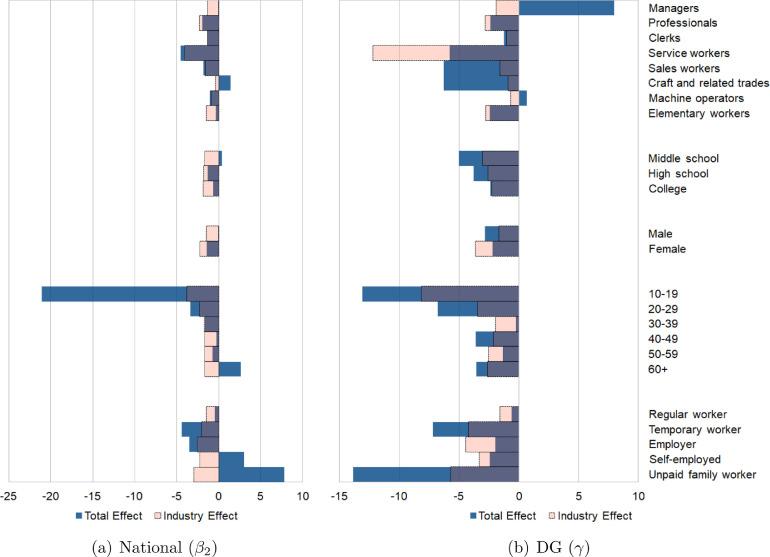
Unlike most countries, Korea did not implement a lockdown in its battle against COVID-19, instead successfully relying on testing and contact tracing. Until the summer of 2020, only one region, Daegu-Gyeongbuk, had a significant number of infections, traced to a religious sect. This allows us to estimate the causal effect of the outbreak on the labor market using difference-in-differences. We find that a one per thousand increase in infections caused a 2 to 3 percent drop in local employment in the early spring. We also find that employment losses caused by local outbreaks in the absence of lockdowns were (i) mainly due to reduced hiring by small establishments, (ii) concentrated in the accommodation/food, education, real estate, and transportation industries, and (iii) worst for economically vulnerable workers who are less educated, young, in low-wage occupations, and on temporary contracts, even controlling for industry effects. These patterns are similar to what we observed in the US and UK: The unequal effects of COVID-19 were the same with or without lockdowns. Our findings are consistent with the lifting of lockdowns having led to only modest employment recoveries in the US and UK, absent larger drops in infection rates.
与大多数国家不同,韩国在抗击新冠疫情的过程中并未实施封锁措施,而是成功依靠检测和接触者追踪。直到2020年夏天,只有大邱-庆北这一个地区出现了大量感染病例,源头是一个宗教团体。这使我们能够运用双重差分法来估计疫情对劳动力市场的因果效应。我们发现,在早春时节,感染率每上升千分之一,当地的就业率就会下降2%至3%。我们还发现,在没有实施封锁的情况下,当地疫情导致的就业损失:(i)主要是由于小机构减少了招聘;(ii)集中在住宿/餐饮、教育、房地产和运输行业;(iii)对于受教育程度较低、年轻、从事低薪职业且签订临时合同的经济弱势群体来说最为严重,即便在控制了行业效应的情况下也是如此。这些模式与我们在美国和英国观察到的情况相似:无论是否实施封锁,新冠疫情的不平等影响都是一样的。我们的研究结果与美国和英国的情况一致,即在感染率没有大幅下降的情况下,解除封锁仅带来了适度的就业复苏。


 Zotero 插件