
可溶性糖蛋白130Fc/奥布替尼中的单个芳香族残基可区分白细胞介素-6和白细胞介素-11的转信号传导。
A single aromatic residue in sgp130Fc/olamkicept allows the discrimination between interleukin-6 and interleukin-11 trans-signaling.
作者信息
Lokau Juliane, Garbers Yvonne, Grötzinger Joachim, Garbers Christoph
机构信息
Department of Pathology, Otto-von-Guericke-University Magdeburg, Medical Faculty, 39120 Magdeburg, Germany.
Health Campus Immunology, Infectiology and Inflammation, Otto-von-Guericke-University, 39120 Magdeburg, Germany.
出版信息
iScience. 2021 Oct 16;24(11):103309. doi: 10.1016/j.isci.2021.103309. eCollection 2021 Nov 19.
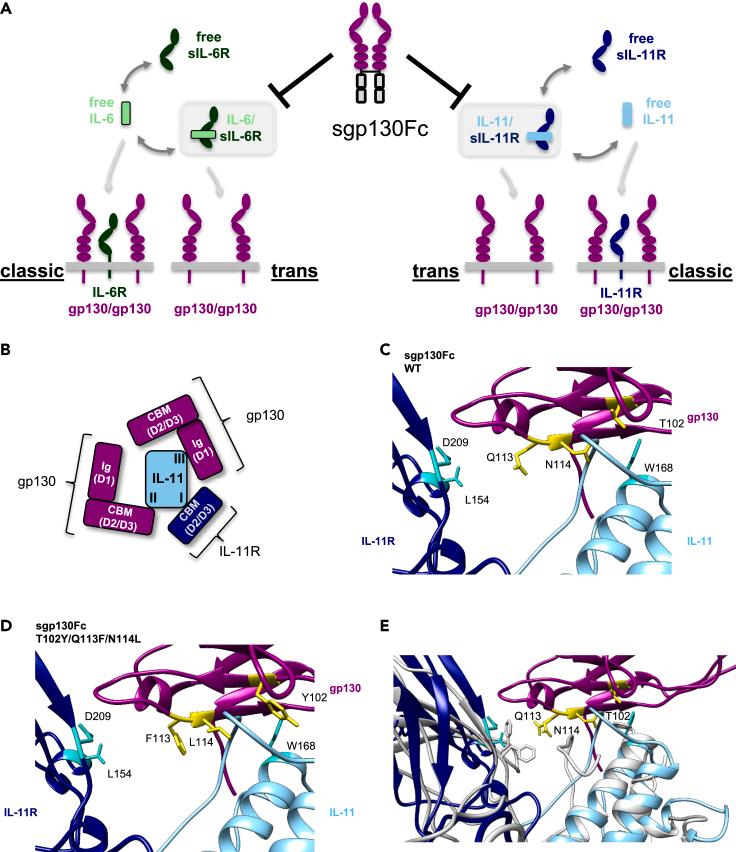
Blocking the activity of cytokines is an efficient strategy to combat inflammatory diseases. Interleukin-6 (IL-6) fulfills its pro-inflammatory properties via its soluble receptor (IL-6 trans-signaling). The selective trans-signaling inhibitor olamkicept (sgp130Fc) is currently in clinical development. We have previously shown that sgp130Fc can also efficiently block trans-signaling of the closely related cytokine IL-11, which elicits the question how selectivity for one of the two cytokines can be achieved. Using structural information, we show that the interfaces between IL-6R-gp130 and IL-11R-gp130, respectively, within the so-called are different between the two cytokines. Modification of an aromatic cluster around Q113 of gp130 within these interfaces allows the discrimination between IL-6 and IL-11 trans-signaling. Using recombinant sgp130Fc variants, we demonstrate that these differences can indeed be exploited to generate a truly selective IL-6 trans-signaling inhibitor. Our data highlight how the selectivity of a clinically relevant designer protein can be further improved.
阻断细胞因子的活性是对抗炎症性疾病的有效策略。白细胞介素-6(IL-6)通过其可溶性受体(IL-6反式信号传导)发挥其促炎特性。选择性反式信号传导抑制剂奥拉基西普(sgp130Fc)目前正处于临床开发阶段。我们之前已经表明,sgp130Fc也能有效阻断密切相关的细胞因子IL-11的反式信号传导,这就引出了一个问题,即如何实现对这两种细胞因子之一的选择性。利用结构信息,我们发现所谓的 内IL-6R-gp130和IL-11R-gp130之间的界面在这两种细胞因子之间是不同的。对这些界面内gp130的Q113周围的芳香簇进行修饰,可以区分IL-6和IL-11的反式信号传导。使用重组sgp130Fc变体,我们证明这些差异确实可以被利用来产生一种真正选择性的IL-6反式信号传导抑制剂。我们的数据突出了如何进一步提高临床相关设计蛋白的选择性。



 Zotero 插件