
寻找纳米塑料:从采样到样品处理
Searching Nanoplastics: From Sampling to Sample Processing.
作者信息
Cerasa Marina, Teodori Simona, Pietrelli Loris
机构信息
National Research Council of Italy-Institute of Atmospheric Pollution Research (CNR-IIA), Via Salaria km 29,300, 00015 Monterotondo, Italy.
Chemistry Department, Sapienza University of Rome, Piazzale Aldo Moro, 00185 Rome, Italy.
出版信息
Polymers (Basel). 2021 Oct 23;13(21):3658. doi: 10.3390/polym13213658.
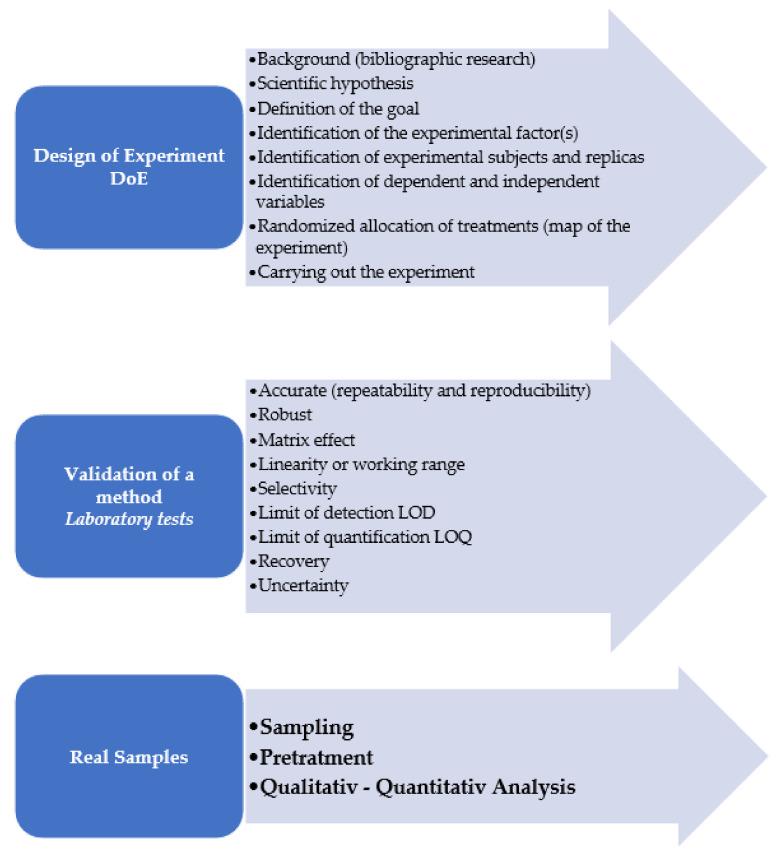
Nanoplastics (NPs) are considered emerging pollutants, namely unregulated contaminants whose toxic effect on humans and the environment has been demonstrated or suspected. They are the result of the physical fragmentation of the plastics that over time reach smaller dimensions (<100 nm). The issues related to the characterization and quantification of NPs in the environmental matrices are mainly related to the infinitepsimal size, to the fact that they are found in bulk, and to the different physico-chemical forms in which the same polymer can evolve over time by degradation. To deal with the study of a new class of pollutants it is necessary to assess the entire analytical method, carefully considering every single step (sampling, cleanup, qualitative, and quantitative analysis) starting from the validation method in the laboratory. This paper reviews the analytical method steps, focusing on the first ones, which the current literature often underestimates: laboratory tests, sampling, and sample processing; in fact, most errors and the quality of the analyses often depend on them. In addition, all newly introduced sample processing methods were examined.
纳米塑料(NPs)被视为新兴污染物,即对人类和环境的毒性作用已得到证实或怀疑的未受监管的污染物。它们是塑料随着时间推移物理破碎成更小尺寸(<100纳米)的产物。环境基质中纳米塑料的表征和定量相关问题主要与极小尺寸、它们以大量形式存在以及同一聚合物随时间通过降解可能演变成的不同物理化学形式有关。为了研究这类新型污染物,有必要评估整个分析方法,从实验室的验证方法开始,仔细考虑每一个步骤(采样、净化、定性和定量分析)。本文回顾了分析方法步骤,重点关注当前文献常常低估的前几个步骤:实验室测试、采样和样品处理;事实上,大多数误差和分析质量往往取决于这些步骤。此外,还研究了所有新引入的样品处理方法。
 Zotero 插件