
前瞻性开放登记研究分析 23 种妇科手术的术后急性疼痛:患者的风险因素和后果。
Acute postoperative pain in 23 procedures of gynaecological surgery analysed in a prospective open registry study on risk factors and consequences for the patient.
机构信息
Department of Gynecology and Reproductive Medicine, Jena University Hospital, Friedrich Schiller-University Jena, Am Klinikum 1, 07747, Jena, Germany.
Department of Obstetrics and Perinatal Medicine, Bonn University Hospital, Sigmund Freud Street 25, 53127, Bonn, Germany.
出版信息
Sci Rep. 2021 Nov 12;11(1):22148. doi: 10.1038/s41598-021-01597-5.
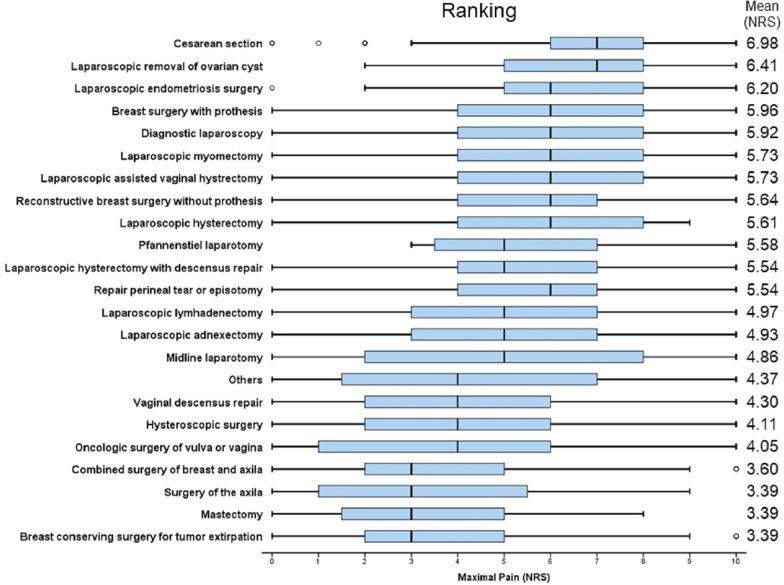
Effective perioperative pain management is essential for optimal patient recovery after surgery and reduces the risk of chronification. However, in clinical practice, perioperative analgesic treatment still needs to be improved and data availability for evidence-based procedure specific analgesic recommendations is insufficient. We aimed to identify procedures related with high pain scores, to evaluate the effect of higher pain intensity on patients and to define patient and intervention related risk factors for increased pain after standard gynaecological and obstetrical surgery. Therefore, we performed a prospective cross-sectional study based on the German registry for quality in postoperative pain (QUIPS). A cohort of 2508 patients receiving surgery between January 2011 and February 2016 in our tertiary referral centre (university departments of gynaecology and obstetrics, respectively) answered a validated pain questionnaire on the first postoperative day. Maximal pain intensity was measured by means of a 11-point numeric rating scale (NRS) and related to procedure, perioperative care as well as patient characteristics. The interventions with the highest reported pain scores were laparoscopic removal of ovarian cysts (NRS of 6.41 ± 2.12) and caesarean section (NRS of 6.98 ± 2.08). Factors associated with higher pain intensity were younger age (OR 1.75, 95% CI 1.65-1.99), chronic pain (OR 2.08, 95% CI 1.65-2.64) and surgery performed outside the regular day shift (OR 1.67, 95% CI 1.09-2.36). Shorter duration of surgery, peridural or local analgesic and preoperative sedation reduced postoperative pain. Patients reporting high pain scores (NRS ≥ 5) showed relevant impairment of daily activities and reduced satisfaction. Caesarean section and minimal invasive procedures were associated with the highest pain scores in the present ranking. Pain management of these procedures has to be reconsidered. Younger age, receiving surgery outside of the regular shifts, chronic pain and the surgical approach itself have a relevant influence on postoperative pain intensity. When reporting pain scores of 5 or more, patients were more likely to have perioperative complications like nausea or vomiting and to be impaired in mobilisation. Registry-based data are useful to identify patients, procedures and critical situations in daily clinical routine, which increase the risk for elevated post-intervention pain. Furthermore, it provides a database for evaluation of new pain management strategies.
有效的围手术期疼痛管理对于术后患者的最佳康复至关重要,并可降低慢性疼痛的风险。然而,在临床实践中,围手术期镇痛治疗仍有待改善,并且缺乏基于证据的特定手术镇痛建议的数据。我们的目的是确定与高疼痛评分相关的手术,评估更高的疼痛强度对患者的影响,并确定患者和干预相关的风险因素,以增加标准妇科和产科手术后的疼痛。因此,我们基于德国术后疼痛质量登记(QUIPS)进行了一项前瞻性横断面研究。我们的三级转诊中心(妇科和产科的大学系)在 2011 年 1 月至 2016 年 2 月期间接受手术的 2508 名患者回答了术后第一天的验证疼痛问卷。通过 11 点数字评分量表(NRS)测量最大疼痛强度,并与手术、围手术期护理以及患者特征相关联。报告的疼痛评分最高的干预措施是腹腔镜卵巢囊肿切除术(NRS 为 6.41 ± 2.12)和剖宫产术(NRS 为 6.98 ± 2.08)。与更高疼痛强度相关的因素是年龄较小(OR 1.75,95%CI 1.65-1.99),慢性疼痛(OR 2.08,95%CI 1.65-2.64)和非常规日班进行手术(OR 1.67,95%CI 1.09-2.36)。手术时间较短、硬膜外或局部镇痛以及术前镇静可减轻术后疼痛。报告高疼痛评分(NRS≥5)的患者日常活动明显受损,满意度降低。在本排名中,剖宫产术和微创手术与最高疼痛评分相关。这些手术的疼痛管理需要重新考虑。年轻、非常规班次手术、慢性疼痛以及手术方式本身对术后疼痛强度有重要影响。当报告疼痛评分为 5 或更高时,患者更容易出现围手术期并发症,如恶心或呕吐,并在活动能力方面受到影响。基于登记的资料可用于确定日常临床实践中增加术后干预后疼痛风险的患者、手术和危急情况。此外,它还为评估新的疼痛管理策略提供了一个数据库。



 Zotero 插件