
新冠病毒疾病、儿童行为问题与母亲的焦虑及心理化:一个中介调节模型
COVID-19, child's behavior problems, and mother's anxiety and mentalization: A mediated moderation model.
作者信息
Dollberg Daphna G, Hanetz-Gamliel Keren, Levy Sigal
机构信息
School of Behavioral Sciences, Academic College of Tel Aviv-Yaffo, Tel Aviv-Yaffo, Israel.
Statistics Education Unit, Academic College of Tel Aviv-Yaffo, Rabenu Yeruham St, P.O.B. 8401, 6818211 Yaffo, Israel.
出版信息
Curr Psychol. 2021 Nov 9:1-12. doi: 10.1007/s12144-021-02476-y.
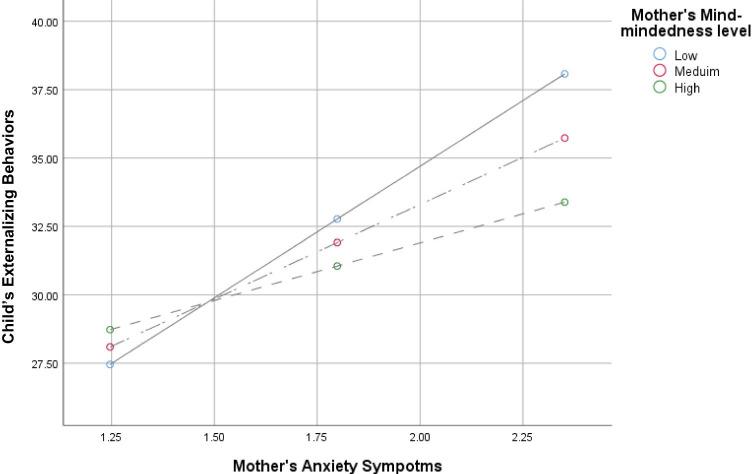
We examined the direct and indirect links between COVID-19, maternal anxiety symptoms, and child behavior problems as well as the mediation-moderation links of mothers' anxiety symptoms and mentalization skills with the prediction of child behavior problems. A sample of 140 Israeli mothers with preschool children comprised the study's two groups: A COVID-19 group ( = 53), recruited shortly after the pandemic outbreak, and a pre-COVID-19 group (n = 87), recruited prior to the pandemic. Mothers completed online questionnaires regarding their own anxiety symptoms (BSI anxiety subscale) and their children's internalizing and externalizing behaviors (CBCL). Maternal mentalization was assessed via the mind-mindedness representational procedure. Findings showed that mothers in the COVID-19 group experienced more anxiety symptoms and perceived their children as having more externalizing and internalizing behaviors compared to mothers in the pre-COVID-19 group. Mothers' anxiety symptoms mediated the effect of the pandemic on children's behaviors so that the higher the mothers' anxiety, the more externalizing and internalizing behaviors among the children. Mothers' mentalization moderated the association between the pandemic and the children's externalizing behaviors. Specifically, when mothers showed higher mentalization skills (higher mind-mindedness), the indirect effect of anxiety on the link between COVID-19 and children's externalizing behaviors was weaker compared to when mothers showed lower mentalization skills (lower mind-mindedness). The implications of these findings for preventive and treatment interventions that aim to reduce maternal anxiety and enhance mentalization skills to prevent children's behavior problems in the context of COVID-19 are discussed.
我们研究了新冠疫情、母亲焦虑症状和儿童行为问题之间的直接和间接联系,以及母亲焦虑症状和心理化技能在预测儿童行为问题方面的中介调节联系。140名有学龄前儿童的以色列母亲组成了该研究的两组:一组是新冠疫情组(n = 53),在疫情爆发后不久招募;另一组是新冠疫情前组(n = 87),在疫情前招募。母亲们完成了关于自身焦虑症状(简明症状量表焦虑分量表)以及孩子内化和外化行为(儿童行为量表)的在线问卷。通过心智关注表征程序评估母亲的心理化水平。研究结果表明,与新冠疫情前组的母亲相比,新冠疫情组的母亲经历了更多焦虑症状,且认为自己的孩子有更多的外化和内化行为。母亲的焦虑症状介导了疫情对孩子行为的影响,即母亲焦虑程度越高,孩子的外化和内化行为就越多。母亲的心理化调节了疫情与孩子外化行为之间的关联。具体而言,当母亲表现出较高的心理化技能(较高的心智关注)时,与母亲表现出较低的心理化技能(较低的心智关注)相比,焦虑对新冠疫情与孩子外化行为之间联系的间接影响较弱。本文讨论了这些研究结果对旨在减轻母亲焦虑并提高心理化技能以预防新冠疫情背景下儿童行为问题的预防和治疗干预措施的启示。

 Zotero 插件