
2-((1H-吲哚-3-基)硫代)-N-苯基乙酰胺:SARS-CoV-2 依赖 RNA 的 RNA 聚合酶抑制剂。
2-((1H-indol-3-yl)thio)-N-phenyl-acetamides: SARS-CoV-2 RNA-dependent RNA polymerase inhibitors.
机构信息
Institute of Medicinal Biotechnology, Chinese Academy of Medical Science, Beijing, China.
Institute of Pathogen Biology, Chinese Academy of Medical Science, Beijing, China.
出版信息
Antiviral Res. 2021 Dec;196:105209. doi: 10.1016/j.antiviral.2021.105209. Epub 2021 Nov 18.
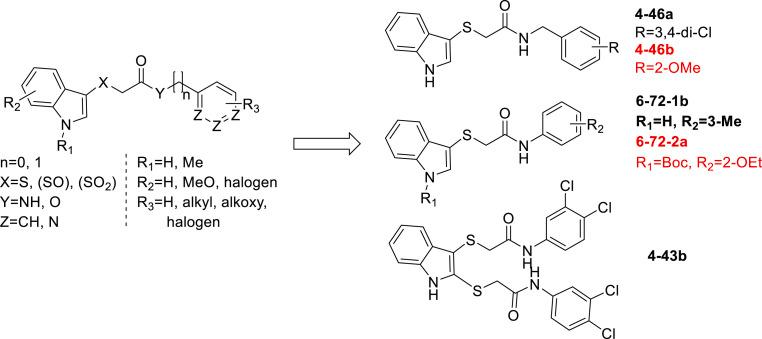
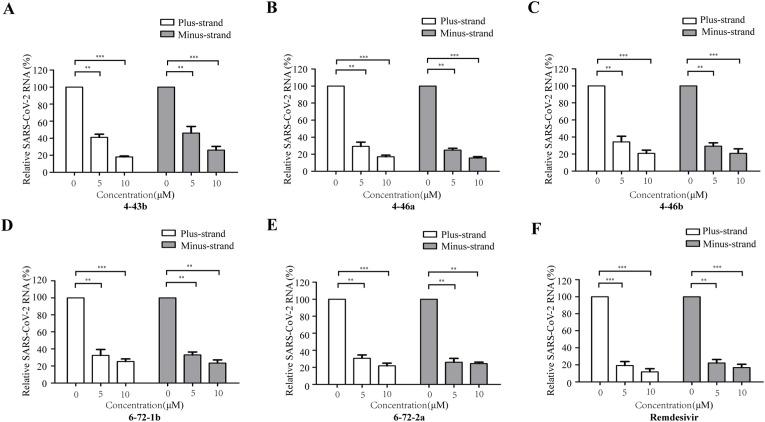
Severe acute respiratory syndrome coronavirus-2 (SARS-CoV-2) is the causative agent of Coronavirus Disease 2019 (COVID-19) pandemic. Despite intensive and global efforts to discover and develop novel antiviral therapies, only Remdesivir has been approved as a treatment for COVID-19. Therefore, effective antiviral therapeutics are still urgently needed to combat and halt the pandemic. Viral RNA-dependent RNA polymerase (RdRp) of SARS-CoV-2 demonstrates high potential as a reliable target for the development of antivirals. We previously developed a cell-based assay to assess the efficiency of compounds that target SARS-CoV-2 RdRp, as well as their tolerance to viral exoribonuclease-mediated proof-reading. In our previous study, we discovered that 2-((1H-indol-3-yl)thio)-N-phenyl-acetamides specifically targets the RdRp of both respiratory syncytial virus (RSV) and influenza A virus. Thus, we hypothesize that 2-((1H-indol-3-yl)thio)-N-phenyl-acetamides may also have the ability to inhibit SARS-CoV-2 replication by targeting its RdRp activity. In this research, we test a compound library containing 103 of 2-((1H-indol-3-yl)thio)-N-phenyl-acetamides against SARS-CoV-2 RdRp, using our cell-based assay. Among these compounds, the top five candidates strongly inhibit SARS-CoV-2 RdRp activity while exhibiting low cytotoxicity and resistance to viral exoribonuclease. Compound 6-72-2a is the most promising candidate with the lowest EC value of 1.41 μM and highest selectivity index (CC/EC) (above 70.92). Furthermore, our data suggests that 4-46b and 6-72-2a also inhibit the replication of HCoV-OC43 and HCoV-NL63 virus in a dose-dependent manner. Compounds 4-46b and 6-72-2a exhibit EC values of 1.13 μM and 0.94 μM, respectively, on HCoV-OC43 viral replication. However, higher concentrations of these compounds are needed to effectively block HCoV-NL63 replication. Together, our findings successfully identified 4-46b and 6-72-2a as promising inhibitors against SARS-CoV-2 RdRp.
严重急性呼吸系统综合征冠状病毒 2 型(SARS-CoV-2)是导致 2019 年冠状病毒病(COVID-19)大流行的病原体。尽管全球范围内进行了密集的努力来发现和开发新的抗病毒疗法,但只有瑞德西韦被批准用于治疗 COVID-19。因此,仍然迫切需要有效的抗病毒疗法来对抗和阻止大流行。SARS-CoV-2 的病毒 RNA 依赖性 RNA 聚合酶(RdRp)具有成为开发抗病毒药物的可靠靶标的巨大潜力。我们之前开发了一种基于细胞的测定法来评估针对 SARS-CoV-2 RdRp 的化合物的效率及其对病毒外切核酸酶介导的校对的耐受性。在我们之前的研究中,我们发现 2-((1H-吲哚-3-基)硫代)-N-苯基-乙酰胺特别针对呼吸道合胞病毒(RSV)和甲型流感病毒的 RdRp。因此,我们假设 2-((1H-吲哚-3-基)硫代)-N-苯基-乙酰胺也可能通过靶向其 RdRp 活性来抑制 SARS-CoV-2 的复制。在这项研究中,我们使用基于细胞的测定法,针对 SARS-CoV-2 RdRp 测试了包含 103 种 2-((1H-吲哚-3-基)硫代)-N-苯基-乙酰胺的化合物文库。在这些化合物中,前五名候选化合物强烈抑制 SARS-CoV-2 RdRp 活性,同时表现出低细胞毒性和对病毒外切核酸酶的抗性。化合物 6-72-2a 是最有前途的候选物,其 EC 值最低为 1.41 μM,选择性指数(CC/EC)最高(超过 70.92)。此外,我们的数据表明,化合物 4-46b 和 6-72-2a 还以剂量依赖性方式抑制 HCoV-OC43 和 HCoV-NL63 病毒的复制。化合物 4-46b 和 6-72-2a 对 HCoV-OC43 病毒复制的 EC 值分别为 1.13 μM 和 0.94 μM。然而,需要更高浓度的这些化合物才能有效阻断 HCoV-NL63 的复制。总之,我们的研究结果成功地鉴定出 4-46b 和 6-72-2a 是针对 SARS-CoV-2 RdRp 的有前途的抑制剂。





 Zotero 插件