
癌症患者对新冠疫苗接种的抗体反应:一项系统评价
Antibody Responses to COVID-19 Vaccination in Cancer: A Systematic Review.
作者信息
Guven Deniz C, Sahin Taha K, Kilickap Saadettin, Uckun Fatih M
机构信息
Department of Medical Oncology, Hacettepe University Cancer Institute, Ankara, Turkey.
Department of Internal Medicine, Hacettepe University Faculty of Medicine, Ankara, Turkey.
出版信息
Front Oncol. 2021 Nov 4;11:759108. doi: 10.3389/fonc.2021.759108. eCollection 2021.
INTRODUCTION
After the results of phase III vaccine studies became available, the leading oncology societies recommended two doses of COVID-19 vaccination to all patients with cancer with no specific recommendation for tumor type and active treatments. However, the data on the COVID-19 vaccine efficacy in cancer patients is limited due to exclusion of cancer patients from most vaccine clinical trials. Therefore, we systemically reviewed the available evidence evaluating the antibody responses in cancer patients.
METHODS
We conducted a systematic search from the Pubmed database and calculated risk differences (RD) and 95% confidence intervals (CI) to compare seroconversion rates between cancer patients and controls using the Review Manager software, version 5.3.
RESULTS
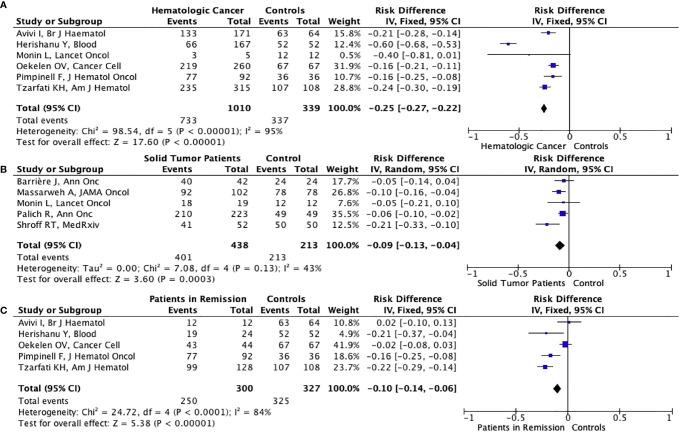
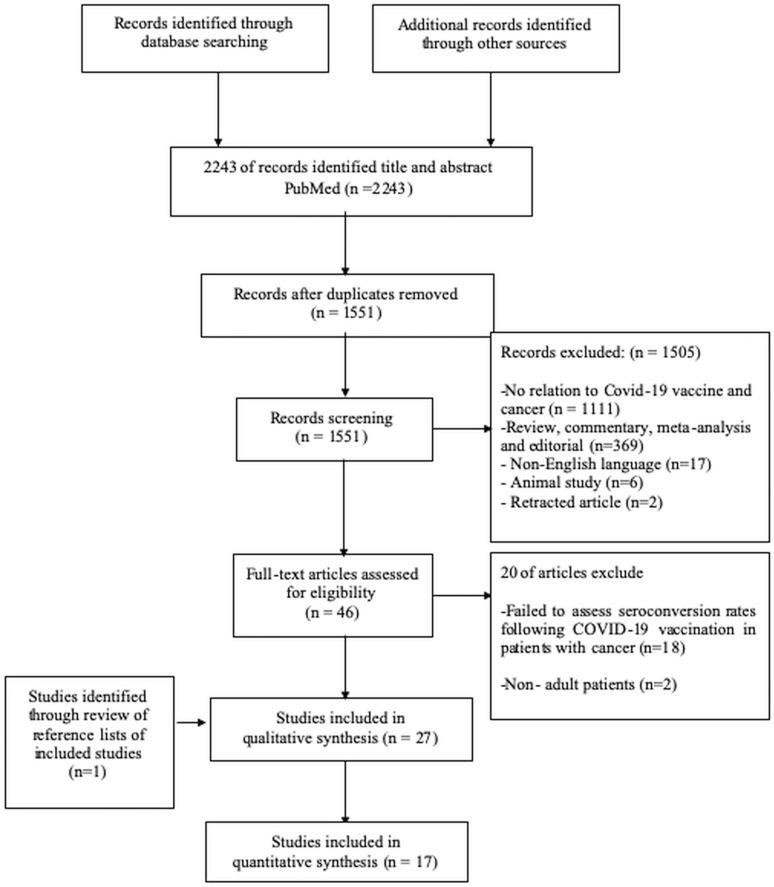
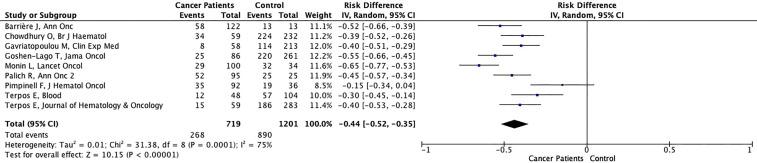
Our systematic search retrieved a total 27 studies and we included 17 studies with control arms in the analyses. Cancer patients had significantly lower seroconversion rates (37.3%) than controls (74.1%) (RD: -0.44, 95% CI: -0.52, -0.35, p<0.001) with first vaccine dose. After two doses, the seroconversion rates were 99.6% in control arm and 78.3% in cancer patients (RD: -0.19, 95% CI: -0.28, -0.10, p<0.001). The difference in seroconversion rates was more pronounced patients with hematologic malignancies (72.6%) (RD: -0.25, 95% CI: -0.27, -0.22, p<0.001) than patients with solid tumors (91.6%) (RD: -0.09, 95% CI: -0.13, -0.04, p<0.003) and patients in remission (RD: -0.10, 95% CI: -0.14, -0.06, p<0.001).
CONCLUSION
In conclusion, COVID-19 vaccine seroconversion rates were significantly lower in patients with hematological malignancies and patients under active treatment. Further research focusing on the approaches to improve vaccine efficacy and exploration of novel treatment options is urgently needed for these patients.
引言
III期疫苗研究结果公布后,主要肿瘤学会建议对所有癌症患者接种两剂新冠疫苗,未针对肿瘤类型和正在进行的治疗给出具体建议。然而,由于大多数疫苗临床试验将癌症患者排除在外,关于新冠疫苗在癌症患者中的疗效数据有限。因此,我们系统回顾了评估癌症患者抗体反应的现有证据。
方法
我们在PubMed数据库中进行了系统检索,并使用Review Manager 5.3版软件计算风险差异(RD)和95%置信区间(CI),以比较癌症患者和对照组之间的血清转化率。
结果
我们的系统检索共获得27项研究,分析时纳入了17项有对照组的研究。癌症患者首剂疫苗后的血清转化率(37.3%)显著低于对照组(74.1%)(RD:-0.44,95% CI:-0.52,-0.35,p<0.001)。两剂接种后,对照组的血清转化率为99.6%,癌症患者为78.3%(RD:-0.19,95% CI:-0.28,-0.10,p<0.001)。血液系统恶性肿瘤患者(72.6%)的血清转化率差异(RD:-0.25,95% CI:-0.27,-0.22,p<0.001)比实体瘤患者(91.6%)(RD:-0.09,95% CI:-0.13,-0.04,p<0.003)和缓解期患者(RD:-0.10,95% CI:-0.14,-0.06,p<0.001)更为明显。
结论
总之,血液系统恶性肿瘤患者和正在接受积极治疗的患者中,新冠疫苗的血清转化率显著较低。迫切需要针对这些患者开展进一步研究,重点关注提高疫苗疗效的方法并探索新的治疗选择。

 Zotero 插件