
假尿苷对新冠病毒mRNA疫苗的关键作用
The Critical Contribution of Pseudouridine to mRNA COVID-19 Vaccines.
作者信息
Morais Pedro, Adachi Hironori, Yu Yi-Tao
机构信息
ProQR Therapeutics, Leiden, Netherlands.
Department of Biochemistry and Biophysics, Center for RNA Biology, University of Rochester Medical Center, Rochester, NY, United States.
出版信息
Front Cell Dev Biol. 2021 Nov 4;9:789427. doi: 10.3389/fcell.2021.789427. eCollection 2021.
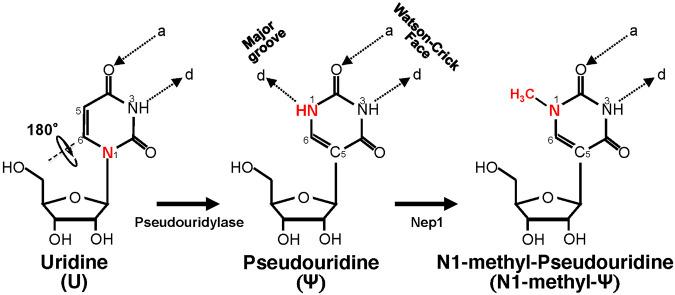
The current COVID-19 pandemic is a massive source of global disruption, having led so far to two hundred and fifty million COVID-19 cases and almost five million deaths worldwide. It was recognized in the beginning that only an effective vaccine could lead to a way out of the pandemic, and therefore the race for the COVID-19 vaccine started immediately, boosted by the availability of the viral sequence data. Two novel vaccine platforms, based on mRNA technology, were developed in 2020 by Pfizer-BioNTech and Moderna Therapeutics (comirnaty® and spikevax®, respectively), and were the first ones presenting efficacies higher than 90%. Both consisted of N1-methyl-pseudouridine-modified mRNA encoding the SARS-COVID-19 Spike protein and were delivered with a lipid nanoparticle (LNP) formulation. Because the delivery problem of ribonucleic acids had been known for decades, the success of LNPs was quickly hailed by many as the unsung hero of COVID-19 mRNA vaccines. However, the clinical trial efficacy results of the Curevac mRNA vaccine (CVnCoV) suggested that the delivery system was not the only key to the success. CVnCoV consisted of an unmodified mRNA (encoding the same spike protein as Moderna and Pfizer-BioNTech's mRNA vaccines) and was formulated with the same LNP as Pfizer-BioNTech's vaccine (Acuitas ALC-0315). However, its efficacy was only 48%. This striking difference in efficacy could be attributed to the presence of a critical RNA modification (N1-methyl-pseudouridine) in the Pfizer-BioNTech and Moderna's mRNA vaccines (but not in CVnCoV). Here we highlight the features of N1-methyl-pseudouridine and its contributions to mRNA vaccines.
当前的新冠疫情是全球混乱的一个巨大根源,截至目前已在全球导致2.5亿例新冠病例和近500万人死亡。从一开始就认识到,只有有效的疫苗才能带来摆脱疫情的出路,因此,在病毒序列数据可用的推动下,新冠疫苗竞赛立即展开。辉瑞-生物科技公司和莫德纳治疗公司在2020年分别基于信使核糖核酸(mRNA)技术开发了两种新型疫苗平台(分别为Comirnaty®和Spikevax®),它们是首批显示出高于90%疗效的疫苗。两者均由编码严重急性呼吸综合征冠状病毒2(SARS-CoV-2)刺突蛋白的N1-甲基-假尿苷修饰的mRNA组成,并采用脂质纳米颗粒(LNP)制剂递送。由于核糖核酸的递送问题已为人所知数十年,LNP的成功很快被许多人誉为新冠mRNA疫苗的无名英雄。然而,Curevac mRNA疫苗(CVnCoV)的临床试验疗效结果表明,递送系统并非成功的唯一关键。CVnCoV由未修饰的mRNA(编码与莫德纳和辉瑞-生物科技公司的mRNA疫苗相同的刺突蛋白)组成,并与辉瑞-生物科技公司疫苗相同的LNP(Acuitas ALC-0315)配制。然而,其疗效仅为48%。这种显著的疗效差异可能归因于辉瑞-生物科技公司和莫德纳公司的mRNA疫苗中存在关键的RNA修饰(N1-甲基-假尿苷)(而CVnCoV中没有)。在此,我们强调N1-甲基-假尿苷的特征及其对mRNA疫苗的贡献。

 Zotero 插件