
利用机器学习预测直肠神经内分泌肿瘤患者的生存率:一项基于监测、流行病学和最终结果(SEER)数据库的人群研究
Predicting Survival of Patients With Rectal Neuroendocrine Tumors Using Machine Learning: A SEER-Based Population Study.
作者信息
Cheng Xiaoyun, Li Jinzhang, Xu Tianming, Li Kemin, Li Jingnan
机构信息
Department of Gastroenterology, Peking Union Medical College Hospital, Chinese Academy of Medical Sciences and Peking Union Medical College, Beijing, China.
Key Laboratory of Gut Microbiota Translational Medicine Research, Peking Union Medical College Hospital, Chinese Academy of Medical Sciences and Peking Union Medical College, Beijing, China.
出版信息
Front Surg. 2021 Nov 3;8:745220. doi: 10.3389/fsurg.2021.745220. eCollection 2021.
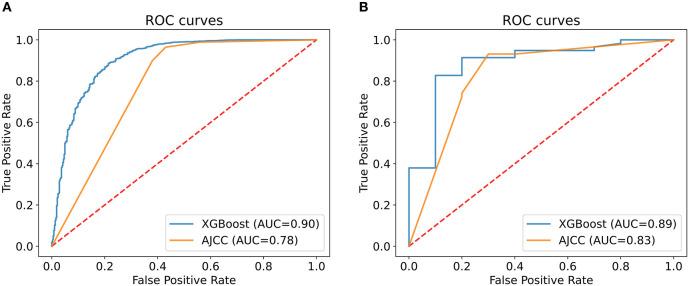
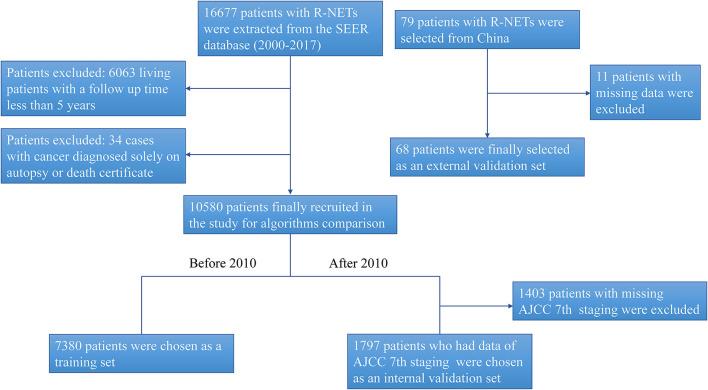
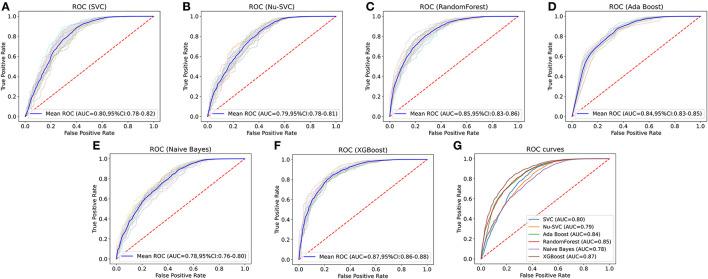
The number of patients diagnosed with rectal neuroendocrine tumors (R-NETs) is increasing year by year. An integrated survival predictive model is required to predict the prognosis of R-NETs. The present study is aimed at exploring epidemiological characteristics of R-NETs based on a retrospective study from the Surveillance, Epidemiology, and End Results (SEER) database and predicting survival of R-NETs with machine learning. Data of patients with R-NETs were extracted from the SEER database (2000-2017), and data were also retrospectively collected from a single medical center in China. The main outcome measure was the 5-year survival status. Risk factors affecting survival were analyzed by Cox regression analysis, and six common machine learning algorithms were chosen to build the predictive models. Data from the SEER database were divided into a training set and an internal validation set according to the year 2010 as a time point. Data from China were chosen as an external validation set. The best machine learning predictive model was compared with the American Joint Committee on Cancer (AJCC) seventh staging system to evaluate its predictive performance in the internal validation dataset and external validation dataset. A total of 10,580 patients from the SEER database and 68 patients from a single medical center were included in the analysis. Age, gender, race, histologic type, tumor size, tumor number, summary stage, and surgical treatment were risk factors affecting survival status. After the adjustment of parameters and algorithms comparison, the predictive model using the eXtreme Gradient Boosting (XGBoost) algorithm had the best predictive performance in the training set [area under the curve (AUC) = 0.87, 95%CI: 0.86-0.88]. In the internal validation, the predictive ability of XGBoost was better than that of the AJCC seventh staging system (AUC: 0.90 vs. 0.78). In the external validation, the XGBoost predictive model (AUC = 0.89) performed better than the AJCC seventh staging system (AUC = 0.83). The XGBoost algorithm had better predictive power than the AJCC seventh staging system, which had a potential value of the clinical application.
被诊断为直肠神经内分泌肿瘤(R-NETs)的患者数量逐年增加。需要一个综合生存预测模型来预测R-NETs的预后。本研究旨在基于监测、流行病学和最终结果(SEER)数据库的回顾性研究探索R-NETs的流行病学特征,并使用机器学习预测R-NETs的生存情况。从SEER数据库(2000 - 2017年)中提取R-NETs患者的数据,同时也回顾性收集了来自中国一家单一医疗中心的数据。主要结局指标是5年生存状况。通过Cox回归分析影响生存的危险因素,并选择六种常见的机器学习算法来构建预测模型。根据2010年作为时间点,将SEER数据库的数据分为训练集和内部验证集。选择来自中国的数据作为外部验证集。将最佳机器学习预测模型与美国癌症联合委员会(AJCC)第七版分期系统进行比较,以评估其在内部验证数据集和外部验证数据集中的预测性能。分析共纳入了来自SEER数据库的10580例患者和来自一家单一医疗中心的68例患者。年龄、性别、种族、组织学类型、肿瘤大小、肿瘤数量、总结分期和手术治疗是影响生存状况的危险因素。经过参数调整和算法比较后,使用极端梯度提升(XGBoost)算法的预测模型在训练集中具有最佳预测性能[曲线下面积(AUC)= 0.87,95%CI:0.86 - 0.88]。在内部验证中,XGBoost的预测能力优于AJCC第七版分期系统(AUC:0.90对0.78)。在外部验证中,XGBoost预测模型(AUC = 0.89)的表现优于AJCC第七版分期系统(AUC = 0.83)。XGBoost算法比AJCC第七版分期系统具有更好的预测能力,具有临床应用的潜在价值。

 Zotero 插件