
手术方法和社会因素与滤泡性甲状腺癌的长期生存相关:基于机器学习算法的预后模型的构建与验证
Surgical Methods and Social Factors Are Associated With Long-Term Survival in Follicular Thyroid Carcinoma: Construction and Validation of a Prognostic Model Based on Machine Learning Algorithms.
作者信息
Mao Yaqian, Huang Yanling, Xu Lizhen, Liang Jixing, Lin Wei, Huang Huibin, Li Liantao, Wen Junping, Chen Gang
机构信息
Shengli Clinical Medical College of Fujian Medical University, Fuzhou, China.
Department of Endocrinology, Fujian Provincial Hospital, Shengli Clinical Medical College of Fujian Medical University, Fuzhou, China.
出版信息
Front Oncol. 2022 Jun 21;12:816427. doi: 10.3389/fonc.2022.816427. eCollection 2022.
BACKGROUND
This study aimed to establish and verify an effective machine learning (ML) model to predict the prognosis of follicular thyroid cancer (FTC), and compare it with the eighth edition of the American Joint Committee on Cancer (AJCC) model.
METHODS
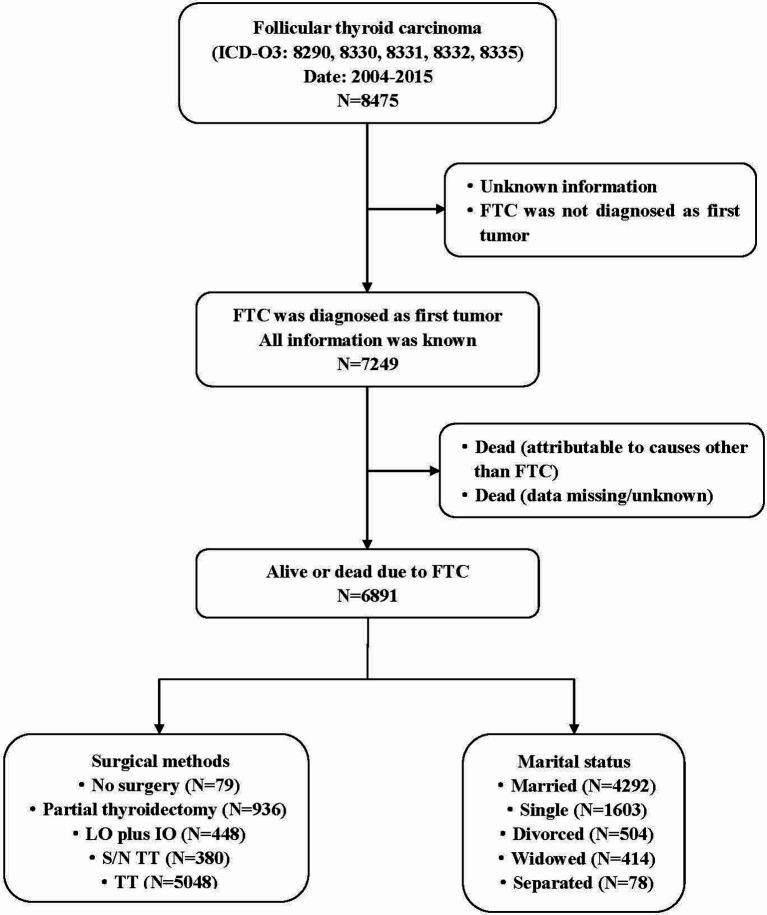
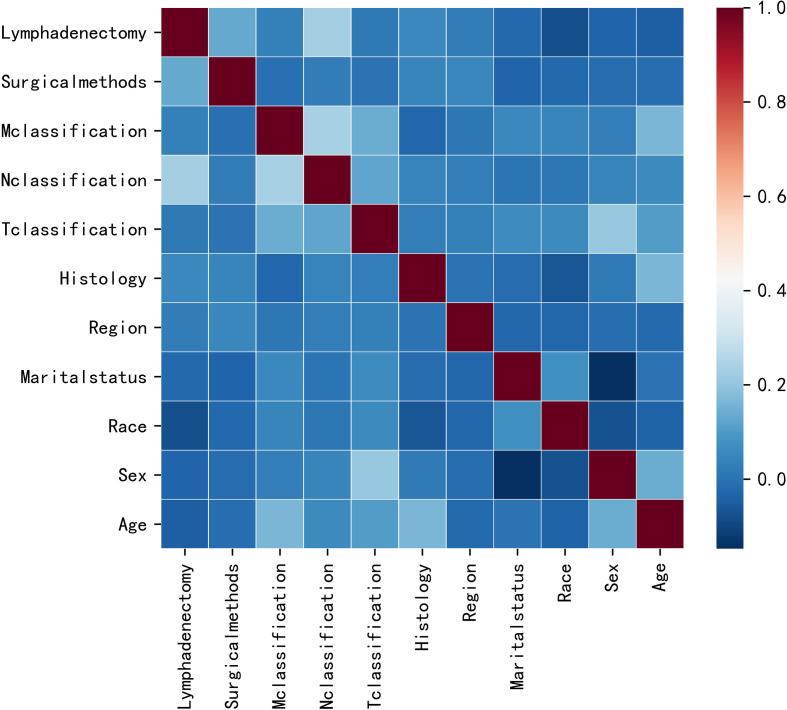
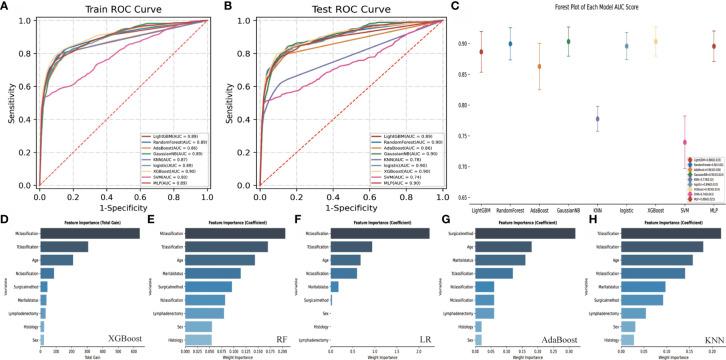
Kaplan-Meier method and Cox regression model were used to analyze the risk factors of cancer-specific survival (CSS). Propensity-score matching (PSM) was used to adjust the confounding factors of different surgeries. Nine different ML algorithms,including eXtreme Gradient Boosting (XGBoost), Light Gradient Boosting Machine (LightGBM), Random Forests (RF), Logistic Regression (LR), Adaptive Boosting (AdaBoost), Gaussian Naive Bayes (GaussianNB), K-Nearest Neighbor (KNN), Support Vector Machine (SVM) and Multi-Layer Perceptron (MLP),were used to build prognostic models of FTC.10-fold cross-validation and SHapley Additive exPlanations were used to train and visualize the optimal ML model.The AJCC model was built by multivariate Cox regression and visualized through nomogram. The performance of the XGBoost model and AJCC model was mainly assessed using the area under the receiver operating characteristic (AUROC).
RESULTS
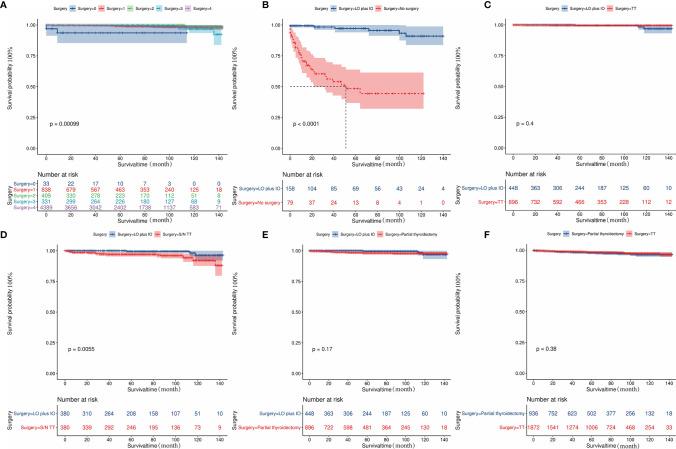
Multivariate Cox regression showed that age, surgical methods, marital status, T classification, N classification and M classification were independent risk factors of CSS. Among different surgeries, the prognosis of one-sided thyroid lobectomy plus isthmectomy (LO plus IO) was the best, followed by total thyroidectomy (hazard ratios: One-sided thyroid LO plus IO, 0.086[95% confidence interval (CI),0.025-0.290], <0.001; total thyroidectomy (TT), 0.490[95%CI,0.295-0.814], =0.006). PSM analysis proved that one-sided thyroid LO plus IO, TT, and partial thyroidectomy had no significant differences in long-term prognosis. Our study also revealed that married patients had better prognosis than single, widowed and separated patients (hazard ratios: single, 1.686[95%CI,1.146-2.479], =0.008; widowed, 1.671[95%CI,1.163-2.402], =0.006; separated, 4.306[95%CI,2.039-9.093], <0.001). Among different ML algorithms, the XGBoost model had the best performance, followed by Gaussian NB, RF, LR, MLP, LightGBM, AdaBoost, KNN and SVM. In predicting FTC prognosis, the predictive performance of the XGBoost model was relatively better than the AJCC model (AUROC: 0.886 vs. 0.814).
CONCLUSION
For high-risk groups, effective surgical methods and well marital status can improve the prognosis of FTC. Compared with the traditional AJCC model, the XGBoost model has relatively better prediction accuracy and clinical usage.
背景
本研究旨在建立并验证一种有效的机器学习(ML)模型来预测滤泡性甲状腺癌(FTC)的预后,并将其与美国癌症联合委员会(AJCC)第八版模型进行比较。
方法
采用Kaplan-Meier法和Cox回归模型分析癌症特异性生存(CSS)的危险因素。倾向评分匹配(PSM)用于调整不同手术的混杂因素。使用九种不同的ML算法,包括极端梯度提升(XGBoost)、轻量级梯度提升机(LightGBM)、随机森林(RF)、逻辑回归(LR)、自适应提升(AdaBoost)、高斯朴素贝叶斯(GaussianNB)、K近邻(KNN)、支持向量机(SVM)和多层感知器(MLP),构建FTC的预后模型。采用10折交叉验证和SHapley加性解释来训练和可视化最佳ML模型。AJCC模型通过多变量Cox回归构建并通过列线图进行可视化。主要使用受试者工作特征曲线下面积(AUROC)评估XGBoost模型和AJCC模型的性能。
结果
多变量Cox回归显示,年龄、手术方式、婚姻状况、T分期、N分期和M分期是CSS的独立危险因素。在不同手术中,单侧甲状腺叶切除术加峡部切除术(LO加IO)的预后最佳,其次是全甲状腺切除术(风险比:单侧甲状腺LO加IO,0.086[95%置信区间(CI),0.025 - 0.290],<0.001;全甲状腺切除术(TT),0.490[95%CI,0.295 - 0.814],=0.006)。PSM分析证明,单侧甲状腺LO加IO、TT和部分甲状腺切除术在长期预后方面无显著差异。我们的研究还表明,已婚患者的预后优于单身、丧偶和分居患者(风险比:单身,1.686[95%CI,1.146 - 2.479],=0.008;丧偶,1.671[95%CI,1.163 - 2.402],=0.006;分居,4.306[95%CI,2.039 - 9.093],<0.001)。在不同的ML算法中,XGBoost模型表现最佳,其次是高斯朴素贝叶斯、随机森林、逻辑回归、多层感知器、LightGBM、AdaBoost、KNN和支持向量机。在预测FTC预后方面,XGBoost模型的预测性能相对优于AJCC模型(AUROC:0.886对0.814)。
结论
对于高危人群,有效的手术方法和良好的婚姻状况可改善FTC的预后。与传统的AJCC模型相比,XGBoost模型具有相对更好的预测准确性和临床实用性。




 Zotero 插件