
识别足部疼痛严重程度的长期轨迹和潜在的预后因素:一项基于人群的队列研究。
Identifying Long-Term Trajectories of Foot Pain Severity and Potential Prognostic Factors: A Population-Based Cohort Study.
机构信息
Primary Care Centre Versus Arthritis, School of Medicine, Keele University, Staffordshire, UK.
Primary Care Centre Versus Arthritis, School of Medicine, Keele University, Staffordshire, UK, and Haywood Academic Rheumatology Centre, Midlands Partnership NHS Foundation Trust, Haywood Hospital, Burslem, Staffordshire, UK.
出版信息
Arthritis Care Res (Hoboken). 2023 May;75(5):1123-1131. doi: 10.1002/acr.24823. Epub 2022 Nov 25.
OBJECTIVES
To identify distinct foot pain trajectories over 7 years and examine their associations with potential prognostic factors.
METHODS
Adults ages ≥50 years and registered with 4 general practices in North Staffordshire, UK were mailed a baseline health survey. Those reporting current or recent foot pain were invited to attend a research assessment clinic. Follow-up was by repeated postal surveys at 18, 36, 54, and 84 months. Distinct trajectories of foot pain were explored using latent class growth analysis (LCGA). Subsequently, identified trajectories were combined into most and least progressive groups, and covariate-adjusted associations with a range of prognostic factors were examined.
RESULTS
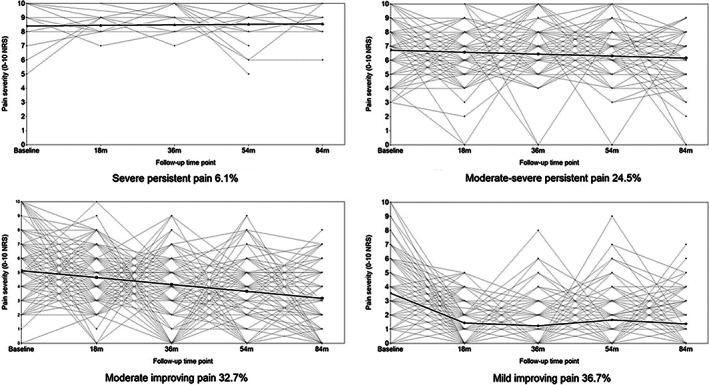
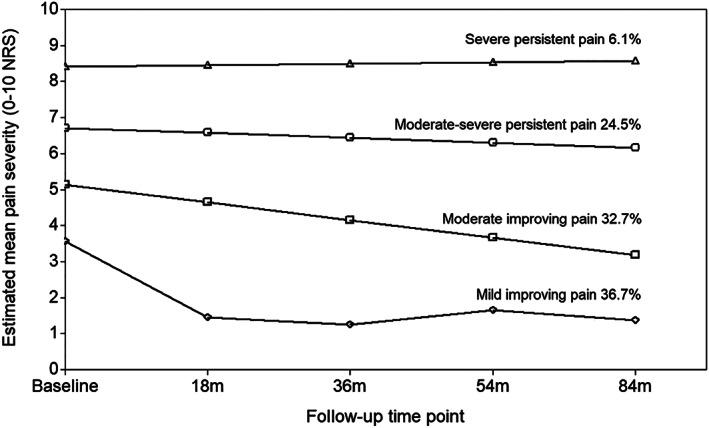
Of 560 adults with foot pain attending baseline research clinics, 425 (76%) provided data at baseline and 2 or more follow-up time points. LCGA for foot pain severity (0-10 numerical rating scale) identified a 4-trajectory model: "mild, improving" (37%); "moderate, improving" (33%); "moderate-severe, persistent" (24%); and "severe, persistent" (6%). Compared with individuals in more favorable (improving) pain trajectories, those in less favorable (persistent) pain trajectories were more likely to be obese, have routine/manual and intermediate occupations, have poorer physical and mental health, have catastrophizing beliefs, have greater foot-specific functional limitation, and have self-assessed hallux valgus at baseline.
CONCLUSIONS
Four distinct trajectories of foot pain were identified over a 7-year period, with one-third of individuals classified as having pain that is persistently moderate-severe and severe in intensity. The effect of intervening to target modifiable prognostic factors such as obesity and hallux valgus on long-term outcomes in people with foot pain requires investigation.
目的
确定 7 年内不同的足部疼痛轨迹,并研究其与潜在预后因素的关系。
方法
英国北斯塔福德郡的 4 家普通诊所招募年龄≥50 岁、有足部疼痛报告或近期足部疼痛报告的成年人参加基线健康调查。邀请那些参加研究评估诊所的人参加。通过在 18、36、54 和 84 个月时重复邮寄问卷调查进行随访。使用潜在类别增长分析(LCGA)探讨足部疼痛的不同轨迹。随后,将确定的轨迹组合成最具进展性和最不具进展性的组,并对一系列预后因素进行协变量调整后的关联分析。
结果
在参加基线研究诊所的 560 名足部疼痛成年人中,425 名(76%)在基线和 2 个或更多随访时间点提供了数据。足部疼痛严重程度(0-10 数字评定量表)的 LCGA 确定了 4 种轨迹模型:“轻度,改善”(37%);“中度,改善”(33%);“中重度,持续”(24%);和“重度,持续”(6%)。与处于更有利(改善)疼痛轨迹的个体相比,处于较不利(持续)疼痛轨迹的个体更有可能肥胖,从事常规/体力和中等职业,身心健康状况较差,存在灾难化信念,足部功能受限更严重,并且在基线时自我评估存在拇外翻。
结论
在 7 年期间确定了 4 种不同的足部疼痛轨迹,其中三分之一的人被归类为疼痛持续中度至重度和严重。需要研究针对可改变的预后因素(如肥胖和拇外翻)进行干预以改善足部疼痛患者的长期结局。
 Zotero 插件