
血清神经丝轻链作为帕金森病进展的标志物:长期观察及临床亚型的意义。
Serum Neurofilament Light Chain as a Marker of Progression in Parkinson's Disease: Long-Term Observation and Implications of Clinical Subtypes.
机构信息
Department of Clinical Sciences Lund, Neurology, Lund University, Lund, Sweden.
Department of Neurology, Skåne University Hospital, Lund, Sweden.
出版信息
J Parkinsons Dis. 2022;12(2):571-584. doi: 10.3233/JPD-212866.
BACKGROUND
Biochemical and clinical biomarkers correlate with progression rate and disease severity in Parkinson's disease (PD) but are not sufficiently studied in late PD.
OBJECTIVE
To examine how serum neurofilament light chain (S-NfL) alone or combined with clinical classifications predicts PD outcome in later disease stages.
METHODS
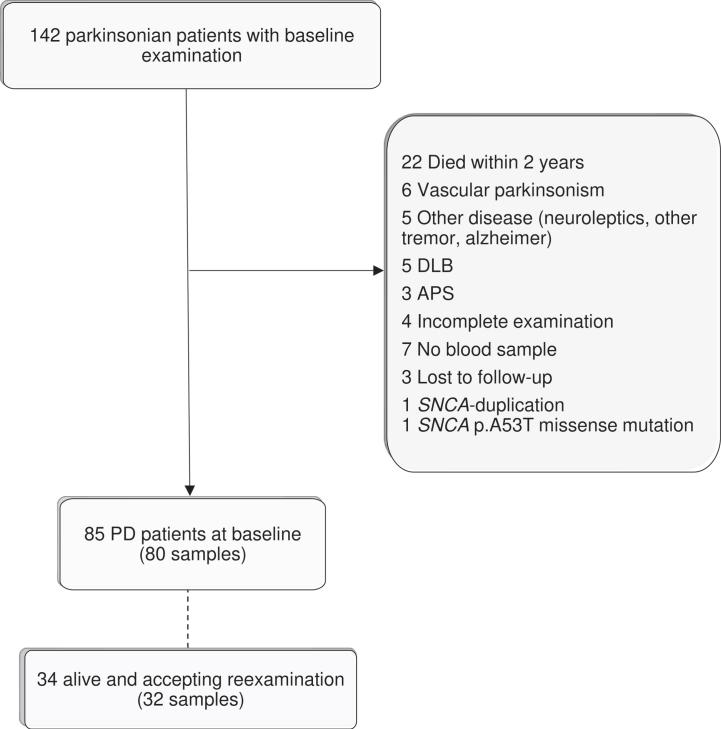
Eighty-five patients with 7.9±5.1 years of PD duration were included in an observational cohort. Clinical scores were obtained at two separate examinations 8.2±2.0 years apart. S-NfL levels were determined with single molecule array (SiMoA). Five predefined disease progression milestones were assessed. After affirming combination potential of S-NfL and either of two clinical classifications, three combined models were constructed based on these factors and age at onset in different combinations.
RESULTS
S-NfL levels showed significant hazard ratios for four out of five disease progression milestones: walking-aid usage (HR 3.5; 95% CI 1.4-8.5), nursing home living (5.1; 2.1-12.5), motor end-stage (6.2; 2.1-17.8), and death (4.1; 1.7-9.7). Higher S-NfL levels were associated with lower ability in activities of daily living and poorer cognition at baseline and/or at follow-up. Combined models showed significantly improved area under receiver operating characteristic curves (0.77-0.91) compared to S-NfL levels alone (0.68-0.71) for predicting the five disease milestones.
CONCLUSION
S-NfL levels stratified patients according to their likelihood to reach clinically relevant progression milestones during this long-term observational study. S-NfL alone reflected motor and social outcomes in later stages of PD. Combining S-NfL with clinical factors was possible and exploratory combined models improved prognostic accuracy.
背景
生物化学和临床生物标志物与帕金森病(PD)的进展速度和疾病严重程度相关,但在晚期 PD 中研究不足。
目的
研究血清神经丝轻链(S-NfL)单独或与临床分类相结合如何预测晚期 PD 患者的结局。
方法
纳入 85 例 PD 病程 7.9±5.1 年的患者进行观察性队列研究。两次检查的时间间隔为 8.2±2.0 年。使用单分子阵列(SiMoA)测定 S-NfL 水平。评估了五个预先定义的疾病进展里程碑。在确认 S-NfL 与两种临床分类中的任何一种结合的潜力后,根据这些因素和发病年龄,以不同组合构建了三种组合模型。
结果
S-NfL 水平对五个疾病进展里程碑中的四个具有显著的危险比:使用助行器(HR 3.5;95%CI 1.4-8.5)、入住疗养院(5.1;2.1-12.5)、运动终末期(6.2;2.1-17.8)和死亡(4.1;1.7-9.7)。较高的 S-NfL 水平与基线和/或随访时日常生活活动能力下降和认知能力较差相关。与 S-NfL 水平单独预测五个疾病里程碑相比,联合模型的受试者工作特征曲线下面积显著提高(0.77-0.91)。
结论
在这项长期观察性研究中,S-NfL 水平根据患者达到临床相关进展里程碑的可能性对患者进行分层。S-NfL 单独反映了 PD 晚期的运动和社会结局。将 S-NfL 与临床因素相结合是可行的,探索性联合模型提高了预测准确性。


 Zotero 插件