
多中心临床研究中溶血对与衰老及年龄相关神经退行性疾病相关蛋白质水平的影响
Impact of hemolysis on the levels of proteins associated with aging and age-related neurodegenerative diseases in a multicentric clinical research.
作者信息
Anwar Masroor, Renu Km, Singh Abhinay Kumar, Nayal Abhilasha, Thyagarajan Bharat, Hu Peifeng, Lee Jinkook, Dey Sharmistha, Dey A B
机构信息
Department of Biophysics, All India Institute of Medical Sciences, New Delhi, India.
Department of Laboratory Medicine & Pathology, University of Minnesota, USA.
出版信息
Pract Lab Med. 2025 Jan 20;44:e00455. doi: 10.1016/j.plabm.2025.e00455. eCollection 2025 Apr.
INTRODUCTION
Hemolysis is a known interference factor that has been found to show erroneous effect. Present study analyzes the impact of hemolysis on the concentrations of protein biomarkers of Alzheimer's disease (Aβ42, t-Tau, p-Tau181) along with novel proteins which are currently under investigation (SIRT1,SIRT2,SIRT6,FOXO3A, NFL, Aβ40, GFAP).
METHODS
Plasma samples were grouped into two categories: hemolyzed and non-hemolyzed groups. Degree of hemolysis (in percentage) was separately analyzed using Single molecule array (SIMOA) technology. Quantitative analysis for hemolyzed and non-hemolyzed samples were done using surface plasmon resonance (SPR) technology.
RESULTS
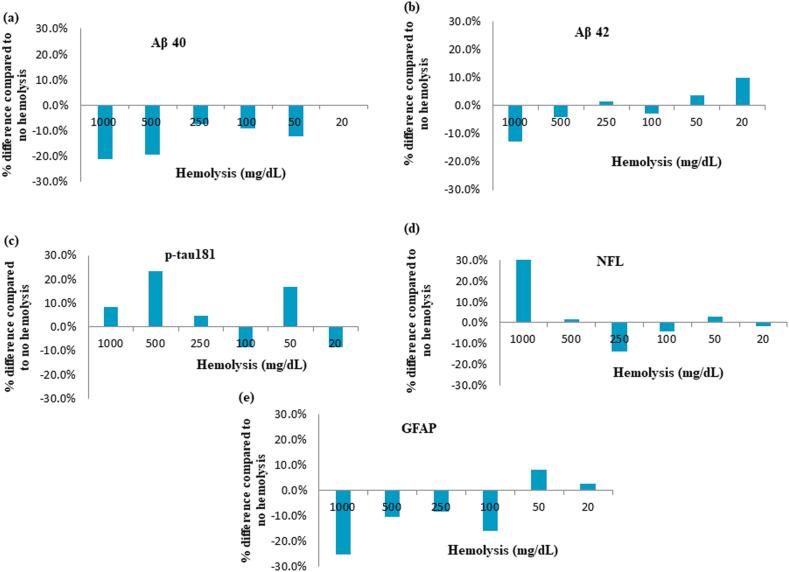
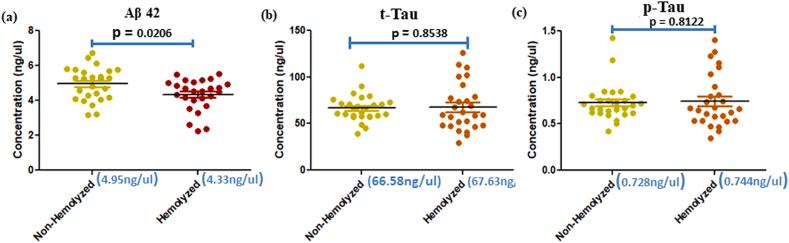
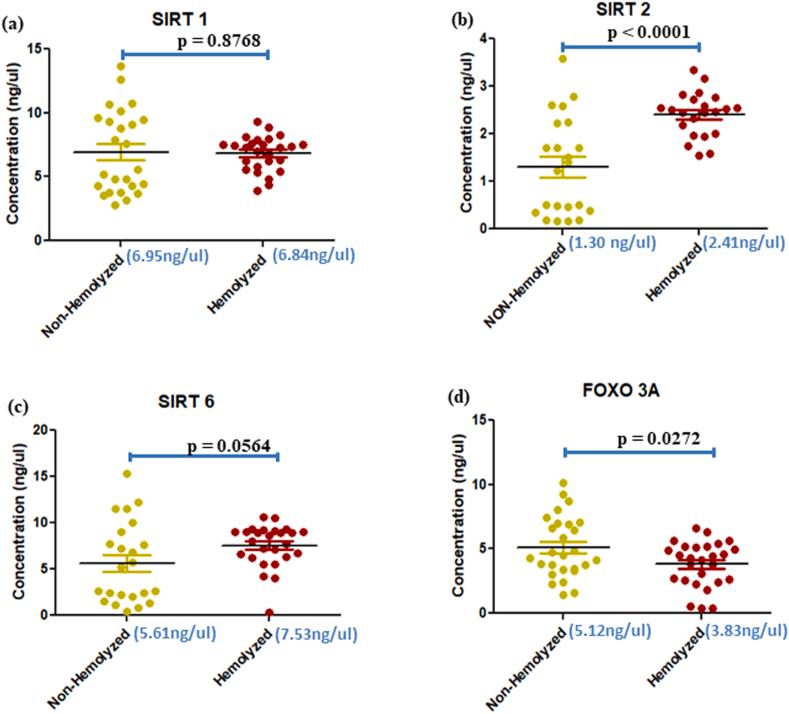
The SIMOA analysis indicated that at high levels of hemolysis (1000 mg/dL) there was an increase in NFL protein level up to approximately 30 % whereas p-Tau181 did not show much interference even at higher hemolysate concentration. Aβ40, Aβ42 and GFAP showed modest effect up to hemolysis of 250mg/dL-500 mg/dL. SPR analysis of total Tau (t-Tau), p-Tau181, SIRT1, SIRT6 showed the consistency in the result and there was no significant difference in hemolyzed plasma compared to non-hemolyzed samples. Aβ42 and FOXO3A showed decline in hemolyzed plasma compared to non-hemolyzed samples (4.34 ± 0.18ng/ul; 4.95 ± 0.19ng/ul) and (3.83 ± 0.34ng/ul; 5.12 ± 0.46ng/ul), respectively whereas, a significant increase in the concentration was observed for SIRT2; 2.4 ± 0.10ng/ul in hemolyzed compared to 1.30 ± 0.22ng/ul in non-hemolyzed group.
CONCLUSIONS
High grade hemolysis leads to altered protein concentration associated with neurodegeneration. Present study emphasizes the need to have pre-analytical inspection for hemolysis detection especially in a multicentric biomarker study.
引言
溶血是一种已知的干扰因素,已发现其会产生错误影响。本研究分析了溶血对阿尔茨海默病蛋白质生物标志物(Aβ42、总tau蛋白(t-Tau)、磷酸化tau蛋白181(p-Tau181))浓度的影响,以及目前正在研究的新蛋白质(沉默信息调节因子1(SIRT1)、沉默信息调节因子2(SIRT2)、沉默信息调节因子6(SIRT6)、叉头框蛋白O3A(FOXO3A)、神经丝轻链蛋白(NFL)、Aβ40、胶质纤维酸性蛋白(GFAP))浓度的影响。
方法
血浆样本分为两类:溶血组和非溶血组。使用单分子阵列(SIMOA)技术分别分析溶血程度(百分比)。使用表面等离子体共振(SPR)技术对溶血和非溶血样本进行定量分析。
结果
SIMOA分析表明,在高溶血水平(1000mg/dL)时,NFL蛋白水平升高约30%,而即使在较高溶血产物浓度下,p-Tau181也未显示出太大干扰。在溶血程度达到250mg/dL - 500mg/dL时,Aβ40、Aβ42和GFAP显示出适度影响。对总tau蛋白(t-Tau)、p-Tau181、SIRT1、SIRT6的SPR分析结果一致,溶血血浆与非溶血样本相比无显著差异。与非溶血样本相比,溶血血浆中的Aβ42和FOXO3A分别下降(4.34±0.18ng/ul;4.95±0.19ng/ul)和(3.83±0.34ng/ul;5.12±0.46ng/ul),而SIRT2浓度显著增加;溶血组为2.4±0.10ng/ul,非溶血组为1.30±0.22ng/ul。
结论
高度溶血会导致与神经退行性变相关的蛋白质浓度改变。本研究强调在多中心生物标志物研究中,尤其是对于溶血检测,需要进行分析前检查。
 Zotero 插件