
植物和动物在各种胁迫下自噬的保守与多样化机制
Conserved and Diversified Mechanism of Autophagy between Plants and Animals upon Various Stresses.
作者信息
Rehman Naveed Ur, Zeng Peichun, Mo Zulong, Guo Shaoying, Liu Yunfeng, Huang Yifeng, Xie Qingjun
机构信息
State Key Laboratory for Conservation and Utilization of Subtropical Agro-Bioresources, Guangdong Provincial Key Laboratory of Plant Molecular Breeding, South China Agricultural University, Guangzhou 510642, China.
State Key Laboratory for Conservation and Utilization of Subtropical Agro-Bioresources, College of Life Sciences and Technology, Guangxi University, Nanning 530004, China.
出版信息
Antioxidants (Basel). 2021 Oct 29;10(11):1736. doi: 10.3390/antiox10111736.
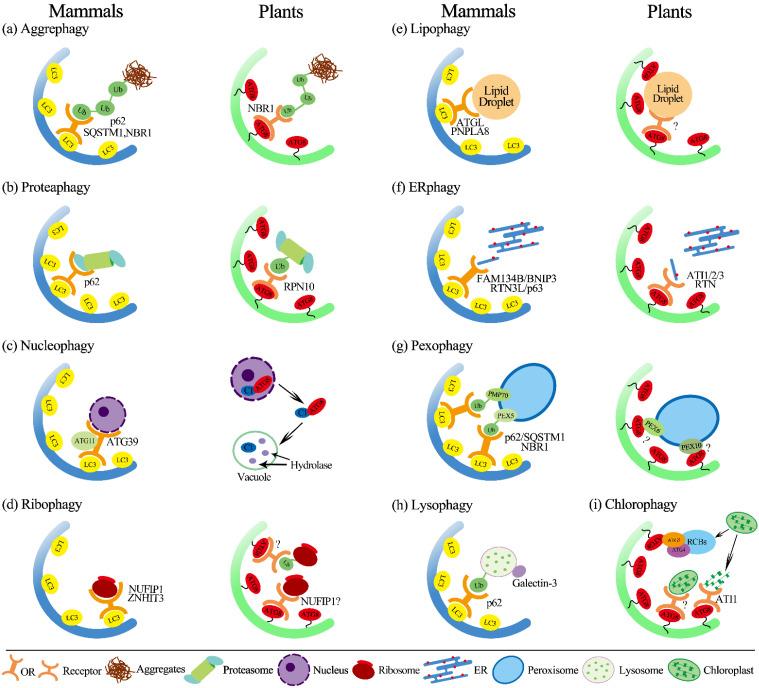
Autophagy is a highly conserved degradation mechanism in eukaryotes, executing the breakdown of unwanted cell components and subsequent recycling of cellular material for stress relief through vacuole-dependence in plants and yeast while it is lysosome-dependent in animal manner. Upon stress, different types of autophagy are stimulated to operate certain biological processes by employing specific selective autophagy receptors (SARs), which hijack the cargo proteins or organelles to the autophagy machinery for subsequent destruction in the vacuole/lysosome. Despite recent advances in autophagy, the conserved and diversified mechanism of autophagy in response to various stresses between plants and animals still remain a mystery. In this review, we intend to summarize and discuss the characterization of the SARs and their corresponding processes, expectantly advancing the scope and perspective of the evolutionary fate of autophagy between plants and animals.
自噬是真核生物中一种高度保守的降解机制,通过植物和酵母中依赖液泡的方式以及动物中依赖溶酶体的方式,对不需要的细胞成分进行分解,并随后回收细胞物质以缓解应激。在应激状态下,不同类型的自噬通过使用特定的选择性自噬受体(SAR)被刺激以运行某些生物学过程,这些受体将货物蛋白或细胞器劫持到自噬机制上,以便随后在液泡/溶酶体中被破坏。尽管自噬研究最近取得了进展,但植物和动物在应对各种应激时自噬的保守和多样化机制仍然是个谜。在这篇综述中,我们打算总结和讨论SAR的特征及其相应过程,期望推进对植物和动物自噬进化命运的范围和观点。

 Zotero 插件