
诱导多能干细胞作为建模血液系统疾病的工具和细胞治疗的潜在来源。
Induced Pluripotent Stem Cells as a Tool for Modeling Hematologic Disorders and as a Potential Source for Cell-Based Therapies.
机构信息
Siriraj Center of Excellence for Stem Cell Research, Faculty of Medicine Siriraj Hospital, Mahidol University, Bangkok 10700, Thailand.
Division of Hematology, Department of Medicine, Faculty of Medicine Siriraj Hospital, Mahidol University, Bangkok 10700, Thailand.
出版信息
Cells. 2021 Nov 19;10(11):3250. doi: 10.3390/cells10113250.
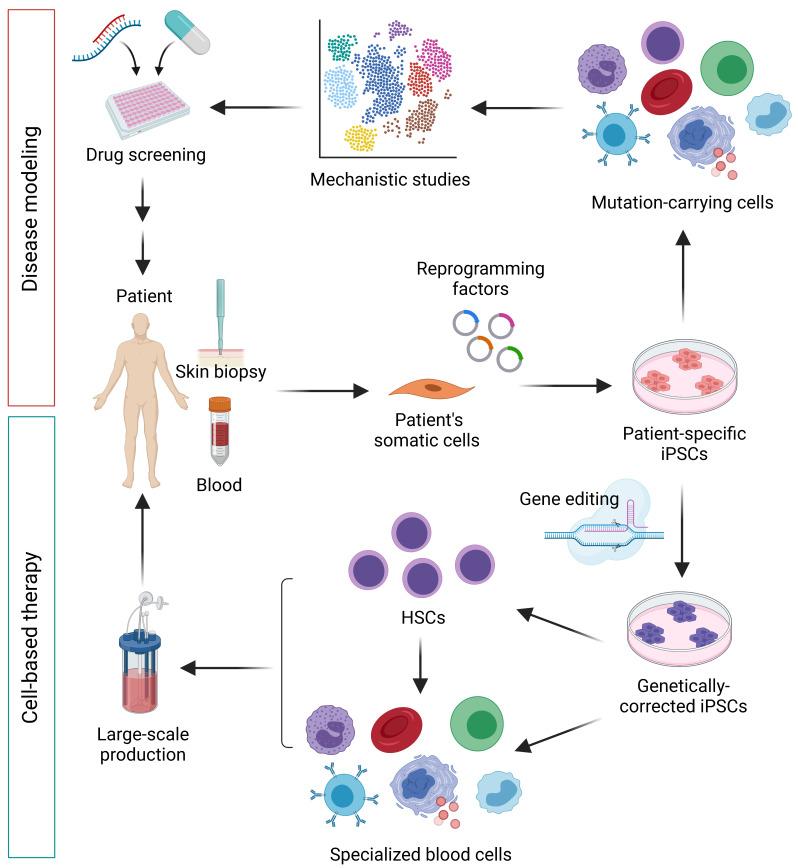
The breakthrough in human induced pluripotent stem cells (hiPSCs) has revolutionized the field of biomedical and pharmaceutical research and opened up vast opportunities for drug discovery and regenerative medicine, especially when combined with gene-editing technology. Numerous healthy and patient-derived hiPSCs for human disease modeling have been established, enabling mechanistic studies of pathogenesis, platforms for preclinical drug screening, and the development of novel therapeutic targets/approaches. Additionally, hiPSCs hold great promise for cell-based therapy, serving as an attractive cell source for generating stem/progenitor cells or functional differentiated cells for degenerative diseases, due to their unlimited proliferative capacity, pluripotency, and ethical acceptability. In this review, we provide an overview of hiPSCs and their utility in the study of hematologic disorders through hematopoietic differentiation. We highlight recent hereditary and acquired genetic hematologic disease modeling with patient-specific iPSCs, and discuss their applications as instrumental drug screening tools. The clinical applications of hiPSCs in cell-based therapy, including the next-generation cancer immunotherapy, are provided. Lastly, we discuss the current challenges that need to be addressed to fulfill the validity of hiPSC-based disease modeling and future perspectives of hiPSCs in the field of hematology.
人类诱导多能干细胞 (hiPSC) 的突破彻底改变了生物医学和药物研发领域,为药物发现和再生医学开辟了广阔的机会,特别是与基因编辑技术结合使用时更是如此。已经建立了许多用于人类疾病建模的健康和患者来源的 hiPSC,使发病机制的机制研究、临床前药物筛选平台和新型治疗靶标/方法的开发成为可能。此外,hiPSC 为基于细胞的治疗提供了巨大的潜力,由于其无限的增殖能力、多能性和伦理可接受性,它们是生成用于退行性疾病的干细胞/祖细胞或功能分化细胞的有吸引力的细胞来源。在这篇综述中,我们通过造血分化概述了 hiPSC 及其在血液系统疾病研究中的应用。我们重点介绍了最近使用患者特异性 iPSC 进行遗传性和获得性遗传性血液疾病建模,并讨论了它们作为有价值的药物筛选工具的应用。提供了 hiPSC 在基于细胞的治疗中的临床应用,包括下一代癌症免疫疗法。最后,我们讨论了满足基于 hiPSC 的疾病建模有效性所需解决的当前挑战以及 hiPSC 在血液学领域的未来展望。
 Zotero 插件