
富含迷迭香酸的紫苏籽油和紫苏籽粕中提取的抗氧化和抗炎作用的 ω-3 脂肪酸的分子机制对 TNF-α 诱导的 A549 肺腺癌细胞的影响。
Molecular Mechanism of Antioxidant and Anti-Inflammatory Effects of Omega-3 Fatty Acids in Perilla Seed Oil and Rosmarinic Acid Rich Fraction Extracted from Perilla Seed Meal on TNF-α Induced A549 Lung Adenocarcinoma Cells.
机构信息
Division of Biochemistry, School of Medical Sciences, University of Phayao, Phayao 56000, Thailand.
Division of Physiology, School of Medical Sciences, University of Phayao, Phayao 56000, Thailand.
出版信息
Molecules. 2021 Nov 9;26(22):6757. doi: 10.3390/molecules26226757.
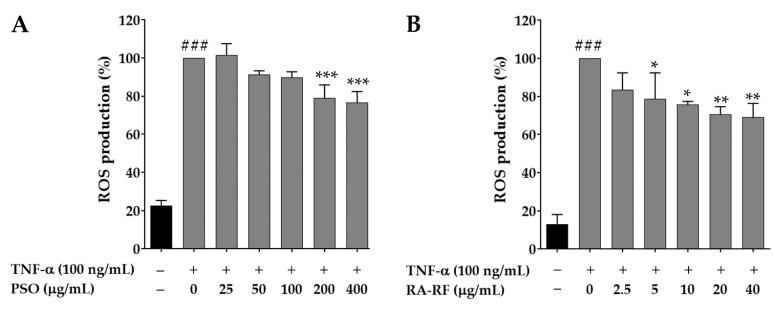
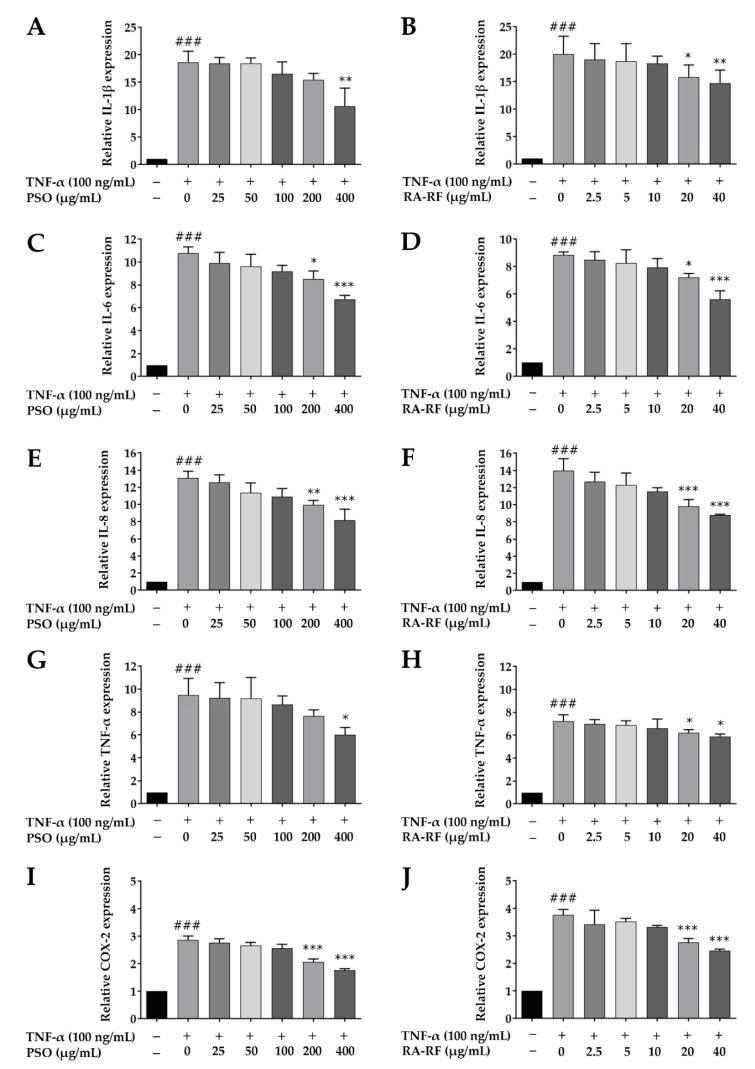
Industrially, after the removal of oil from perilla seeds (PS) by screw-type compression, the large quantities of residual perilla seed meal (PSM) becomes non-valuable waste. Therefore, to increase the health value and price of PS and PSM, we focused on the biological effects of perilla seed oil (PSO) and rosmarinic acid-rich fraction (RA-RF) extracted from PSM for their role in preventing oxidative stress and inflammation caused by TNF-α exposure in an A549 lung adenocarcinoma culture model. The A549 cells were pretreated with PSO or RA-RF and followed by TNF-α treatment. We found that PSO and RA-RF were not toxic to TNF-α-induced A549 cells. Both extracts significantly decreased the generation of reactive oxygen species (ROS) in this cell line. The mRNA expression levels of IL-1β, IL-6, IL-8, TNF-α, and COX-2 were significantly decreased by the treatment of PSO and RA-RF. The Western blot indicated that the expression of MnSOD, FOXO1, and NF-κB and phosphorylation of JNK were also significantly diminished by PSO and RA-RF treatment. The results demonstrated that PSO and RA-RF act as antioxidants to scavenge TNF-α induced ROS levels, resulting in decreased the expression of MnSOD, FOXO1, NF-κB and JNK signaling pathway in a human lung cell culture exposed to TNF-α.
工业上,从紫苏种子(PS)中通过螺旋式压缩去除油后,大量的剩余紫苏籽粉(PSM)成为无价值的废物。因此,为了提高 PS 和 PSM 的健康价值和价格,我们专注于从 PSM 中提取的紫苏籽油(PSO)和迷迭香酸丰富馏分(RA-RF)的生物学效应,研究它们在预防 TNF-α 暴露引起的氧化应激和炎症中的作用在 A549 肺腺癌细胞培养模型中。用 PSO 或 RA-RF 预处理 A549 细胞,然后用 TNF-α 处理。我们发现 PSO 和 RA-RF 对 TNF-α 诱导的 A549 细胞没有毒性。这两种提取物都能显著降低该细胞系中活性氧(ROS)的产生。PSO 和 RA-RF 处理还显著降低了 IL-1β、IL-6、IL-8、TNF-α 和 COX-2 的 mRNA 表达水平。Western blot 表明,PSO 和 RA-RF 处理还显著降低了 MnSOD、FOXO1、NF-κB 和 JNK 的表达以及 JNK 的磷酸化。结果表明,PSO 和 RA-RF 作为抗氧化剂清除 TNF-α 诱导的 ROS 水平,从而降低 TNF-α 暴露的人肺细胞培养物中 MnSOD、FOXO1、NF-κB 和 JNK 信号通路的表达。




 Zotero 插件