
欧米伽-6/欧米伽-3 比例作为肺癌的保护因素:一项关于多不饱和脂肪酸与肺腺癌风险的孟德尔随机化研究
Omega-6/Omega-3 Ratio as a Protective Factor in Lung Cancer: A Mendelian Randomization Study on Polyunsaturated Fatty Acids and Lung Adenocarcinoma Risk.
作者信息
Wang Cheng, Ding Ya, Hu Qikang, Wang Bin, Xie Shouzhi, Yang Zhi, Zhang Zhe, Dai Dexing, Xiong An, Sun Ruoman, Ling Yali, Qiu Lei, Yu Fenglei, Xie Zhongjian, Peng Muyun
机构信息
The Second Xiangya Hospital of Central South University, Changsha, China.
Hunan Key Laboratory of Early Diagnosis and Precise Treatment of Lung Cancer, Early-Stage Lung Cancer Center, Department of Thoracic Surgery, The Second Xiangya Hospital of Central South University, Changsha, China.
出版信息
J Cancer. 2025 Jun 12;16(8):2649-2662. doi: 10.7150/jca.112416. eCollection 2025.
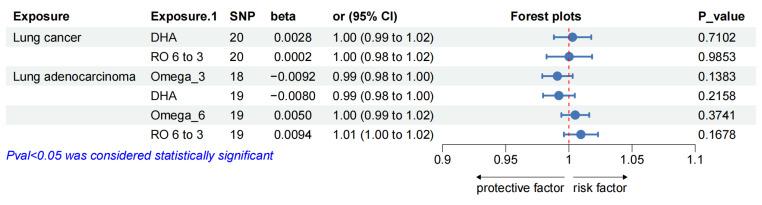
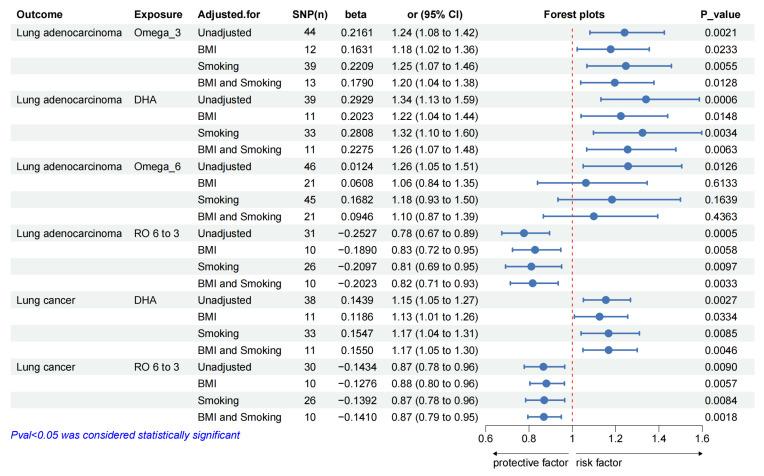
While observational studies have reported conflicting associations between polyunsaturated fatty acids (PUFAs) and lung cancer risk, the causal role of specific PUFA subtypes remains unclear. Leveraging genome-wide association data from the UK Biobank and International Lung Cancer Consortium, we employed univariable, multivariable, and bidirectional Mendelian randomization (MR) analyses to investigate the causal effects of seven PUFA traits (including omega-3, DHA, EPA, omega-6, LA, AA, and the omega-6/omega-3 ratio) on lung cancer and its subtypes. Our primary finding revealed a robust protective effect of a higher omega-6/omega-3 ratio against overall lung cancer (IVW: OR = 0.87; 95% CI: 0.78-0.96; = 0.009) and lung adenocarcinoma (LUAD) (IVW: OR = 0.78; 95% CI: 0.67-0.89; = 0.0005). Conversely, elevated omega-3 and DHA levels were associated with increased LUAD risk. These associations persisted after adjusting for BMI, smoking, and potential pleiotropy. This study provides the first causal evidence that a higher omega-6/omega-3 ratio reduces lung cancer risk, particularly LUAD, through multivariable and bidirectional Mendelian randomization analyses that account for BMI, smoking, and genetic pleiotropy. These findings highlight the ratio's potential as a novel and modifiable dietary target for prevention, offering actionable insights beyond prior studies focused on individual PUFA subtypes.
虽然观察性研究报告了多不饱和脂肪酸(PUFAs)与肺癌风险之间存在相互矛盾的关联,但特定PUFA亚型的因果作用仍不清楚。利用英国生物银行和国际肺癌联盟的全基因组关联数据,我们采用单变量、多变量和双向孟德尔随机化(MR)分析,以研究7种PUFA特征(包括ω-3、DHA、EPA、ω-6、LA、AA和ω-6/ω-3比值)对肺癌及其亚型的因果影响。我们的主要发现显示,较高的ω-6/ω-3比值对总体肺癌(IVW:OR = 0.87;95%CI:0.78 - 0.96;P = 0.009)和肺腺癌(LUAD)(IVW:OR = 0.78;95%CI:0.67 - 0.89;P = 0.0005)具有显著的保护作用。相反

 Zotero 插件