
纳米医学在放射治疗中的进展
Advances of Nanomedicine in Radiotherapy.
作者信息
Liu Wei, Chen Bo, Zheng Haocheng, Xing Yun, Chen Guiyuan, Zhou Peijie, Qian Liting, Min Yuanzeng
机构信息
Department of Radiation Oncology, The First Affiliated Hospital of USTC, Division of Life Sciences and Medicine, University of Science and Technology of China, Hefei 230001, China.
Department of Bio-X Interdisciplinary Science at Hefei National Laboratory (HFNL) for Physical Science at the Microscale, University of Science and Technology of China, Hefei 230026, China.
出版信息
Pharmaceutics. 2021 Oct 21;13(11):1757. doi: 10.3390/pharmaceutics13111757.
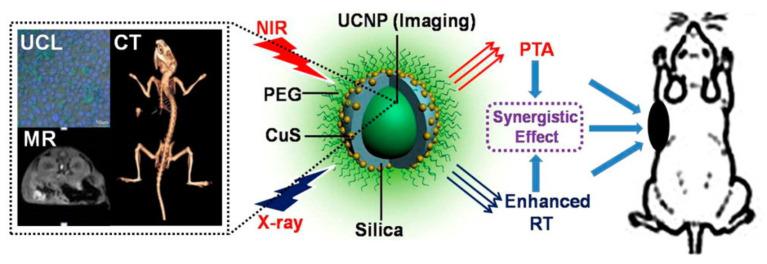
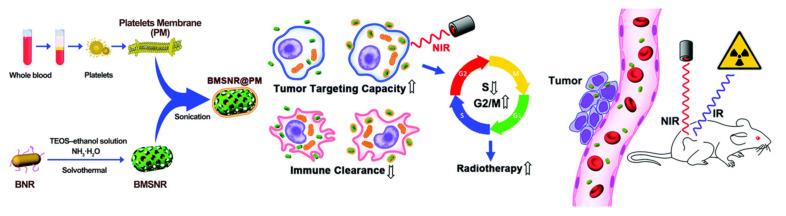
Radiotherapy (RT) remains one of the current main treatment strategies for many types of cancer. However, how to improve RT efficiency while reducing its side effects is still a large challenge to be overcome. Advancements in nanomedicine have provided many effective approaches for radiosensitization. Metal nanoparticles (NPs) such as platinum-based or hafnium-based NPs are proved to be ideal radiosensitizers because of their unique physicochemical properties and high X-ray absorption efficiency. With nanoparticles, such as liposomes, bovine serum albumin, and polymers, the radiosensitizing drugs can be promoted to reach the tumor sites, thereby enhancing anti-tumor responses. Nowadays, the combination of some NPs and RT have been applied to clinical treatment for many types of cancer, including breast cancer. Here, as well as reviewing recent studies on radiotherapy combined with inorganic, organic, and biomimetic nanomaterials for oncology, we analyzed the underlying mechanisms of NPs radiosensitization, which may contribute to exploring new directions for the clinical translation of nanoparticle-based radiosensitizers.
放射疗法(RT)仍然是目前多种癌症的主要治疗策略之一。然而,如何在减少副作用的同时提高放射治疗效率仍是一个有待克服的巨大挑战。纳米医学的进展为放射增敏提供了许多有效方法。诸如铂基或铪基纳米颗粒(NPs)等金属纳米颗粒因其独特的物理化学性质和高X射线吸收效率而被证明是理想的放射增敏剂。借助脂质体、牛血清白蛋白和聚合物等纳米颗粒,可促进放射增敏药物到达肿瘤部位,从而增强抗肿瘤反应。如今,一些纳米颗粒与放射疗法的联合已应用于包括乳腺癌在内的多种癌症的临床治疗。在此,我们不仅回顾了近期关于放疗联合无机、有机和仿生纳米材料用于肿瘤学的研究,还分析了纳米颗粒放射增敏的潜在机制,这可能有助于探索基于纳米颗粒的放射增敏剂临床转化的新方向。


 Zotero 插件