
预测 COVID-19 患者呼吸道和血流细菌感染的因素和微生物学研究:快速综述更新和荟萃回归分析。
Predictors and microbiology of respiratory and bloodstream bacterial infection in patients with COVID-19: living rapid review update and meta-regression.
机构信息
Public Health Ontario, ON, Canada; Hotel Dieu Shaver Health and Rehabilitation Centre, ON, Canada.
Sinai Health-University Health Network Antimicrobial Stewardship Program, University Health Network, Toronto, Canada; University of Toronto, ON, Canada; Toronto General Hospital Research Institute, Toronto, ON, Canada.
出版信息
Clin Microbiol Infect. 2022 Apr;28(4):491-501. doi: 10.1016/j.cmi.2021.11.008. Epub 2021 Nov 26.
BACKGROUND
The prevalence of bacterial infection in patients with COVID-19 is low, however, empiric antibiotic use is high. Risk stratification may be needed to minimize unnecessary empiric antibiotic use.
OBJECTIVE
To identify risk factors and microbiology associated with respiratory and bloodstream bacterial infection in patients with COVID-19.
DATA SOURCES
We searched MEDLINE, OVID Epub and EMBASE for published literature up to 5 February 2021.
STUDY ELIGIBILITY CRITERIA
Studies including at least 50 patients with COVID-19 in any healthcare setting.
METHODS
We used a validated ten-item risk of bias tool for disease prevalence. The main outcome of interest was the proportion of COVID-19 patients with bloodstream and/or respiratory bacterial co-infection and secondary infection. We performed meta-regression to identify study population factors associated with bacterial infection including healthcare setting, age, comorbidities and COVID-19 medication.
RESULTS
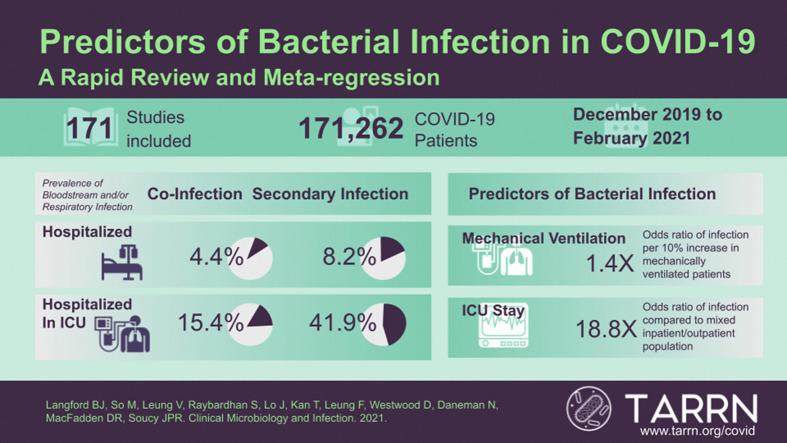
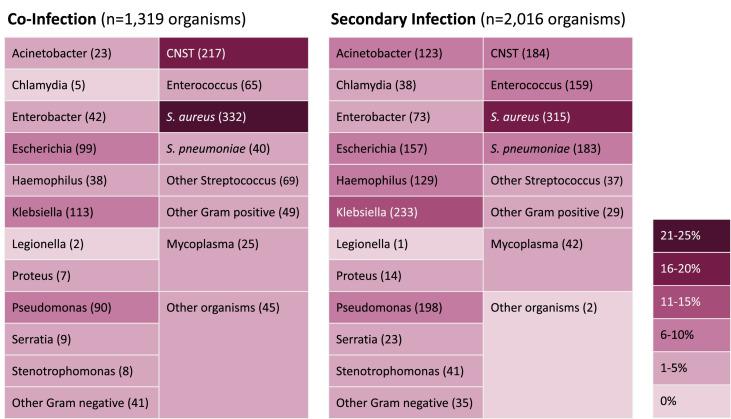
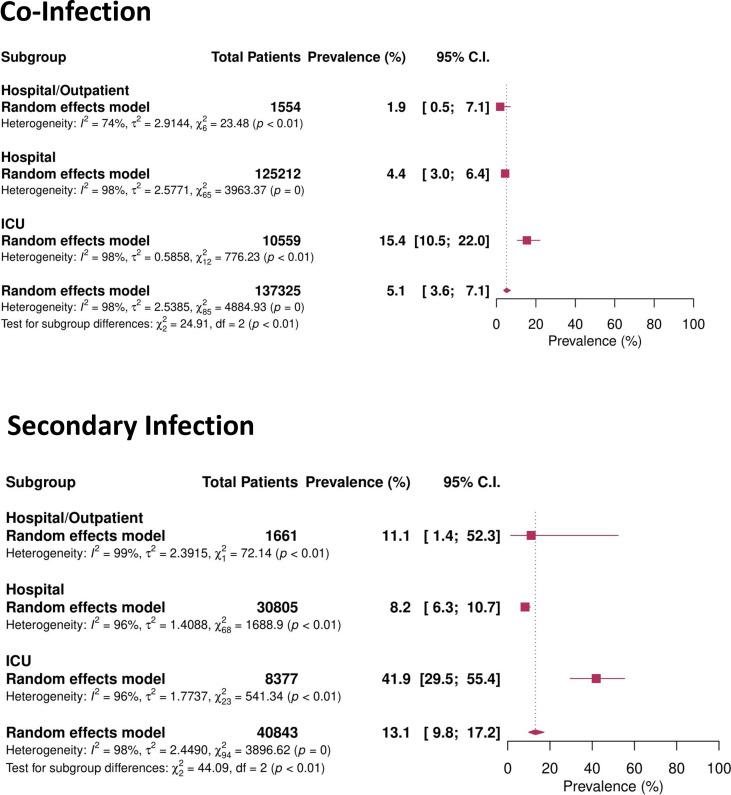
Out of 33 345 studies screened, 171 were included in the final analysis. Bacterial infection data were available from 171 262 patients. The prevalence of co-infection was 5.1% (95% CI 3.6-7.1%) and secondary infection was 13.1% (95% CI 9.8-17.2%). There was a higher odds of bacterial infection in studies with a higher proportion of patients in the intensive care unit (ICU) (adjusted OR 18.8, 95% CI 6.5-54.8). Female sex was associated with a lower odds of secondary infection (adjusted OR 0.73, 95% CI 0.55-0.97) but not co-infection (adjusted OR 1.05, 95% CI 0.80-1.37). The most common organisms isolated included Staphylococcus aureus, coagulase-negative staphylococci and Klebsiella species.
CONCLUSIONS
While the odds of respiratory and bloodstream bacterial infection are low in patients with COVID-19, meta-regression revealed potential risk factors for infection, including ICU setting and mechanical ventilation. The risk for secondary infection is substantially greater than the risk for co-infection in patients with COVID-19. Understanding predictors of co-infection and secondary infection may help to support improved antibiotic stewardship in patients with COVID-19.
背景
COVID-19 患者的细菌感染发生率较低,但经验性使用抗生素的情况却很高。为了尽量减少不必要的经验性抗生素使用,可能需要进行风险分层。
目的
确定 COVID-19 患者发生呼吸道和血流细菌感染的相关危险因素和微生物学特征。
资料来源
我们检索了 MEDLINE、OVID Epub 和 EMBASE 数据库,截至 2021 年 2 月 5 日的公开发表文献。
研究入选标准
在任何医疗环境中纳入至少 50 例 COVID-19 患者的研究。
方法
我们使用了一种经过验证的十项疾病流行率偏倚风险工具。主要结局是 COVID-19 患者血流和/或呼吸道细菌合并感染和继发感染的比例。我们进行了荟萃回归分析,以确定与细菌感染相关的研究人群因素,包括医疗环境、年龄、合并症和 COVID-19 治疗药物。
结果
在筛选的 33345 篇研究中,有 171 篇被纳入最终分析。共有 171262 例患者的细菌感染数据可用。合并感染的发生率为 5.1%(95%CI 3.6%-7.1%),继发感染的发生率为 13.1%(95%CI 9.8%-17.2%)。在 ICU 患者比例较高的研究中,细菌感染的可能性更高(校正比值比 18.8,95%CI 6.5-54.8)。女性与继发感染的可能性降低相关(校正比值比 0.73,95%CI 0.55-0.97),但与合并感染无关(校正比值比 1.05,95%CI 0.80-1.37)。最常见的分离病原体包括金黄色葡萄球菌、凝固酶阴性葡萄球菌和肺炎克雷伯菌。
结论
虽然 COVID-19 患者发生呼吸道和血流细菌感染的可能性较低,但荟萃回归分析显示,感染的潜在危险因素包括 ICU 环境和机械通气。COVID-19 患者继发感染的风险明显大于合并感染的风险。了解合并感染和继发感染的预测因素可能有助于支持 COVID-19 患者的抗生素管理。


 Zotero 插件